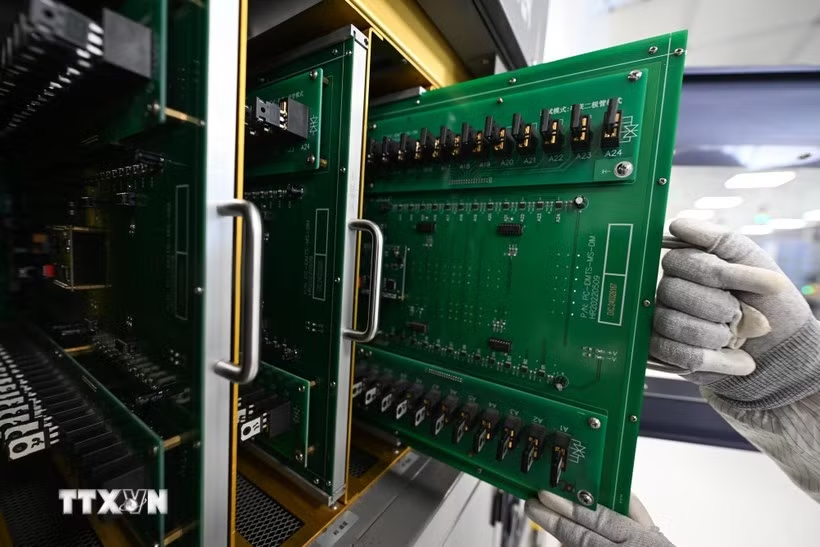
Bangkok (VNA) – The Thai Government is stepping up cooperation with European partners to develop the semiconductor industry, photonics technology, and other high-tech sectors as part of efforts to create new economic growth drivers.
According to Thai Deputy Prime Minister and Minister of Higher Education, Science, Research and Innovation Yotchanan Wongsawat, a Thai delegation visited the Netherlands and Belgium from June 13–20 to explore opportunities for cooperation in the semiconductor sector with leading universities, research institutes, and technology organisations.
During the visit, the delegation paid a fact-finding tour to three of the Netherlands’ leading technology universities – Eindhoven University of Technology, University of Twente, and Delft University of Technology. These institutions are recognised for their strengths in semiconductor research, deep technology (Deep Tech), and innovation.
Yotchanan said discussions with international partners helped Thailand identify two promising areas for future development: photonic chip technology and advanced chip packaging.
In Belgium, the delegation met with IMEC, one of the world's leading semiconductor research and development centres, to discuss research cooperation and technology transfer. The delegation also visited Bio Base Europe Pilot Plant to learn about biotechnology applications supporting the development of a circular economy.
In addition to scientific and technological cooperation, Thai officials held policy discussions with the Dutch Minister of Education, Culture and Science and the European Union Commissioner responsible for start-ups and innovation, focusing on strengthening innovation ecosystem connectivity, attracting European technology companies to invest in Thailand, and exploring opportunities for Thailand’s participation in the EU’s research and innovation programme, Horizon Europe.
According to Thailand’s Ministry of Higher Education, Science, Research and Innovation, the country is also developing mechanisms to connect Thai scientists, experts, and students living in Europe in an effort to attract highly skilled talent to support the development of strategic technology industries at home./.

Thailand improves competitiveness ranking but faces pressure for reform
Thailand's business efficiency improved from 24th to 21st place, supported by gains in the labour market, finance, productivity and corporate governance. However, the TMA warned that labour productivity remains one of the biggest risks to the country's long-term competitiveness.