Van Phuc silk weaving village officially recognised as Hanoi tourist destination

With its millennia-old heritage and growing integration of preservation and innovation, Van Phuc silk weaving village is poised to become a distinctive cultural destination, helping promote Hanoi’s sustainable cultural tourism and bring the quintessence of Vietnamese silk weaving closer to domestic and international visitors.

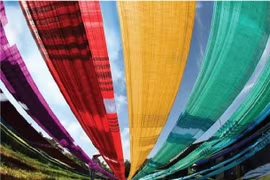
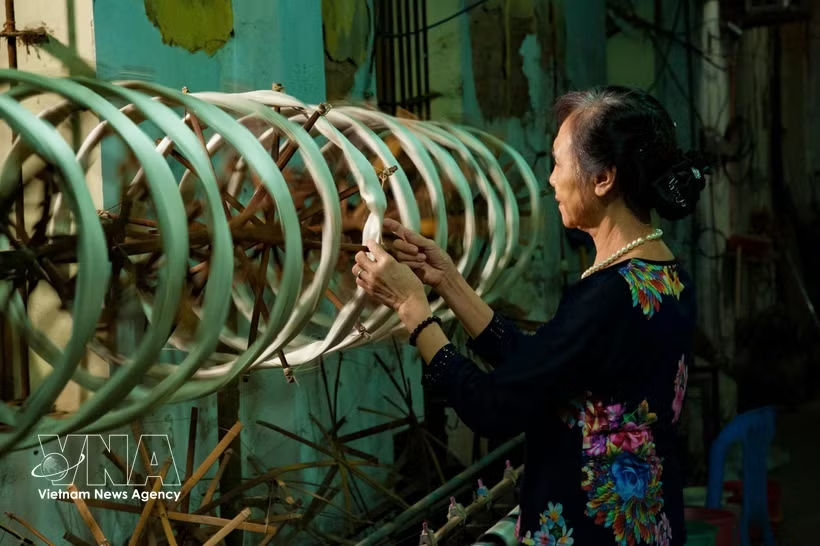
Hanoi’s traditional silk weaving craft continues to be preserved and developed today. (Photo: VNA)

Hanoi (VNA) – The Hanoi People’s Committee has recently issued Decision No. 3971/QD-UBND officially recognising Van Phuc silk weaving village in Ha Dong ward as a tourist destination, marking a new milestone in efforts to preserve and promote the values of one of the capital’s most renowned craft villages.

The recognition is expected to create fresh momentum for developing tourism in tandem with heritage preservation and is in line with Hanoi’s orientation of promoting cultural industries, turning traditional craft villages into spaces for cultural discovery, creativity and experiential tourism.

Located along the Nhue River about 10km southwest of central Hanoi, Van Phuc is one of Vietnam’s oldest silk-weaving villages that remains active today. It has more than 4,000 households with about 14,620 residents, covering 54.68ha designated for conservation and development as a distinctive craft village-tourism space.

According to local historical records, silk weaving in Van Phuc is associated with A La De Nuong, who is revered as the village’s tutelary deity. Legend has it that around the mid-9th century, she taught local people sericulture, silk production and weaving, laying the foundation for a craft that has survived for more than a millennium. Van Phuc silk gained international recognition as early as the beginning of the 20th century, when it was showcased at international fairs in Marseille and Paris and acclaimed as one of Indochina’s refined handicrafts. Today, the village produces dozens of silk and brocade varieties, combining traditional patterns and techniques with modern designs and consumer demands.

The craft has received a number of important recognitions. Van Phuc was recognised as a traditional silk and silk-weaving craft village in 2001, while its silk won the Thang Long Golden Brand title in 2011. Silk weaving was listed as national intangible cultural heritage in 2023. In early 2025, Van Phuc became one of Vietnam’s first two craft villages to join the World Craft Cities network.

The village offers visitors more than silk shopping. Van Phuc Silk Street features over 150 shops and a silk market, while traditional village spaces, including an old banyan tree, well and communal house, remain preserved.

Visitors can also explore silk conservation and development centres, weaving workshops and production facilities, witnessing the process from setting up threads to completing finished products. Vun Art Cooperative offers a creative experience through artworks made from silk scraps, combining craft preservation with job creation for people with disabilities and sustainable development.

Van Phuc also boasts cultural and historical attractions such as Van Phuc Communal House, dedicated to A La De Nuong, and Van Phuc Pagoda, along with traditional festivals held annually.

The recognition is expected to encourage further investment in infrastructure and services, diversify tourism products and connect Van Phuc with Hanoi’s cultural and craft-village tourism routes. With its millennia-old heritage and growing integration of preservation and innovation, Van Phuc is poised to become a distinctive cultural destination, helping promote Hanoi’s sustainable cultural tourism and bring the quintessence of Vietnamese silk weaving closer to domestic and international visitors./.
VNA

See more

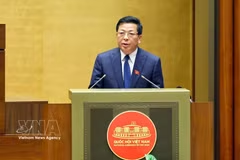
Minister of Construction Tran Hong Minh speaks at the session (Photo: VNA)

Lawmakers mull over changes to architecture law

On architectural management, the draft Law amending and supplementing several articles of the Law on Architecture clarifies the concept of “national cultural identity in architecture”, tying design to the preservation and promotion of regional heritage. It pushes architecture that mirrors local identity and fits each locality’s natural, historical and social conditions, while setting criteria to identify, assess and protect architecturally valuable buildings as a distinct form of cultural heritage.

The top 14 contestants of Top Chef Vietnam 2026. (Photo: vtv.vn)

Top Chef Vietnam returns with mission to elevate Vietnamese cuisine globally

Vietnam currently ranks 16th among the world's top 100 cuisines in the latest TasteAtlas rankings, up three places from 2024 and six from 2023. Meanwhile, Travel + Leisure has described Vietnamese cuisine as "exceptional" and listed Vietnam among the leading destinations for travellers seeking cultural experiences through food.

Organisers, sponsors and officials pose for a commemorative photo at the launch ceremony. (Photo: VNA)

Halong Bay Heritage Marathon 2026 expected to attract 18,000 runners

Competitors will race in the 42.195 km marathon, 21.0975 km half marathon, 10 km and 5 km events. Starting and finishing at the Quang Ninh Planning, Fair and Exhibition Palace, the course will once again feature fully closed roads along Ha Long Bay, a route named by Runner's World UK among the world's 50 most scenic running courses.

Artists of Italy's Teatro Lirico Giuseppe Verdi di Trieste perform the opera La Traviata. (Photo published by VNA)

Over 100 Italian artists bring opera masterpiece La Traviata to Vietnam

First staged at Venice's Teatro La Fenice in 1853, La Traviata was adapted from Alexandre Dumas fils' La Dame aux Camélias (Camille). More than 170 years on, it remains one of the most enduring works in the operatic repertoire and is regularly performed at leading theatres worldwide.

Hanoi launches tourism-focused art programme

Hanoi launches tourism-focused art programme

The “Chuyen Ha Noi – Mot ngay rat Ha Noi” (Hanoi stories – A truly Hanoi day) programme is scheduled to be staged regularly at 8 p.m. every Friday at the theatre, located at 31–33 Luong Van Can street, Hoan Kiem ward. It is expected to become one of the city’s signature cultural attractions for both domestic and international visitors.

A digital book is embedded in the bronze nghe statues at the Temple of Literature in Hanoi. (Photo: VNA)

Vietnam’s folk culture to go digital

Digitising Vietnam’s folk culture, including oral literature, beliefs, customs, festivals and art passed down through generations, has become an urgent lever for national cultural development in the new era.

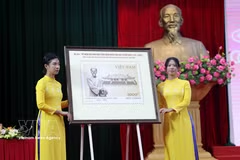
The special commemorative postage stamp marking the 300th birth anniversary of renowned Vietnamese cultural figure Le Quy Don (1726–2026) (Photo: VNA)

Commemorative stamp issued to mark Le Quy Don's 300th birth anniversary

Speaking at the event, Deputy Minister of Science and Technology Pham Duc Long described Le Quy Don as one of Vietnam's most distinguished cultural figures of the 18th century. A celebrated scholar, poet, historian, thinker, educator and diplomat, Le Quy Don left behind an extensive body of work whose enduring value continues to enrich the nation's cultural, scientific and educational heritage.

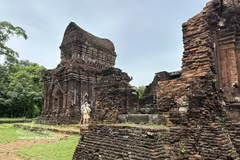
The My Son temple complex served as the foremost religious and spiritual centre of successive ancient Champa dynasties for nearly nine centuries, from the 4th to the 13th century, featuring an extensive ensemble of Hindu temples and towers. (Photo: VNA)

My Son inscriptions set sights on UNESCO documentary heritage status

Located in Thu Bon commune, Da Nang city, My Son is renowned for its architectural heritage, but it also preserves an exceptional archive engraved on stone. These inscriptions have enabled scholars to unravel the history of the sanctuary and trace the rise and development of the ancient Champa kingdom over many centuries.

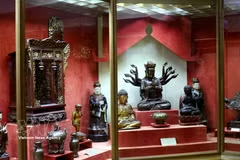
Vietnamese cultural artefacts on display at the State Museum of Oriental Art in Russia. (Photo: VNA)

Moscow museum bridges Vietnam-Russia cultural exchange

Among its rich collections, the Vietnamese gallery at the State Museum of Oriental Art in Moscow stands out as a vivid testament to the country's history, culture and craftsmanship, helping promote Vietnam's cultural identity to Russian and international visitors.

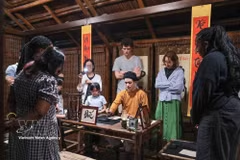
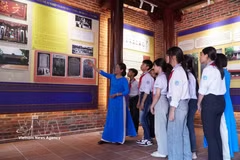
Students and teachers explore the legacy of scholar Le Quy Don (Photo: VNA)

Exhibition showcases legacy of scholar Le Quy Don

Speaking at the opening ceremony, Nguyen Hang Nga, Director of the Vietnam Exhibition Centre for Culture and Arts, said the exhibition gives visitors deeper insight into cultural figure and scholar Le Quy Don's vast scholarly contributions through photographs, historical documents, woodblock reproductions, stone inscriptions, books and other valuable archival materials.