Vietnam builds internal strength in face of global headwinds

Export growth has averaged around 10% annually, placing Vietnam among the world’s top 20 exporting economies since 2023.

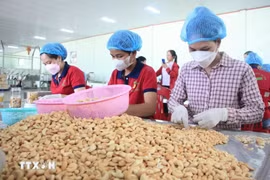
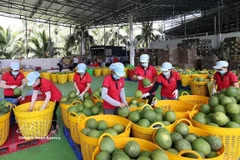
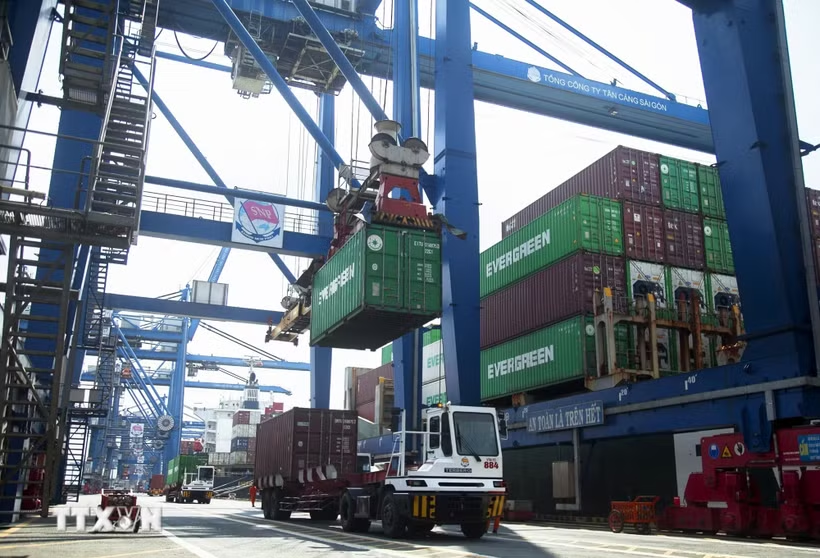
Illustrative image (Photo: VNA)

Hanoi (VNA) - Vietnam is targeting export growth of more than 8% and a trade surplus of about 25 billion USD in 2026, setting a challenging goal as the country seeks to expand on an export base of roughly 470 billion USD in 2025.

Ambitious 2026 target

Nguyen Anh Son, Director General of the Ministry of Industry and Trade (MoIT)’s Export-Import Department, said export growth has averaged around 10% annually, placing Vietnam among the world’s top 20 exporting economies since 2023.

Vietnam has also maintained a trade surplus for 10 straight years from 2016 - 2025, providing a stable source of foreign currency, easing exchange rate pressure, and bolstering foreign exchange reserves - an important factor for a highly open economy.

Despite strong performance, structural risks remain. Export markets have diversified but still rely heavily on key regions, with Northeast Asia, the US, ASEAN, and the European Union accounting for nearly 80% of total exports, leaving Vietnam vulnerable to demand or policy shifts in those markets.

Major agricultural exports such as coffee, pepper, shrimp, and pangasius catfish generate substantial revenue but are largely traded outside commodity exchanges, thereby restricting firms’ ability to hedge price volatility and secure long-term contracts. Meanwhile, the utilisation rate of preferential tariffs under free trade agreements hovers at just 31%, signaling ample untapped potential.

Tran Viet Hoa, Director General of the MIT’s Industry Department, described the 2026 target as ambitious, given narrowing market opportunities, warning that traditional growth engines will no longer suffice, and breakthrough measures are required

Nguyen Thao Hien, Deputy Director General of the Overseas Market Development Department, pointed to persistent global trade volatility and rising barriers. Export growth continues to rely heavily on foreign-invested enterprises, while domestic firms remain stuck in low-value segments. Heavy dependence on imported inputs across many industries further heightens exposure to external shocks

Three pillars for next phase

To meet its targets, the MoIT has focused on strengthening domestic capacity, expanding market reach, and cutting costs and risks. It aims to restructure industry toward higher-value-added production, slash raw material exports, boost hi-tech manufacturing, increase local supply chain autonomy, and develop supporting industries.

Raising localisation rates is seen as critical to reducing reliance on imported components and increasing the “Made in Vietnam” value in export products.

For 2026, market strategy will focus on fully exploiting existing free trade agreements, penetrating recovering and niche markets, and negotiating new bilateral and multilateral deals, Hoa said.

Particular focus will fall on trade defence. Chu Thang Trung, Deputy Director General of the MoIT’s Trade Remedies Authority of Vietnam, said tighter coordination will be needed to combat illegal transshipment, origin fraud, and trade remedy cases.

With logistics costs still high, the MoIT is fast-tracking the national logistics strategy for 2025–2035 to lower transport and warehousing costs and sharpen competitiveness.

Bui Nguyen Anh Tuan, Deputy Director General of the Domestic Market Management and Development Department, said many localities are planning global, regional, and national logistics hubs. These could improve goods circulation if backed by an appropriate legal framework.

Cross-border e-commerce is gaining traction as a new growth driver. Online exports hit 1.7 billion USD in 2024, of a total cross-border e-commerce trade volume of 4.1 billion USD. Vietnamese goods are gaining ground on global platforms. However, small and medium-sized firms still struggle with limited resources, market knowledge, and high logistics costs. The ministry plans to expand its “Go Global” programme to help them integrate more deeply into global value chains.

Additional measures include developing free trade zones, establishing a commodity derivatives market, and updating the Commercial Law up to international standards, he added./.
VNA

See more

A border guard checks VMS on a fishing boat. (Photo: VNA)

An Giang subsidises VMS upgrades to fight illegal fishing

The provincial budget will cover 50% of actual invoiced costs, capped at 5 million VND (192 USD) per vessel for upgrades and 11 million VND for replacements, with vessel owners paying the remainder. The policy is framed as a shared state-citizen responsibility aimed at driving regulatory compliance. The support runs through December 31, 2026.

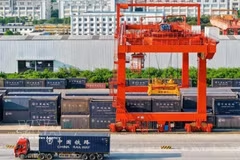
Cargo transit through Nanning International Railway Port before heading to Vietnam’s Yen Vien station. (Photo: VNA)

Vietnam, China add cross-border rail link in trade push

China Railway Nanning Group said a container train hauling 170 tonnes of calcium hydroxide left Guigang station in the Guangxi Zhuang Autonomous Region on May 23 afternoon. The shipment transited through Nanning International Railway Port before heading to Vietnam’s Yen Vien station. The corridor is a new cross-border logistics addition following the launch of the Liuzhou-Nanning-Vietnam rail service.

Customers conduct transactions at the head office of Bao Viet Securities Company in Hanoi. (Photo: VNA)

SOE equitisation urged to improve quality, attract foreign capital

Major policies have been introduced to strengthen the financial market and improve the role of SOEs. Notably, Politburo Resolution No.79-NQ/TW dated January 6, 2026 on State economic development requires SOEs to serve as the core force of the State economy, operate effectively under market principles and adopt modern, transparent governance standards with regional and international competitiveness.

Director of the Agency for Domestic Market Management and Development Tran Huu Linh joins celebrities during the “Vitality of Vietnamese Goods” livestream session (Photo: gdnd)

From tradition to digitalisation: Elevating Vietnamese goods

For many years, the campaign “Vietnamese people prioritise using Vietnamese goods” has played an important role in promoting domestic consumption and supporting local businesses. Today, alongside traditional trade fairs and distribution channels, digital platforms are creating new opportunities for Vietnamese products to increase their competitiveness.

Vice Chairman of the National Assembly (NA) Nguyen Hong Dien receives a delegation from the European Chamber of Commerce in Vietnam (EuroCham) in Hanoi on May 22. (Photo: VNA)

Vietnam, EU promote substantive, effective economic cooperation

The NA always attaches importance to improving institutional frameworks and building a comprehensive, transparent and development-enabling legal environment to support both domestic and foreign businesses, including European enterprises operating in Vietnam, said NA Vice Chairman Nguyen Hong Dien.

Exports and imports are handled at Hai Phong International Container Terminal. (Photo: VNA)

Vietnam seen as attractive investment destination for 2026–2035

The article described Vietnam as strategically positioned along major regional maritime routes, including the East – West corridor linking the Americas, the Middle East, India and Europe, and the North – South corridor connecting China and Southeast Asia, helping make the country a gateway for international trade.

The working session between Deputy Minister of Finance Nguyen Duc Tam and a delegation of foreign investors led by venture capital fund Argor Capital (Photo: tapchikinhtetaichinh.vn)

Vietnam taps venture capital for innovation: Deputy Finance Minister

To secure double-digit growth over the next two decades, the official said the Vietnamese Government will maintain political and macroeconomic stability while building a transparent legal environment that treats domestic and foreign investors equally and cuts red tape to attract quality private and foreign capital.

The Vietnam Agriculture Reputation Index (VARI), a new programme to rate the credibility of agricultural businesses, and its portal are launched in Hanoi on May 22 (Photo: VNA)

Agriculture reputation index launched to improve market trust, funding access

The VARI initiative is designed to research, survey and assess the credibility of enterprises and entrepreneurs in the agricultural sector in a scientific, objective and transparent manner. It aims to create a reliable reference system that helps consumers, farmers, partners and investors identify responsible businesses that uphold commitments and pursue sustainable development.

A production line for camera modules and export-oriented electronic components at the factory of MCNEX VINA Co., Ltd. in Phuc Son Industrial Park, Ninh Binh province. (Photo: VNA)

Eco-industrial parks seen as catalyst for higher-quality FDI

The eco-industrial park model will help Vietnam meet international environmental standards while creating opportunities to improve growth quality and economic competitiveness. Many multinational corporations now view green standards, emissions reduction and energy efficiency as key conditions when selecting investment destinations.