Vietnam calls for stronger int’l cooperation in combating terrorism, violent extremism

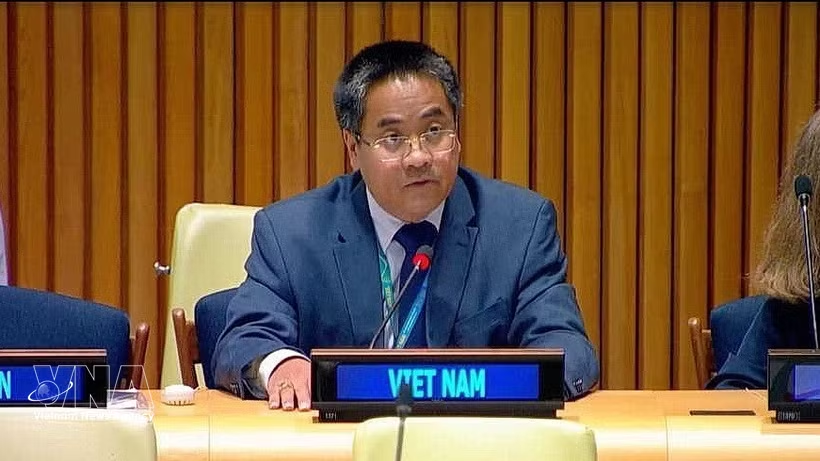
Reaffirming Vietnam’s consistent position of condemning terrorism in all forms, manifestations and motivations, Minister Counsellor Nguyen Hai Luu, Deputy Permanent Representative of Vietnam to the UN, called on UN member states to strengthen cooperation in investigating, prosecuting and bringing to trial individuals and organisations responsible for planning, carrying out or financing terrorist acts, including those linked to terrorist incidents in Vietnam in recent years.

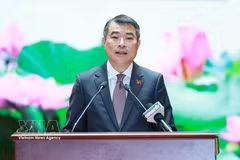
Minister Counsellor Nguyen Hai Luu, Deputy Permanent Representative of Vietnam to the UN (Photo: VNA)

New York (VNA) – Vietnam has called for stronger international cooperation against terrorist acts and violent extremism at the United Nations General Assembly (UNGA)’s ninth biennial review of the UN Global Counter-Terrorism Strategy held at UN Headquarters in New York on July 2 (local time).

Speaking at the event, Minister Counsellor Nguyen Hai Luu, Deputy Permanent Representative of Vietnam to the UN, acknowledged the efforts made by the UN and its member states in combating terrorism, while stressing that terrorism remains a serious threat to global peace, stability and development.

He expressed concern over the growing use of cyberspace, emerging technologies, and social, ethnic and religious issues by terrorist and extremist groups to spread radical ideologies, recruit members, organise networks and incite cross-border violence, posing increasing challenges to countries' counter-terrorism efforts.

Reaffirming Vietnam’s consistent position of condemning terrorism in all forms, manifestations and motivations, the Vietnamese diplomat called on UN member states to strengthen cooperation in investigating, prosecuting and bringing to trial individuals and organisations responsible for planning, carrying out or financing terrorist acts, including those linked to terrorist incidents in Vietnam in recent years.

On counter-terrorism measures, he underscored the need for a comprehensive approach that combines strengthened security and law enforcement with efforts to address the root causes of terrorism, including political, economic and social inequalities, protracted conflicts, discrimination and marginalisation.

Vietnam also highlighted the importance of international cooperation, information and experience sharing, technical assistance and capacity building, particularly for developing countries, while affirming that all counter-terrorism measures must comply with the UN Charter and international law and opposing the application of double standards in counter-terrorism efforts.

Earlier, at the fourth United Nations High-Level Conference of Heads of Counter-Terrorism Agencies, a representative of Vietnam’s Ministry of Public Security shared the country’s assessment of external terrorist threats to national security, including the risks posed by terrorists seeking to enter, hide in or transit through Vietnam; the misuse of cyberspace to disseminate extremist ideology, provide instructions on making weapons and explosives, and promote methods of attack; and attempts to exploit socio-economic, ethnic and religious issues to incite extremism, violence and terrorist activities.

On the sidelines of the conference, the Vietnamese delegation held discussions with several key partners and the UN Office of Counter-Terrorism (UNOCT) on initiatives to strengthen cooperation, share experience and enhance counter-terrorism capacity, particularly in responding to emerging threats.

Adopted by the UN General Assembly in 2006, the UN Global Counter-Terrorism Strategy serves as the principal international framework for counter-terrorism cooperation. It is built on four pillars: addressing conditions conducive to the spread of terrorism; preventing and combating terrorism; building states’ capacity and strengthening the UN’s role; and ensuring respect for human rights and the rule of law in counter-terrorism efforts./.

VNA
See more

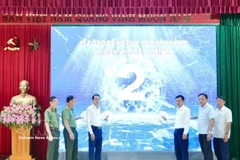
Delegates launch the AI-powered kiosk system for public administrative services in Dong Tien commune, Thanh Hoa province. (Photo: VNA)

Thanh Hoa introduces AI kiosk to streamline public administrative procedures

While traditional electronic kiosks mainly provide information lookup or queue-number services, the new AI kiosk applied by Dong Tien commune in Thanh Hoa province incorporates technologies such as AI, a conversational virtual assistant, voice recognition, natural language processing (NLP), optical character recognition (OCR), and connectivity with the VNeID digital identity platform and the national online public service system.

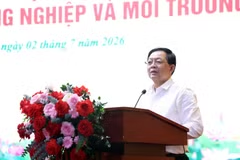
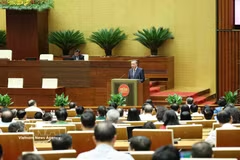
Deputy Prime Minister Ho Quoc Dung addresses the conference (Photo: baochinhphu.vn)

Agriculture-environment urged to perform stronger legal reform, digital transformation

Another key priority is the vigorous implementation of Resolution No. 57-NQ/TW on science, technology, innovation and digital transformation. The ministry was tasked with leading a 100-day nationwide campaign to review and complete outstanding tasks related to the resolution, with detailed weekly and monthly action plans and clearly assigned responsibilities, said Deputy Prime Minister Ho Quoc Dung.

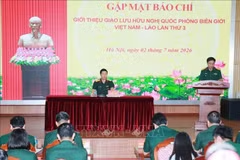
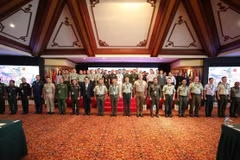
Delegates at the 22nd ASEAN Defence Ministers' Meeting-Plus (ADMM-Plus) Experts' Working Group (EWG) on Peacekeeping Operations. (Photo published by VNA)

Vietnam shares peacekeeping expertise at ADMM+ experts' meeting

The Vietnamese delegation highlighted the increasing contributions of Vietnamese female peacekeepers serving at UN missions and headquarters, noting their important role not only in fulfilling operational duties but also in supporting community engagement, civilian protection, medical services and humanitarian assistance.

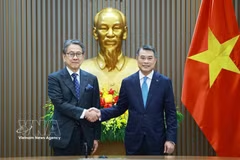
Prime Minister Le Minh Hung (R) receives Maeda Tadashi, Governor of the Japan Bank for International Cooperation (JBIC) in Hanoi on July 2 (Photo: VNA)

JBIC pledges continued support for Vietnam's strategic development goals

Prime Minister Le Minh Hung said there remains ample room to expand bilateral cooperation, stressing JBIC's important role in mobilising financial resources and advancing strategic infrastructure projects to support Vietnam's long-term development goals, particularly its green transition.

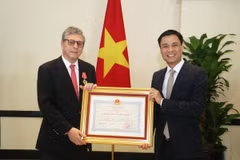
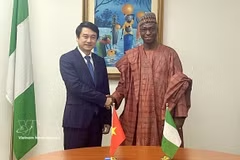
Deputy Minister of Foreign Affairs Dang Hoang Giang (R) presents the Friendship Order to Brazilian Ambassador to Vietnam Marco Farani. (Photo: Ministry of Foreign Affairs)

Brazilian Ambassador to Vietnam awarded Friendship Order

Presenting the state honour, Deputy Minister of Foreign Affairs Dang Hoang Giang said the award reflects the high regard of the Vietnamese Party, State and people for Farani’s role in strengthening the friendship and cooperation between the two nations. He praised the ambassador’s dedication, professionalism and unwavering commitment throughout his tenure in Vietnam.

☕ Afternoon briefing on July 2

☕ Afternoon briefing on July 2

A ceremony marking the 50th anniversary of Saigon - Gia Dinh city being officially named after President Ho Chi Minh, conferences reviewing the performance of military and public security tasks in H1, and Vietnam classified as an upper-middle-income country by the WB are among news highlights on July 2.

Prime Minister Le Minh Hung (right) attends the conference held by the Ministry of Public Security in Hanoi on July 2, 2026. (Photo: VNA)

Security must be linked to expanding national development space: PM

Prime Minister Le Minh Hung urged the public security force to continue setting the standard in translating the Party’s strategic policies and the State’s laws into practice. He called on the force to take the lead in enabling development through concrete, measurable outcomes, proactively review and recommend measures to address shortcomings in institutions, policies and legislation, and focus on removing bottlenecks in order to unlock resources needed to achieve double-digit economic growth.

Prime Minister Le Minh Hung speaks at the national political-military conference. (Photo: VNA)

Prime Minister urges military to enhance strategic advisory role, forecasting capacity

Prime Minister Le Minh Hung noted that the military has demonstrated strong strategic awareness and responsiveness, accurately assessed developments, and effectively advised the Party and State on military and defence matters. These efforts have enabled the flexible and effective handling of emerging situations, maintained a proactive posture, prevented surprises and firmly safeguarded national sovereignty and territorial integrity.

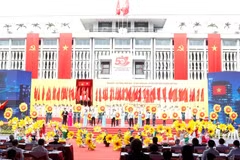
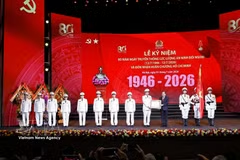
An art performance at the ceremony to mark the 50th anniversary of Saigon-Gia Dinh city being officially named after President Ho Chi Minh (July 2, 1976–2026). (Photo: VNA)

Top leader attends ceremony marking 50 years of Saigon-Gia Dinh bearing late President’s name

Ho Chi Minh City has every reason to take pride in its remarkable achievements over the past half-century. From a war-ravaged urban centre facing enormous post-war difficulties, it gradually restored production, stabilised people's livelihoods, consolidated the achievements of the revolution, built an effective system of governance, and safeguarded national defence and security, thereby laying a solid foundation for long-term development.

☀️ Morning digest on July 2

☀️ Morning digest on July 2

A conference reviewing the 18-month implementation of the Politburo’s Resolution 57, Vietnam's fruit and vegetable exports during the first half of 2026, and UOB Vietnam starting work on the first purpose-built headquarters developed by a foreign bank in the Vietnam International Financial Centre in Ho Chi Minh City are among news highlights on July 1 evening.

Party General Secretary and State President To Lam speaks at the conference. (Photo: VNA)

Top leader demands concrete output under Resolution 57

Top leader To Lam stressed that while the 14th National Party Congress’s Resolution serves as the strategic blueprint for the country's next growth stage, Resolution 57 is one of the key engines for turning that blueprint into reality.

National Assembly Chairman Tran Thanh Man presents the Ho Chi Minh Order to the external security force at the ceremony in Hanoi on July 1, in recognition of its outstanding contributions to the revolutionary cause of the Party and the nation. (Photo: VNA)

NA Chairman calls for building regular, elite, modern external security force

The NA Chairman stressed that under all circumstances, the force must remain absolutely loyal to the Party, the nation and the people, while upholding the principle of the Party’s absolute, direct and comprehensive leadership – specifically through the Central Public Security Party Committee and the leadership of the Ministry of Public Security.

Party General Secretary and State President To Lam (centre) chairs the conference. (Photo: VNA)

Politburo sets six priorities for implementing Resolution No. 57

After 18 months of implementing Resolution No. 57, ministries, sectors and localities have adopted innovative and effective approaches that have generated positive momentum, while winning broad support from businesses, the scientific community and the public for policies on science, technology, innovation and digital transformation.

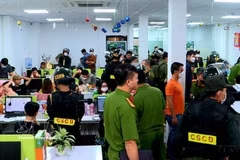
Police in Tan Binh district, Ho Chi Minh City, in coordination with the Department of Cybersecurity and High-Tech Crime Prevention under the Ministry of Public Security, searched multiple locations and placed 86 suspects in temporary criminal detention for investigation into alleged telecom and online fraud. (Photo: VNA)

New Cybersecurity Law strengthens protection of citizens' rights in digital age

The law also introduces more comprehensive provisions on data security, information system protection and measures to prevent, detect and address cybersecurity violations. It prioritises prevention, enhances early warning and incident response capabilities, and links cybersecurity with maintaining social order and security amid rapid digital transformation.

An overview of the the July 1 national conference reviewing the one-year operation of the three-tier administration model (Photo: VNA)

Localities propose reforms to improve three-tier administration model

A Hanoi official called for further decentralisation to commune-level authorities in line with resource allocation, continued streamlining of organisational structures to eliminate unnecessary intermediary layers, further refining the Party organisations’ model to align with the state administrative system, greater autonomy for non-business public service units, and wider participation of businesses and social organisations in delivering suitable public services.