Vietnam extends all possible support to reputable int’l education establishments: Deputy PM

Deputy PM Le Tien Chau called on RMIT to broaden enrollment and develop new courses in priority fields, including artificial intelligence, data science, semiconductors, renewable energy, and digital economy, while expanding scholarships and student exchanges to improve Vietnamese students’ access to quality international education.

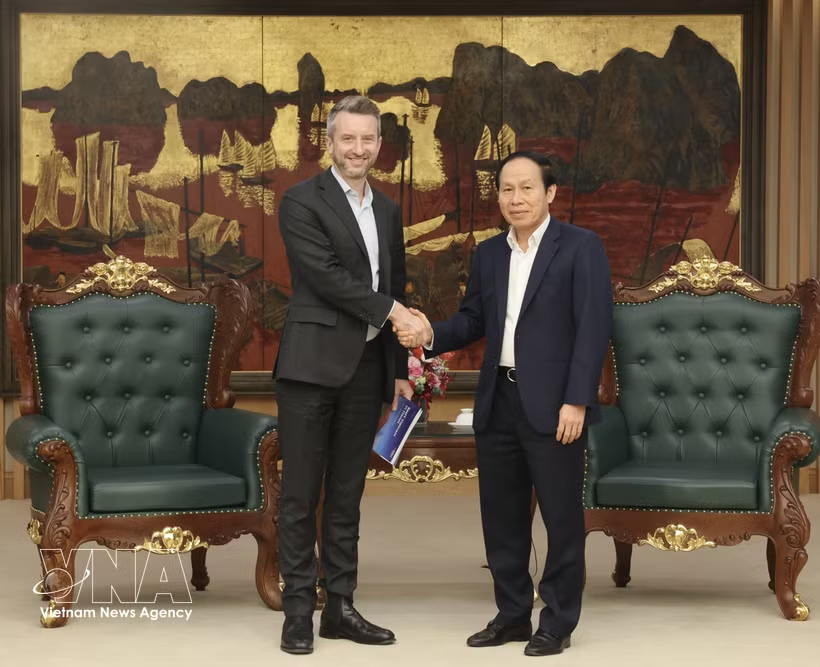
Deputy Prime Minister Le Tien Chau (R) and Deputy Vice-Chancellor of RMIT Melbourne and Chair of the Board of RMIT Vietnam Layton Pike (Photo: VNA)

Hanoi (VNA) – The Vietnamese Government will extend all possible support to reputable international education establishments for stable and long-term operations in the country, Deputy Prime Minister Le Tien Chau told Deputy Vice-Chancellor of RMIT Melbourne and Chair of the Board of RMIT Vietnam Layton Pike during a reception in Hanoi on May 27.

Chau praised RMIT’s contributions, particularly those of RMIT Vietnam, over the past 25 years in deepening Vietnam – Australia education cooperation. He said Vietnam considers quality workforce training one of its three strategic breakthroughs for the next growth phase.

With the Politburo recently issuing Resolution 71 on education and training breakthroughs, placing higher education at the centre of talent cultivation and sci-tech and innovation push, he called it a crucial political and legal foundation for both nations to step up collaboration in areas of shared demand, potential, and strength.

Pike, for his part, thanked the Vietnamese Government for backing RMIT Melbourne’s operations and partnerships. As the university plans to scale up investment in the country, he voiced hope for continued guidance from the Government, ministries, and local authorities, adding that RMIT Melbourne would work closely with relevant sides to complete legal procedures related to the university’s branch campus project.

Noting the substantial room for joint work in education and workforce training, Chau urged RMIT Melbourne to treat Vietnam as a strategic partner and keep expanding investment in the country.

Future RMIT Vietnam campuses, he said, should be fully developed, especially in sci-tech, innovation, and digital transformation.

The host vowed to direct ministries, agencies, and local authorities to tackle issues related to RMIT Vietnam’s branch campus project and support the university during investment procedures.

He also encouraged RMIT Melbourne to partner with the Vietnamese Ministry of Education and Training to scale the flagship Empowering Educators with AI (EEAI) project, aiming to lift AI capabilities among teachers and education administrators nationwide.

Chau called on the university to broaden enrollment and develop new courses in priority fields, including artificial intelligence, data science, semiconductors, renewable energy, and digital economy, while expanding scholarships and student exchanges to improve Vietnamese students’ access to quality international education.

The Deputy PM also invited RMIT Melbourne to help Vietnam with policy consultation, starting with a comprehensive review of the country’s legal and regulatory framework.

RMIT Vietnam should offer independent assessments from both academic and foreign investor perspectives to identify institutional and legal obstacles in sectors where the university excels, especially in education and training, and suggest reforms to help unlock development resources, he said./.
VNA

See more

Permanent Deputy Prime Minister Pham Gia Tuc (R) and AIIB President Zou Jiayi (Photo: VNA)

Vietnam drives infrastructure investment cooperation: Deputy PM

The Asian Infrastructure Investment Bank is financing six projects in Vietnam and working on two more, including a metro system. It aims to pursue a medium- and long-term, system-wide approach rather than focusing solely on individual projects, and wants to work closely with Vietnamese authorities to build a cooperation portfolio tailored to the country’s development needs.

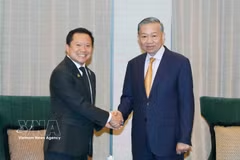
Party General Secretary and State President To Lam receives Thapana Sirivadhanabhakdi, Executive Chairman of TCC Group and CEO of Thai Beverage Public Company Limited (ThaiBev), in Bangkok on May 27, 2026. (Photo: VNA)

Vietnam’s top leader receives Executive Chairman of Thailand’s TCC Group

Vietnam attaches importance to its Comprehensive Strategic Partnership with Thailand, in which economic, trade, investment, and business connectivity cooperation serves as a key pillar contributing to sustainable growth and stronger links between the two economies, said Party General Secretary and State President To Lam.

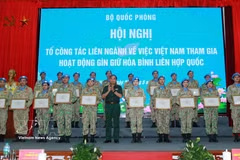
The insignia “For the cause of UN peacekeeping” is presented to 60 individuals. (Photo: VNA)

Vietnam readies seven new unit types for UN peacekeeping

Vietnam will deploy seven new unit types for the United Nations peacekeeping mission, including mechanised infantry/base protection, Level-2 field hospital, engineering, military/military police control, communications, transport helicopter, and airfield support.

Prime Minister Le Minh Hung (right) at the working session with the Dong Thap provincial Party Committee’s Standing Board on May 27 (Photo: VNA)

PM asks for stronger governance reforms to unlock Dong Thap’s growth potential

Chairing a working session on May 27 with the provincial Party Committee’s Standing Board as part of his southern working trip, the PM requested the locality to strongly renew its mindset and governance methods, stressing that the locality must proactively propose policies and special mechanisms suited to local conditions and integrate them into its action programmes based on assigned key tasks.

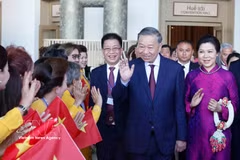
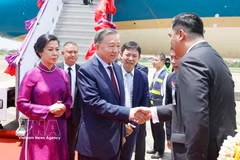
Party General Secretary and State President To Lam and his spouse are welcomed at Udon Thani International Airport on May 27 afternoon. (Photo: VNA)

Top Vietnamese leader begins official visit to Thailand

Immediately after their arrival, General Secretary and President Lam, his spouse, and the Vietnamese delegation paid tribute to President Ho Chi Minh at the Ho Chi Minh Memorial Site and met with the Vietnamese community here.

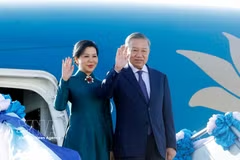
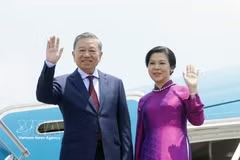
General Secretary of the Communist Party of Vietnam Central Committee and President of Vietnam To Lam and his spouse Ngo Phuong Ly leave Hanoi on May 27 for a three-day official visit to Thailand. (Photo: VNA)

Top leader leaves Hanoi for official visit to Thailand

General Secretary of the Communist Party of Vietnam (CPV) Central Committee and State President To Lam, accompanied by his spouse Ngo Phuong Ly and a high-ranking Vietnamese delegation, left Hanoi on May 27 for a three-day official visit to Thailand at the invitation of Thai Prime Minister Anutin Charnvirakul and his spouse.

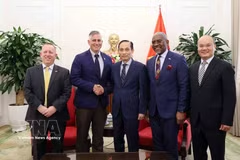
Minister of Foreign Affairs Le Hoai Trung (centre) and US lawmakers at the reception in Hanoi on May 26 (Photo: VNA)

Foreign Minister lauds US Congress's role in bilateral relations

The minister called for the continued maintenance of regular and constructive dialogue channels to properly address differences, with respect for each other’s political regimes, independence, sovereignty and territorial integrity, and in line with the Comprehensive Strategic Partnership.

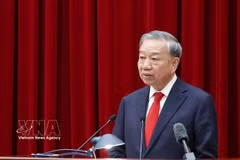
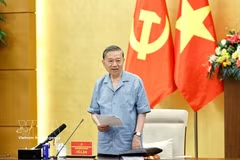
Party General Secretary and State President To Lam speaks at the conference. (Photo: VNA)

Top leader calls for stronger reforms in legislative work

Party General Secretary and State President To Lam has called for stronger reforms in legislative work, while chairing a conference in Hanoi on May 26 to adopt a draft report on the second round of the Politburo and Secretariat’s inspections and supervision over the National Assembly (NA) Party Committee’s Standing Board.

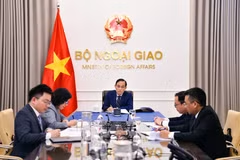
Minister of Foreign Affairs Le Hoai Trung and Vietnamese officials participate in the phone talks on May 26. (Photo: Ministry of Foreign Affairs)

Vietnam consistently treasures ties with traditional African friends: minister

Foreign Minister Le Hoai Trung stressed that amid growing global and regional uncertainties, Vietnam and traditional partners such as Algeria and Namibia should increase exchanges, share viewpoints on international issues of common interests, and enhance coordination in such issues as ocean governance, sustainable development and marine ecosystem conservation, while continuing mutual support at multilateral forums.