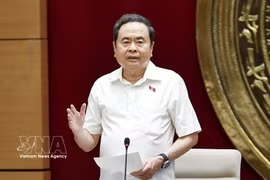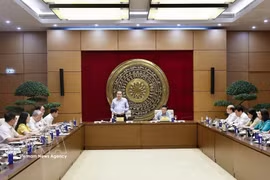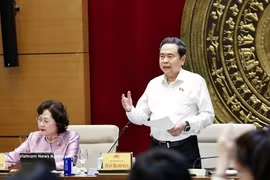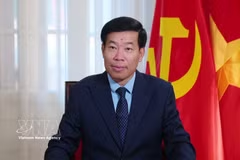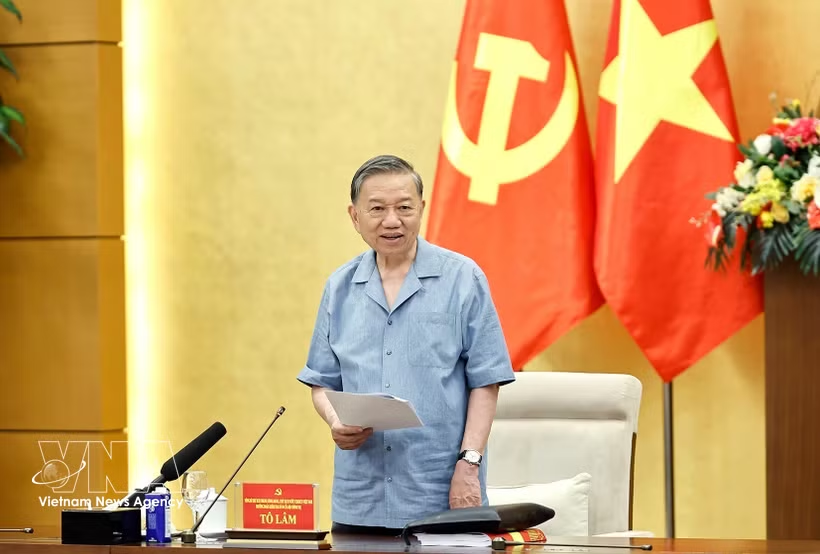
Hanoi (VNA) – Party General Secretary and State President To Lam has called for stronger reforms in legislative work, emphasising a shift from a management-oriented mindset to a development-driven one, moving away from “ban it if it cannot be control” toward creating legal frameworks that foster innovation, unlock productive capacity and pool all resources for development.
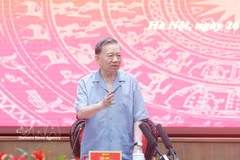
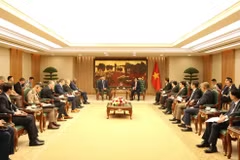
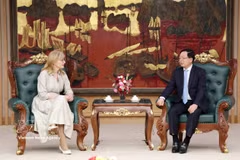
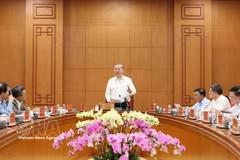
The top leader made the statement while chairing a conference in Hanoi on May 26 to adopt a draft report on the second round of the Politburo and Secretariat’s inspections and supervision over the National Assembly (NA) Party Committee’s Standing Board.
General Secretary and President Lam, who also heads the inspection team No. 10, said the report was carefully prepared as requested by the Politburo and Secretariat and fully captured the Standing Board’s direction on the matters under review.
He asked the inspection team to fully incorporate the Standing Board’s feedback and finalise the draft before submitting it to the Politburo for consideration.
The NA Party Committee has clearly functioned as the political leadership nucleus for lawmaking, oversight and decisions on major national issues, acting proactively and decisively while working closely with the Government Party Committee and relevant agencies to handle an exceptionally heavy workload, including unprecedented tasks demanding urgent action, he said.
He described the rollout of the three-tier administration model, organisational restructuring and decentralisation as a sweeping state overhaul that fundamentally ensured continuity and stability without disrupting the political system or affecting citizens and businesses. He credited the NA Party Committee with the success, noting that legal documents were issued on time, the apparatus ran smoothly and no major systemic bottlenecks emerged.
However, he stressed the need to keep reviewing and improving the institutional framework to guarantee long-term consistency and stability, moving beyond temporary and transitional regulatory measures. He called for close monitoring of operational realities at the grassroots, especially at the commune level after restructuring, to promptly address difficulties related to staffing, personnel capacity, working conditions and the delineation of authority.
He commended the committee for aggressively streamlining NA agencies and called for continued reviews of functions, duties and job positions, along with faster digital transformation and administrative reform to build a genuinely professional, highly capable workforce able to meet increasingly demanding legislative and oversight requirements.
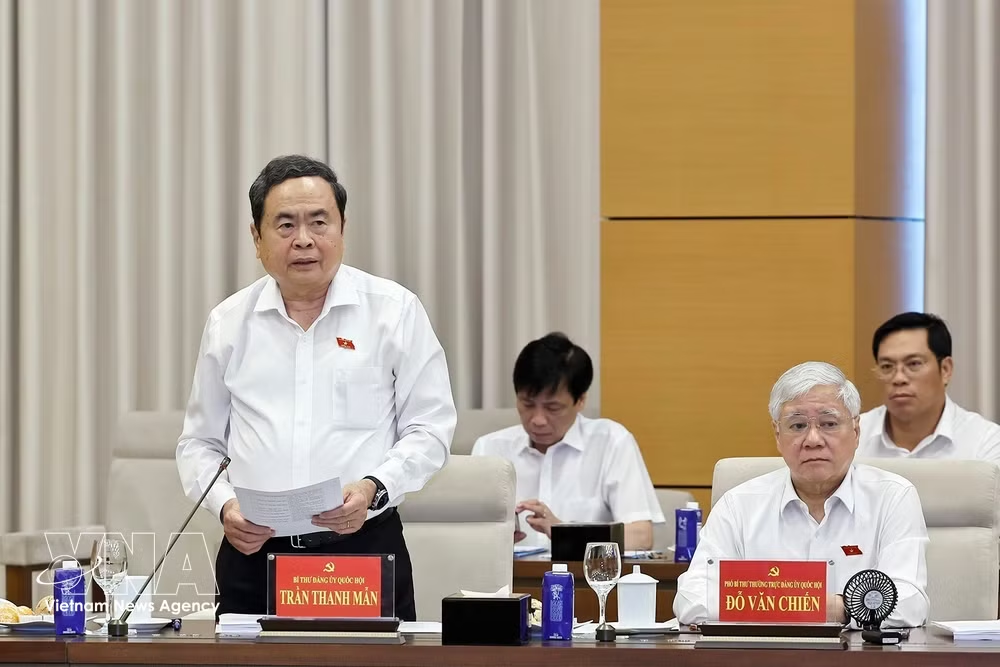
On the double-digit growth targets laid out by the 14th National Party Congress’s Resolution and the Party Central Committee’s conclusion, he said achieving such expansion would be an extremely difficult, unprecedented task for Vietnam.
The NA must keep clearing institutional bottlenecks, accelerate amendments to laws on investment, land, finance, science and technology, data and digital transformation, and strengthen oversight to ensure newly enacted policies are enforced effectively and generate real momentum for growth, he said.
Turning to the Politburo’s Resolution 57 on sci-tech, innovation, and national digital transformation, he pushed the committee to continue building the “digital legislature” and “digital legislation,” while enhancing policy analysis capabilities powered by big data and artificial intelligence (AI).
He also urged faster completion of the legal framework governing emerging technologies, digital economy, digital assets and digital data.
The top leader spotlighted the committee’s proactive, responsible and determined efforts in handling the enormous workload, saying it contributed remarkably to delivering on the 14th Party Congress’s resolution.
He further asked the committee to effectively lead the comprehensive review of legal documents under the guidance of the Central Steering Committee for Resolution 66.
It was also required to team up with the Government Party Committee and relevant agencies to accelerate the completion of legal documents under delegated legislative authority in recent years.
Its other tasks include reviewing the first year of the three-tier administration model while continuing to reform personnel evaluation and management in line with the Party Central Committee’s regulations and directives./.