Vietnamese exporters urged to hedge transport risk as Middle East roils trade routes

Vietnamese firms have been urged to adopt aggressive risk management tools to shield export and import operations and defend market share as global tensions escalate.

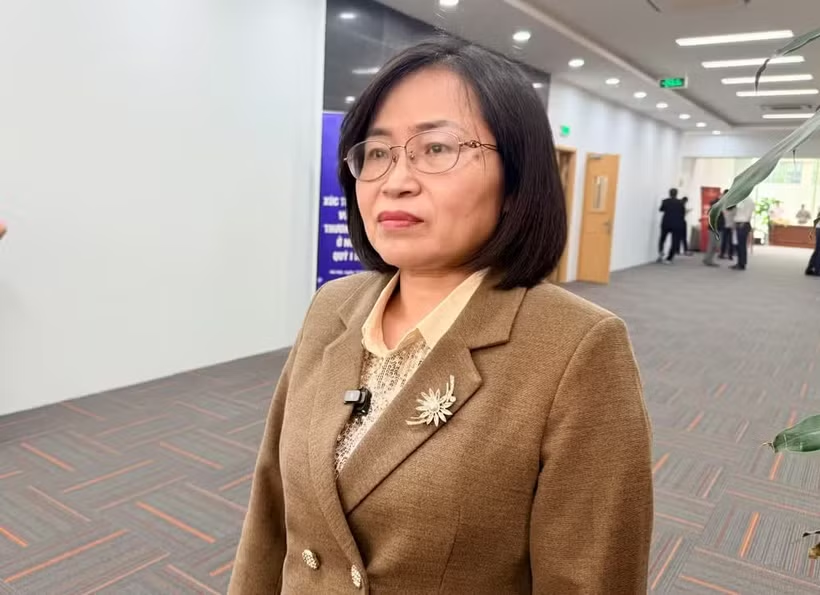
VASEP Deputy Secretary-General Le Hang (Photo: VietnamPlus)

Hanoi (VNA) - Vietnamese firms have been urged to adopt aggressive risk management tools to shield export and import operations and defend market share as global tensions escalate.

Seafood sector feels the squeeze

Le Hang, Deputy Secretary-General of the Vietnam Association of Seafood Exporters and Producers (VASEP), said the seafood industry is absorbing multiple shocks from geopolitical friction, with Middle Eastern conflicts hitting particularly hard.

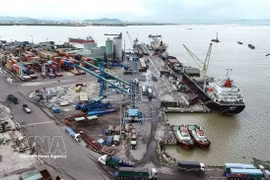
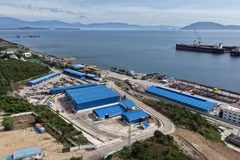
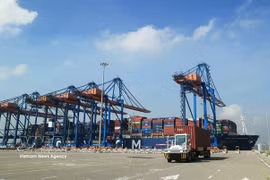
"The seafood sector depends heavily on maritime transport and cold chain infrastructure. When the conflict erupts, freight costs spike, directly eroding competitiveness. Shipping lines may impose additional surcharges or divert vessels via Africa, adding five to seven days of transit and driving up operating costs”, she said.

According to her, updating freight rate changes through VASEP, the Ministry of Industry and Trade, and relevant agencies lets firms rapidly recalibrate strategy. She added that equally critical is securing a stable raw material supply to meet demand, including when probing new export markets.

Truong Xuan Trung from the Vietnam Trade Office in the United Arab Emirates (UAE) said aviation, tourism, and logistics are also getting squeezed as airports and transport corridors face operational curbs, while disruption to key regional shipping lanes compounds cargo complications.

The UAE cut oil output by 500,000-800,000 barrels per day after the conflict broke out, and several extraction and processing facilities suspended operations, which threatens to pump up international logistics and transport costs, lift production expenses, and weaken the competitiveness of export goods.

Trung said Vietnamese enterprises should zero in on risks, including transport breakdowns, extended delivery timelines, cargo spoilage, and payment exposure from volatile markets.

‘End of Voyage’ clause: A contractual landmine

Ngo Khac Le, Deputy Secretary-General of the Vietnam Logistics Business Association, cautioned that one critical risk scenario companies need to monitor closely is the "End of Voyage" clause. Embedded in bills of lading from major shipping lines, the provision lets carriers abort a voyage and drop cargo at an unscheduled port on war, danger, or on the grounds of force majeure.

Courts and arbitration panels have largely upheld the clause when lines prove the original route was unsafe or impractical and their actions were reasonable, but it cannot be deployed as a catch-all. If a discharge is judged unnecessary, cargo owners can still pursue compensation. Voyage termination does not just disrupt a single shipment; it can ricochet across global logistics networks, triggering port congestion, vessel shortages, container scarcity, and cascading delays.

"Firms need to scrutinise sales contracts and chosen Incoterms to pin down which party wears the risk and extra costs when cargo is dumped at an unscheduled port," Le said.

Once liability is mapped, they can evaluate response options. These include arranging onward haulage to the intended destination or an alternative port, stripping cargo from containers for redistribution, or redirecting shipments to different buyers. Other options are locating new local buyers, returning goods to the port of origin, storing cargo until market conditions settle, or, when costs exceed cargo value, considering abandoning the freight.

In parallel, they should scrub cargo insurance contracts to determine if such events fall within coverage and exactly when the policy clock runs out. For shipments still under negotiation, Le advised considering a pause to reassess transport plans against the current geopolitical backdrop.

To contain exposure and manage cargo flow, exporters must proactively coordinate with every link in the supply chain, staying in tight contact with shipping lines for updates on port conditions and alternative routing while working with buyers or sellers to agree on cargo-handling solutions.

When letters of credit come into play, early engagement with banks is essential to untangle documentation and payment snarls.

Across all scenarios, Le told companies to retain all relevant records, including bills of lading, shipping notices, correspondence, storage receipts, sales contracts, insurance agreements, and photos of containers and cargo at discharge, to protect their interests in disputes or insurance claims.

Minimising future risks

Le stressed that exporters should reassess transport contracts and bills of lading first, zeroing in on war risk or deviation clauses that permit route changes. When negotiating sales contracts, they should consider adding clauses that address vessels altering routes or discharging cargo outside planned destinations. Enterprises also need to bulk up logistics insurance coverage and weigh broadening protection against geopolitical blowback.

Diversifying transport corridors and transshipment hubs is another key lever to avoid overdependence on a single route or carrier. They should simultaneously line up backup customers and new markets to cut vulnerability when specific corridors or markets falter.

Building contingency logistics plans is now the norm. They should map out alternative transshipment ports in advance, diversify transport methods through single-mode or multimodal options, and lock in partnerships with bonded warehouses and logistics providers in major transit hubs./.

VNA

See more

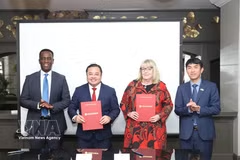
At the Vietnam–Canada Business Forum 2026 (Photo: VNA)

Green transition creates fresh opportunities for Vietnam–Canada partnership

Rahul Malhotra, owner of RM Venturex, said the forum provided businesses with valuable insights into opportunities for deeper Vietnam–Canada cooperation. He noted that support from diplomatic channels and the engagement of both public and private sectors are helping create favourable conditions for stronger economic ties among Canada, Vietnam and ASEAN.

At the working session between Can Tho leaders and representatives of Singaporean businesses. (Photo: VNA)

Can Tho invites Singaporean firms to invest in industry, energy, logistics

Singapore is currently the Mekong Delta city’s largest source of foreign direct investment (FDI), with 12 active projects totalling nearly 320 million USD in registered capital. A flagship project is the Vietnam-Singapore Industrial Park (VSIP) Can Tho, launched in 2022 with an investment of over 3.7 trillion VND (140 million USD) and covering nearly 294 hectares.

Workers process tra fish for exports. (Photo: VNA)

Sustainable transformation needed for Vietnam’s strategic pangasius sector

With continued policy support, technological innovation and close coordination among authorities, businesses and farmers, Vietnam’s pangasius industry is expected to make a strong and sustainable breakthrough during the 2026–2030 period, reinforcing its position as the world’s leading exporter of the fish.

Deputy Prime Minister Nguyen Van Thang speaks at the event. (Photo: baochinhphu.vn)

Deputy PM calls for integrated ASEAN fintech ecosystem

Deputy PM Nguyen Van Thang proposed a shared vision for an ASEAN fintech ecosystem that is open, secure, transparent, inclusive, and sustainable: “Open” to foster connectivity, “Secure” to enable growth, “Transparent” to build trust, “Inclusive” to ensure that no one is left behind, and “Sustainable” to strengthen resilience and support long-term progress.

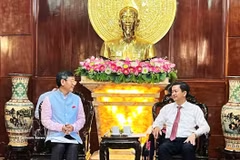
Vice Chairperson of the National Committee of the Chinese People's Political Consultative Conference (CPPCC) Xian Hui (left) meets with Secretary of Phu Tho provincial Party Commitee Pham Dai Duong on comprehensive cooperation (Photo: VNA)

Phu Tho expands cooperation with Chinese localities

A high-level delegation of the National Committee of the Chinese People's Political Consultative Conference (CPPCC), led by its Vice Chairperson Xian Hui, visited the production facility of BYD Vietnam Co., Ltd. at Phu Ha Industrial Park and held a working session with leaders of Phu Tho province on June 9.

Financial buildings in downtown Ho Chi Minh City along the Saigon River. (Photo: VNA)

Robust dispute resolution framework key to Vietnam’s IFC ambitions

The development strategy for VIFC-HCMC envisions a comprehensive financial ecosystem encompassing green finance, carbon credits, financial technology (fintech), blockchain technology, digital assets, digital banking and other innovative business models. These highly internationalised sectors involve complex cross-border transactions and sophisticated legal structures.

A step in the semiconductor chip manufacturing process. (Photo: VNA)

LG to build first semiconductor substrate plant in Vietnam

LG Innotek, an affiliate of the Republic of Korea's LG Group, has announced a plan to build its first semiconductor substrate plant in Vietnam, marking a significant step in expanding its production capacity and strengthening its semiconductor packaging solutions business.

Minister of Industry and Trade Le Manh Hung, President and Chief Executive Officer of Murphy Oil Eric M. Hambly, and delegates at their meeting on June 8 in Hanoi. (Photo: moit.gov.vn)

Murphy Oil urged to expand investment in Vietnam

Murphy Oil has operated in Vietnam since 2012 and currently participates in and operates many important oil and gas contracts at projects such as Lac Da Vang and Hai Su Vang, which are expected to contribute additional oil and gas supplies, strengthen energy security and support Vietnam’s economic development.

Deputy Prime Minister Nguyen Van Thang (R) receives Krishna Srinivasan, Director of the Asia and Pacific Department at the International Monetary Fund (IMF), in Hanoi on June 8. (Photo: VNA)

Deputy PM receives IMF Asia-Pacific Director

Director of the Asia and Pacific Department at the International Monetary Fund (IMF) Krisha Srinivasan affirmed that the IMF will continue to accompany and support Vietnam in the development of its financial sector, thereby helping to strengthen resilience and promote sustainable growth in the years ahead.

An article on Vietnam's e-commerce boom on Le Monde (Photo: VNA)

Digital economy fuels new growth momentum in Vietnam: French daily

French daily Le Monde recently reported that Vietnam’s e-commerce revenue approached 26 billion EUR (29.6 billion USD) in 2025, jumping 25% from a year earlier on the heels of a 20% gain in 2024. The sector now commands roughly 11% of total retail sales, cementing Vietnam’s status as one of Southeast Asia’s most dynamic markets.

Vietnam Airlines Group offers nearly 2.2 million discounted domestic seats from now until August 16 to meet peak summer travel demand. (Photo: VNA)

Vietnam Airlines Group offers nearly 2.2 million discounted domestic seats

Vietnam Airlines Group, comprising Vietnam Airlines, Pacific Airlines and Vietnam Air Services Company (VASCO), will provide nearly 5.5 million seats on domestic routes from now until August 16 to meet peak summer travel demand, including around 2.2 million seats offered at promotional fares on various routes.

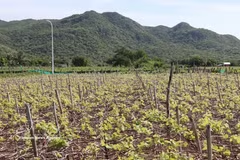
A pepper farm in Gia Lai province (Photo: VNA)

Vietnam’s pepper exports jump 21.7% in volume in five months

May shipments, however, totaled 25,180 tonnes worth 166.2 million USD, down 18.9% by volume and 13.9% by value from April, and 4.8% lower in volume from a year earlier. Major exporters reported declining shipments, underscoring a sector-wide pullback.