Agricultural sector to cut at least 15% greenhouse gas emissions by 2035

The project on low-emission crop production for the period for 2025-2035, with a vision extending to 2050, focuses on high-emission crops such as rice, cassava, sugarcane, coffee, and bananas. It aims to pilot at least 15 farming models nationwide that are ready for carbon credits and meet international standards.

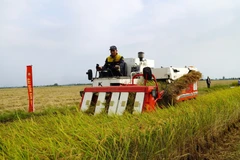
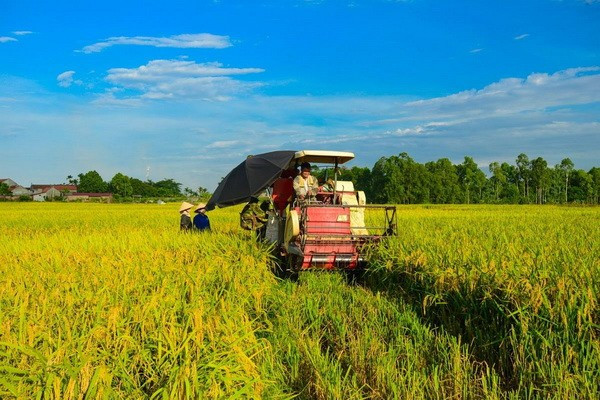
Farmers harvest rice in the Mekong Delta. (Photo: VNA)

Hanoi (VNA) — Vietnam's agricultural sector aims to reduce greenhouse gas emissions by at least 15% by 2035, compared to the baseline set in 2020. As part of this initiative, the Ministry of Agriculture and Environment (MAE) plans to introduce a low-emission label for agricultural commodities.

These are two among the objectives set under the project on low-emission crop production for the period for 2025-2035, with a vision extending to 2050, focusing on high-emission crops such as rice, cassava, sugarcane, coffee, and bananas. It aims to pilot at least 15 farming models nationwide that are ready for carbon credits and meet international standards.

Each province will develop one or two low-emission production models with potential for replication.

The sector will also develop at least five technical emission-reduction packages for key crops, create an emissions database integrated into the national monitoring system, and train 3,000 agricultural extension officers, farmers, and businesses in farming practices and emission-measurement tools.

To raise awareness, the ministry plans to issue five communication toolkits promoting green, low-carbon, and responsible farming practices.

By 2050, Vietnam’s crop production is expected to evolve into an ecological, low-emission, and modern sector—central to the country’s green transition. The agricultural sector aims for complete the adoption of sustainable farming practices across major crops, a comprehensive national emissions database, and extensive use of the low-emission label for key agricultural products.
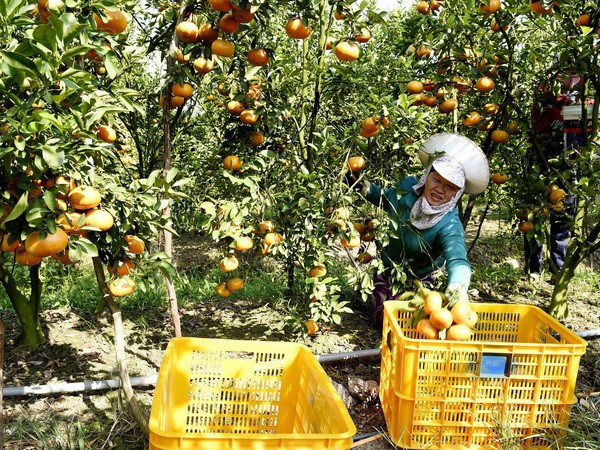
A farmer in the Mekong Delta province of Dong Thap picks tangerines. (Photo: VNA).

A farmer in the Mekong Delta province of Dong Thap picks tangerines. (Photo: VNA).

Vietnam targets to become a regional leader in climate-responsible agriculture, enhancing its green competitiveness in global markets and contributing to the realisation of the nation’s net-zero commitment by 2050.

To implement the project, the MAE has outlined seven groups of solutions, focusing on strengthening governance, advancing science and technology, restructuring production along value chains, building data systems, mobilising finance, promoting training and communication, and enhancing international cooperation.

First, the ministry will improve regulatory frameworks, policies, and management tools, integrating emission-reduction goals into sectoral planning while strengthening decentralisation, monitoring, and the use of digital technologies for programme evaluation.

In terms of science and technology, the sector will research, standardise, and transfer low-emission farming packages, expand the use of digital tools, sensors, and artificial intelligence (AI), and promote pilot demonstration models for replication nationwide.

In terms of production organisation, efforts will concentrate on developing value-chain linkages related to traceability and carbon credits. This will involve encouraging cooperatives to take a central role and supporting enterprises in investing in raw material zones.

A unified emissions database system will be established from the central to the local levels, integrated with the Measurement, Reporting, and Verification (MRV) framework and the national greenhouse gas inventory.

Implementation funding will come from state budget, private capital, international aid, and global climate programmes, with priority given to investments in data systems, training, pilot models, and technology.

Training and communication efforts will focus on disseminating technical knowledge, raising awareness about carbon credits, and combining vocational training with public outreach.

Finally, Vietnam will strengthen international cooperation in research, project development, experience sharing, and participation in the global carbon credit market, contributing to advancing the country’s agriculture toward a low-emission, sustainable future./.
VNA

See more

Houses in Xuan Canh commune, Dak Lak province, completely collapse. (Photo: VNA)

Typhoon Kalmaegi damages over 26,470 houses and causes extensive losses

The typhoon and its aftermath left five people dead, three missing, and 17 injured. It also damaged 3,721 ha of rice and crops, and 3,958 ha of industrial and perennial fruit trees, up by 14 ha from the previous report. For aquaculture, 54,335 cages and 18 ha of shrimp and fish farms were destroyed, along with 118 cattle and 3,593 poultry. Additionally, 21 boats were sunk and 44 others damaged.

Nguyen Thi Vang is the oldest member of the scrap-collecting cooperative group in An Dong ward in Hue city. (Photo: VNA)

Hue turns waste into resource through tech-enabled scrap collectors

Through the mGreen application, women who once earned their living by collecting recyclable waste have become “green warriors” connected to a digital recycling supply chain. The initiative is not only improving livelihoods and enhancing social status but also forming a sustainable waste circulation loop, reinforcing Hue’s image as a green city.

Vice Chairman of the Hanoi People’s Committee Nguyen Manh Quyen receives Sylvain Ouillon, Chief Representative of the French National Research Institute for Sustainable Development (IRD) in Vietnam (Photo: Hanoi Moi)

Hanoi strengthens ties with IRD to tackle air pollution

Vice Chairman of the Hanoi People’s Committee Nguyen Manh Quyen on November 6 received Sylvain Ouillon, Chief Representative of the French National Research Institute for Sustainable Development (IRD) in Vietnam, to discuss potential cooperation in air quality monitoring and pollution reduction in the capital city.

Houses inundated by storm-triggered flooding. (Photo: VNA)

Central, Central Highlands localities race to recover from Storm Kalmaegi

According to Vietnam Disaster and Dyke Management Authority (VDDMA), the storm left five people dead and six injured. As of 7 a.m. on November 7, 52 houses had collapsed and 2,593 others were damaged or unroofed, including 2,412 in Gia Lai province. Nine fishing vessels were reported sunk.

High waves in Ly Son island, Quang Ngai province due to Typhoon Kalmaegi. (Photo: VNA)

Central, Central Highlands localities respond to Typhoon Kalmaegi

As Typhoon Kalmaegi, the 13th storm to hit the East Sea this year, intensifies and heads toward Vietnam’s central coast, localities across the central and Central Highlands regions, including Dak Lak, Lam Dong, Da Nang and Quang Ngai, have activated their highest-level disaster response measures to ensure the safety of people and property.

A map released at 2pm on November 4, tracking the path of Typhoon Kalmaegi (Source: National Centre for Hydro-Meteorological Forecasting)

PM urges proactive measures in response to Typhoon Kalmaegi

As Typhoon Kalmaegi is expected to enter the East Sea on the morning of November 5, with sustained winds of level 13–14 and gusts reaching level 17, Prime Minister Pham Minh Chinh has ordered ministries, sectors, and local authorities to implement the highest-level response measures to protect lives and minimise damage.

Residents in the buffer zone of the UNESCO-recognised Western Nghe An Biosphere Reserve (Photo: VNA)

Vietnam's World Biosphere Reserves eye to become ideal destinations

Vietnam's World Biosphere Reserves have truly become a rendezvous for integration, cooperation, and the exchange of information and experiences among countries and international organisations in the field of conservation and sustainable development, as well as an ideal destination for domestic and international tourists, heard a conference in the central province of Khanh Hoa on November 3.

Heavy rain and prolonged flooding have caused deep inundation, making transportation difficult. (Photo: VNA)

Heavy downpours, floods leave 37 dead, five missing

In addition, floods have submerged and damaged 7,897 hectares of paddy and crops, and 64,356 livestock and poultry have died or been swept away. Across the nation, 103 houses have collapsed or been washed away, 451 others damaged, and 12,676 flooded.