Hanoi (VNA) - Vietnam holds significant potential for generating carbon credits. However, according to the Ministry of Agriculture and Environment, the implementation process still faces obstacles due to the absence of clear regulations on payment levels, cost coverage for measurement, reporting and verification of emission reductions, as well as mechanisms for dispute resolution and complaints.
This reality requires management agencies to study and establish a clearer legal framework for implementing forest carbon projects and issuing carbon credits, ensuring a balance of interests between the State, forest owners, and stakeholders.
According to the Ministry of Agriculture and Environment, Vietnam’s forests hold significant economic and environmental potential.
To date, the total forest area nationwide is more than 14.87 million hectares, including over 10.1 million hectares of natural forests and more than 4.7 million hectares of planted forests.
The national forest coverage rate is about 42%.
With its large forest area and rich biodiversity, Vietnam has the capacity to generate substantial income from selling carbon credits, developing eco-tourism sites, and sustainably utilising forest products.
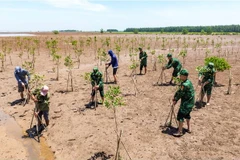
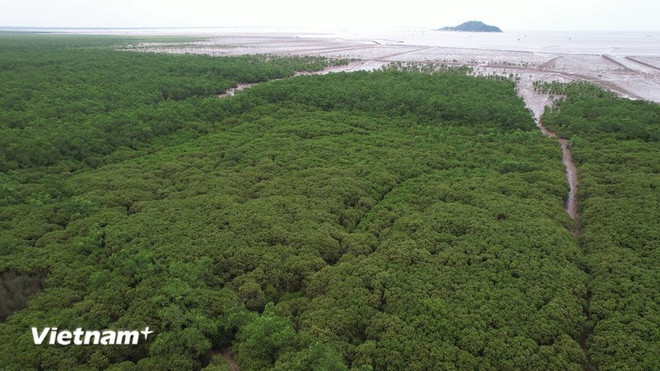
In particular, the Can Gio mangrove forest alone could generate 1–5 million carbon credits annually.
Therefore, in 2022, the Government issued Decree No. 107/2022/ND-CP on the pilot transfer of emission reduction outcomes and financial management of emission reduction payment agreements in the North Central region. The decree took effect upon issuance and will run until December 31, 2026.
After nearly three years of piloting the transfer of emission reduction outcomes and managing revenue from forest carbon, results show that this is a new source of income for long-term forest protection and development.
However, during implementation, several difficulties remain, particularly regarding the use of proceeds from emission reduction transfers by organizational forest owners and the identification of beneficiaries.
Particularly, there are still no specific regulations on payment levels and covering costs for essential activities such as measurement, reporting, verification of emission reductions, and forest carbon monitoring and supervision.
Several international partners are actively working with the Ministry of Agriculture and Environment to discuss and negotiate agreements on carbon credit exchanges.
Some localities have received the Prime Minister’s approval in principle to pilot projects on forest carbon absorption and storage services, but implementation has not been possible due to the absence of a legal framework for the exchange and transfer of emission reduction outcomes and forest carbon credits.
Recently, the Government issued Decree No. 119/2025/ND-CP dated June 9, 2025, amending and supplementing certain provisions of Decree No. 06/2022/ND-CP.
The decree stipulates the procedures for developing, appraising, and approving carbon projects in general, and specifies that only organisations may register carbon projects.
However, it has yet to specify which agencies are authorised to implement forest carbon projects.
Meanwhile, under the 2017 Forestry Law, some forests are under all-people ownership, while others are owned by organisations, households, individuals, and local communities.
This creates the need for specific regulations on which agencies, organisations, or individuals may implement forest carbon projects in accordance with the different forms of forest ownership in Vietnam.
In response to these challenges, the Ministry of Agriculture and Environment is seeking broad public feedback on a draft Decree regulating forest carbon absorption and storage services.
According to Nguyen Tuan Quang, Deputy Director General of the Department of Climate Change (Ministry of Agriculture and Environment), the Government on January 24, 2025, approved a scheme for developing the carbon market and is finalising documents guidance for implementation.
Vietnam is also promoting the development of voluntary carbon credit exchanges operated by the private sector, notably the ASEAN Carbon Credit Exchange, which connects buyers and sellers of credits under both international and domestic standards./.