CPTPP launches preliminary accession talks with Indonesia, Philippines, UAE

The CPTPP entered into force in 2018 after the US withdrew from the agreement during President Donald Trump’s first term in office. The pact currently comprises 12 members: Australia, Brunei, Canada, Chile, Japan, Malaysia, Mexico, New Zealand, Peru, Singapore, the UK and Vietnam.

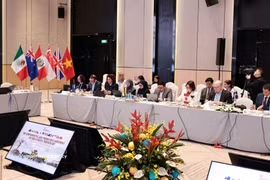
Hanoi (VNA) – Member countries of the Comprehensive and Progressive Agreement for Trans-Pacific Partnership (CPTPP) have agreed to launch preliminary discussions with Indonesia, the Philippines and the United Arab Emirates (UAE), paving the way for formal accession negotiations by the three economies.

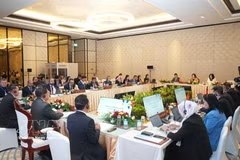
According to a joint statement issued following a ministerial virtual meeting on June 26, the 12 CPTPP members have for the first time established a preliminary consultation mechanism before opening formal accession negotiations. Under the process, member states will assess the candidates’ domestic legal frameworks and trade regulations against the agreement’s standards.

To join the CPTPP, applicant economies must meet a range of stringent requirements, including the elimination of tariffs on most goods, compliance with intellectual property protection rules and adherence to other high-standard trade commitments. The launch of formal accession negotiations also requires the consensus of all existing members.

The introduction of the preliminary consultation mechanism comes amid growing interest in the CPTPP from economies seeking closer integration into the regional trading system. Cambodia submitted its application to join the agreement in November 2025, while Argentina formally applied earlier this month.

Observers say the CPTPP’s role as a framework for promoting free trade is becoming increasingly important at a time of rising protectionism worldwide, including the impact of higher US tariffs and growing economic pressures from China.

At the meeting, member countries also issued a separate statement highlighting the need to strengthen cooperation in the energy sector to address the potential impacts of the ongoing crisis in the Middle East.

The CPTPP entered into force in 2018 after the US withdrew from the agreement during President Donald Trump’s first term in office. The pact currently comprises 12 members: Australia, Brunei, Canada, Chile, Japan, Malaysia, Mexico, New Zealand, Peru, Singapore, the UK and Vietnam./.

VNA

See more

New Singapore-Malaysia rail link expected to boost cross-border spending

New Singapore-Malaysia rail link expected to boost cross-border spending

Singaporean consumers are expected to spend an additional 1.05 billion SGD (about 810 million USD) annually in Johor Bahru, Malaysia's southernmost city bordering Singapore, according to a study conducted jointly by the Singapore Business Federation (SBF), the Restaurant Association of Singapore, and the Singapore Retailers Association.

Indonesia restarts research reactor after nearly 14 years

Indonesia restarts research reactor after nearly 14 years

Under its national energy development plan, Indonesia aims to commission its first nuclear power plants with a combined capacity of about 500 MW in the early 2030s, before expanding nuclear generation to 7-8 GW in the 2040s and 35-37 GW by the 2060s to diversify energy supplies and meet growing electricity demand.

An article published on July 9, 2026 by Auto Plus, one of France's leading automotive magazines, gives a positive assessment of VinFast's VF 2 mini electric car. (Photo published by VNA)

French magazine highlights VinFast's rapid growth

According to L'Automobile, VinFast sold 115,916 vehicles in the first six months of 2026, its highest figure since the company began operations. The result also made VinFast the first Vietnamese automaker to surpass 100,000 vehicle sales in the first half of a year.

Thailand–EU FTA talks advance in Brussels

Thailand–EU FTA talks advance in Brussels

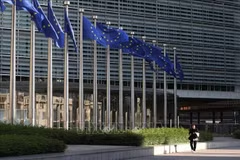
The two sides agreed to expedite FTA negotiations and work toward resolving outstanding issues in agricultural products, industrial goods, government procurement, energy and raw materials, digital trade, and regulatory matters, including intellectual property.

Indonesia attracts 5.8 billion USD in foreign inflows after rate hikes

Indonesia attracts 5.8 billion USD in foreign inflows after rate hikes

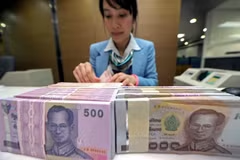
Data from the central bank showed that after recording net foreign outflows in the first quarter of 2026, Indonesia's government bond market rebounded with net inflows of 17.7 trillion IDR. Meanwhile, cumulative foreign investment in Bank Indonesia Rupiah Securities reached 174 trillion IDR.

Firefighters strive to extinguish a forest fire in Kampar of Indonesia's Riau province on July 20, 2025. (Photo: Xinhua/VNA)

Indonesia strengthens forest fire prevention mechanisms

Under the approach, competent agencies will review existing regulations, strengthen inspections of fire prevention and firefighting systems, and implement measures including weather modification through cloud seeding, monitoring water levels in peatland areas, and pre-positioning personnel and equipment in high-risk locations.

Malaysia moves to enact landmark climate change law

Malaysia moves to enact landmark climate change law

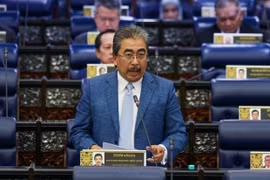
Once passed, the bill will make Malaysia the second ASEAN country, after the Philippines, to enact a dedicated climate change law, and the 60th country in the world to have a standalone legal framework in this area.

Indonesia shifts strategy to combat online gambling

Indonesia shifts strategy to combat online gambling

Minister of Communication and Digital Affairs Meutya Hafid announced on July 14 that the new strategy marks a shift from focusing primarily on blocking gambling websites to a more comprehensive approach targeting the entire criminal ecosystem.

Passengers at the international airport in Bangkok, Thailand (Photo: Xinhua/VNA)

Thailand adjusts visa policy to balance tourism and security

The adjustments aim to ensure that entry facilitation measures for foreign visitors reflect current circumstances while closing security loopholes, preventing misuse, and reducing overlapping entitlements under the principle of “one country, one entitlement”.