Indonesia sees major agricultural export opportunities amid surplus supply

Of the 12 strategic food commodities, Indonesia has achieved self-sufficiency and even exports for eight of them. Currently, only three food commodities still require foreign supplies to meet national needs, namely garlic, beef, and soybeans.

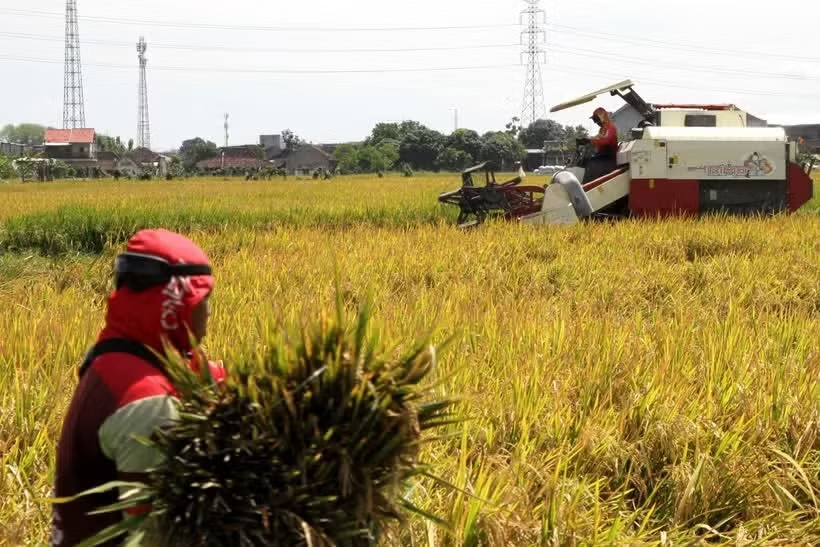
Farmers harvest rice in a paddy field in Central Java, Indonesia. (Photo: Xinhua/VNA)

Jakarta (VNA) – Indonesia is steadily transforming from a country focused on ensuring food security into one with the capacity to export agricultural products and farming inputs, President Prabowo Subianto said at the 17th National Congress of Farmers and Fishermen held on June 24 in Gorontalo, Sulawesi Island.

The President noted that rising agricultural output and growing surpluses are creating significant opportunities for Indonesia to expand exports of agricultural commodities and inputs, marking a new phase in the country's agricultural development.

He stressed that the abundance of rice and corn reflects Indonesia’s growing capacity to achieve food self-sufficiency, one of his administration’s key priorities. Prabowo further assured the people that Indonesia is now capable of independently meeting its need for certain strategic food commodities, notably rice and corn.

According to Agriculture Minister Amran Sulaiman, of the 12 strategic food commodities, Indonesia has achieved self-sufficiency and even exports for eight of them. Currently, only three food commodities still require foreign supplies to meet national needs, namely garlic, beef, and soybeans.

The total shortfall for these three food commodities, which are not yet self-sufficient, amounts to approximately 3.5 million tonnes. Meanwhile, domestic agricultural production has now reached a total output of 73 million tonnes.

However, President Prabowo Subianto stressed that exports would only be expanded after safeguarding the interests of domestic farmers through fair procurement prices, ensuring producers remain profitable and retain incentives to sustain production./.

VNA

See more

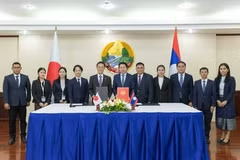
At the signing ceremony of exchange of notes on assistance for the Project for Human Resource Development Scholarship (JDS) for Laos (Photo: https://kpl.gov.la/)

Laos, Japan boosts cooperation in training human resources

Speaking at the signing ceremony, Lao Deputy Minister of Foreign Affairs Anouphap Vongnokeo expressed the Lao Government’s sincere appreciation to the Government and people of Japan for their longstanding support and cooperation for Laos’ socio-economic development and the improvement of people's livelihoods.

High-rises in Kuala Lumpur, Malaysia (Photo: AFP/VNA)

Malaysia to develop low-altitude economy

Speaking at the launch of the initiative on June 24, Malaysian Transport Minister Anthony Loke Siew Fook said the Civil Aviation Authority of Malaysia (CAAM) has been tasked with developing a regulatory framework to support the safe integration and expansion of low-altitude aviation services.

​ Thailand secures deal to export 500 tonnes of durian to China

Malaysia's FDI reaches record high in 2025

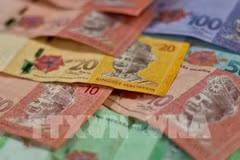
Malaysia attracted a record 65.9 billion MYR (15.9 billion USD) in foreign direct investment (FDI) in 2025, up 41.2% from 46.7 billion MYR in 2024, reflecting sustained foreign investor confidence in the country's economy, according to the Department of Statistics Malaysia (DOSM).

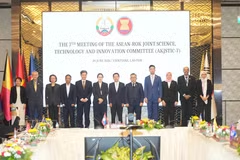
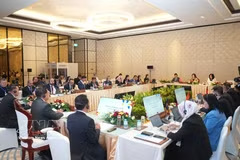
Delegates at the 13th meeting of the ASEAN – China Joint Science, Technology and Innovation Committee (ACJSTIC-13) in Vientiane, Laos on June 24 (Photo: VNA)

ASEAN, China pledge to bolster science, technology, innovation cooperation

As Chair of the 22nd ASEAN Ministerial Meeting on Science, Technology and Innovation (AMMSTI-22), Laos has selected the theme “Advancing ASEAN Plan of Action on Science, Technology and Innovation (APASTI) for a Resilient, Sustainable and Competitive ASEAN”, reflecting the group’s shared aspiration to accelerate development based on science, technology and innovation, further strengthen regional resilience, and ensure ASEAN maintains its competitiveness in an era of rapid technological transformation, said Lao Deputy Minister of Education and Sports Kingmano Phommahaxay.

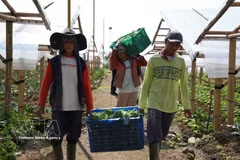
Farmers in Cipanas, West Java province of Indonesia, harvest vegetables (Photo: VNA)

Indonesia promotes transition to low-emission agriculture

Indonesia is preparing an initiative to promote low-emission rice farming systems, particularly in low- and medium-yield production areas, according to Ade Candradijaya, Head of the Agricultural Cooperation Bureau at the Ministry of Agriculture.

Illustrative photo: AFP/VNA

Malaysia warns of rising losses from online scams

Non-existent investment scams consistently recorded the highest losses, amounting to 848.62 million MYR in 2024, rising to 1.46 billion MYR in 2025 and totalling 361.63 million MYR so far this year.

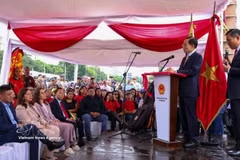
Minister of Foreign Affairs Le Hoai Trung (second, right) speaks at the wreath-laying ceremony held on June 24 at the Ho Chi Minh Monument in the capital city of Caracas (Photo: VNA)

Venezuelan NA leader hails President Ho Chi Minh’s legacy

The great successes of the Vietnamese revolution stem from the sound policies and talented leadership of the CPV and the immense contributions of President Ho Chi Minh, said First Vice President of the Venezuelan National Assembly Pedro Infante.

Cargo ships at Singapore port. (Illustrative photo: Xinhua/VNA)

Singapore’s core inflation remains stable

According to a joint statement released on June 23 by the Monetary Authority of Singapore (MAS) and the Ministry of Trade and Industry (MTI), May’s core inflation came in below the 1.6% median forecast of analysts. Core inflation excludes the costs of accommodation and private transport and is used by the MAS to assess underlying price trends in the economy.

Thailand targets high-income status within 12 years

Thailand targets high-income status within 12 years

To achieve these goals, the Government has adopted a development strategy based on an “economic team” approach centred on three key priorities - maintaining macroeconomic stability and fiscal discipline; developing infrastructure and human resources; and promoting sectors in which Thailand holds competitive advantages.