Thailand’s exports forecast to slow in second half of 2026

The Thai National Shippers' Council expects exports to expand by around 2–4% year on year in the second half while full-year growth could still reach 3–5% if global trade avoids any major new disruption.

Bangkok (VNA) – The Thai National Shippers' Council (TNSC) has projected that Thailand’s exports will continue to expand in the second half of 2026, though at a slower pace, as the country faces increasing risks from the global economic slowdown, geopolitical tensions and volatility in international trade.

TNSC Chairman Thanakorn Kasetsuwan said Thailand’s exports have posted solid growth in the first half of the year, driven largely by importers in many markets accelerating orders in anticipation of possible changes in trade and tariff policies in the coming months.

However, he noted that this front-loading effect is expected to weaken in the second half, resulting in a moderation of export growth momentum.

The council expects exports to expand by around 2–4% year on year in the second half while full-year growth could still reach 3–5% if global trade avoids any major new disruption.

The TNSC warned that uncertainties in the global economy, geopolitical tensions in several regions, particularly the Middle East, and fluctuations in the trade policies of major economies will continue to pose risks to export activities.

Although the US and Iran have signed a peace agreement, uncertainties surrounding negotiations on a final settlement and the situation in the Strait of Hormuz could still have implications for the global economy, the council noted.

In addition, the economic outlook in Thailand’s key export markets, including the US, the European Union (EU), China and Japan, is also under pressure from slowing growth, persistently high interest rates, and a gradual recovery in consumer confidence. This could result in weaker-than-expected import demand in certain sectors.

However, the TNSC maintained that Thailand still holds competitive advantages in several key export categories such as processed food and agricultural products, animal feed, fruits, health and wellness products, natural rubber, and goods related to food security.

In addition, the expansion into new markets, including the Middle East, South Asia, Africa, and ASEAN countries, is expected to help reduce dependence on traditional export destinations and create additional room for long-term growth./.
VNA

See more

Fertiliser products of PT Pupuk Indonesia (Photo: VNA)

Indonesia in talks with Asian countries on fertiliser exports

Indonesia has an annual fertiliser production capacity of around 14.8 million tonnes, including 9.4 million tonnes of urea. After meeting domestic demand, Indonesia is estimated to have an exportable surplus of between 1.5 million and 2 million tonnes each year.

Cargo ships at Singapore port. (Illustrative photo: Xinhua/VNA)

Singapore’s core inflation remains stable

According to a joint statement released on June 23 by the Monetary Authority of Singapore (MAS) and the Ministry of Trade and Industry (MTI), May’s core inflation came in below the 1.6% median forecast of analysts. Core inflation excludes the costs of accommodation and private transport and is used by the MAS to assess underlying price trends in the economy.

Tourists in Bangkok, Thailand (Photo: Xinhua/VNA)

Thailand unveils new security strategy

The Thai Prime Minister has instructed all relevant agencies to integrate their work under a unified approach guided by the principles of “relieving hardship, improving public welfare, protecting public peace, eradicating drugs and defeating criminal gangs.

Malaysia strengthens cybercrime legislation

Malaysia strengthens cybercrime legislation

According to the blue bill book, Clause 24 provides for the offence of disseminating intimate images of any person by transmitting, distributing, publishing, selling, offering for sale or otherwise making such content available through a computer system.

(Photo: dea.gov)

Thailand warns public about dangers of ‘pink cocaine’

A Thai official described 2C-B as a complex mixture of synthetic substances sold under the name “pink cocaine” and available in powder, tablet and capsule forms. The drug has gained popularity among patrons of nightlife and entertainment venues.

Malaysia adjusts diesel subsidy from July 1

Malaysia adjusts diesel subsidy from July 1

Around 700,000 private diesel vehicle owners will receive a monthly fuel quota of up to 200 litres shared between diesel and RON95. Eligible diesel pickup truck and SUV owners can apply for an extra 100 litres, increasing their monthly quota to 300 litres.

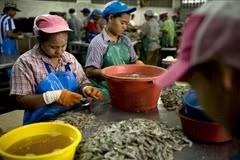
Migrant workers at a shrimp processing factory in Mahachai, on the outskirts of Bangkok, Thailand. (Photo: AFP/VNA)

Thai authorities crack down on nominee firms, illegal foreign workers

Thai authorities are intensifying inspections of businesses suspected of using Thai nationals as nominee shareholders for foreign investors and employing foreign workers illegally in Bangkok, as part of efforts to strengthen investment oversight and ensure fair competition.

Thailand expands probe into illegal crypto mining operations

Thailand expands probe into illegal crypto mining operations

In 2025, the DSI’s Technology and Cyber Crime Bureau dismantled three major networks accused of illegally using electricity for digital currency mining. Authorities seized more than 6,390 cryptocurrency mining machines and found total damage to the Provincial Electricity Authority (PEA) of more than 953 million THB.

​

Laos targets completion of commune-level administrative system by 2027

Lao Party General Secretary and President Thongloun Sisoulith said newly established communes must quickly become fully operational, serving as the primary level for delivering public services, addressing citizens’ concerns and implementing Party policies at the grassroots level.