Indonesia expects 8.84 billion USD in savings from B50 biodiesel rollout

Indonesian Minsiter of Energy and Mineral Resources Bahlil Lahadalia emphasised that the July rollout is a critical step toward national energy independence, aimed at reducing the country's reliance on imported diesel fuel.

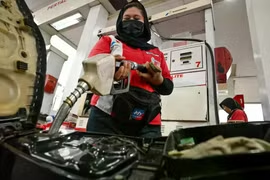
Jakarta (VNA) – Indonesia will begin the nationwide implementation of its mandatory B50 biodiesel programme from July 1, a move expected to strengthen energy self-sufficiency and reduce diesel imports.

PT Pertamina Patra Niaga, the downstream subsidiary of state oil and gas company PT Pertamina, has declared its full operational readiness nationwide for the implementation of the programme, according to the company’s Director of Downstream Optimisation and Distribution Hari Purnomo.

Hari noted that total fuel distribution volumes will remain unchanged from the current B40 mandate.

The primary adjustment lies in the fuel's composition ratio, which increases the palm-oil-based fatty acid methyl ester (FAME) content from 40% to 50%, mixed with 50% petroleum diesel.

As for pricing, it will be adjusted based on prevailing market conditions when the policy takes effect, he added.

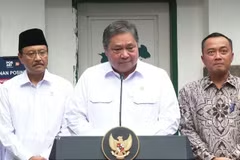
Indonesian Minsiter of Energy and Mineral Resources Bahlil Lahadalia emphasised that the July rollout is a critical step toward national energy independence, aimed at reducing the country's reliance on imported diesel fuel.

The Indonesian Government estimates that the shift to higher-blend biodiesel is projected to save the country up to 157.28 trillion IDR (approximately 8.84 billion USD) in foreign exchange this year.

Bahlil confirmed that a series of technical trials of the B50 blend have yielded positive results.

Data compiled through mid-June indicates that the B50 blend exhibits a lower water content than B40 and has performed well across various transportation modes and heavy machinery.

Technical testing for the automotive sector, which began in December 2025, is on track for completion this month. Meanwhile, comprehensive field testing for mining equipment, excavators and agricultural machinery will continue into the second half of 2026.

The Indonesian Government is also finalising specialised B50 technical assessments for the national railway network and the power generation sector to ensure reliability across both the transportation and power sectors./.
VNA

See more

Tourists in Bangkok, Thailand (Photo: Xinhua/VNA)

Thailand unveils new security strategy

The Thai Prime Minister has instructed all relevant agencies to integrate their work under a unified approach guided by the principles of “relieving hardship, improving public welfare, protecting public peace, eradicating drugs and defeating criminal gangs.

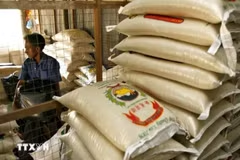
A rice shop in Thailand. (Photo: VNA)

Thailand eyes 7 million tonnes in rice export

Deputy Prime Minister and Minister of Commerce Suphajee Suthumpun said the ministry has held discussions with the Thai Rice Exporters Association to review developments in rice trade and market conditions, and explore measures to further promote rice exports.

Malaysia strengthens cybercrime legislation

Malaysia strengthens cybercrime legislation

According to the blue bill book, Clause 24 provides for the offence of disseminating intimate images of any person by transmitting, distributing, publishing, selling, offering for sale or otherwise making such content available through a computer system.

(Photo: dea.gov)

Thailand warns public about dangers of ‘pink cocaine’

A Thai official described 2C-B as a complex mixture of synthetic substances sold under the name “pink cocaine” and available in powder, tablet and capsule forms. The drug has gained popularity among patrons of nightlife and entertainment venues.

Malaysia adjusts diesel subsidy from July 1

Malaysia adjusts diesel subsidy from July 1

Around 700,000 private diesel vehicle owners will receive a monthly fuel quota of up to 200 litres shared between diesel and RON95. Eligible diesel pickup truck and SUV owners can apply for an extra 100 litres, increasing their monthly quota to 300 litres.

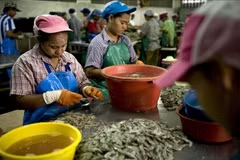
Migrant workers at a shrimp processing factory in Mahachai, on the outskirts of Bangkok, Thailand. (Photo: AFP/VNA)

Thai authorities crack down on nominee firms, illegal foreign workers

Thai authorities are intensifying inspections of businesses suspected of using Thai nationals as nominee shareholders for foreign investors and employing foreign workers illegally in Bangkok, as part of efforts to strengthen investment oversight and ensure fair competition.

Thailand expands probe into illegal crypto mining operations

Thailand expands probe into illegal crypto mining operations

In 2025, the DSI’s Technology and Cyber Crime Bureau dismantled three major networks accused of illegally using electricity for digital currency mining. Authorities seized more than 6,390 cryptocurrency mining machines and found total damage to the Provincial Electricity Authority (PEA) of more than 953 million THB.

​

Laos targets completion of commune-level administrative system by 2027

Lao Party General Secretary and President Thongloun Sisoulith said newly established communes must quickly become fully operational, serving as the primary level for delivering public services, addressing citizens’ concerns and implementing Party policies at the grassroots level.

WB plans over 3 bln USD in financing for Philippines

Thailand attracts over 4.7 billion USD in FDI in first five months of 2026

The top five foreign investors in Thailand during the reviewed period were the US, mainland China, Singapore, Japan, and Hong Kong (China). Investment activities are concentrated in sectors such as engineering, industrial manufacturing, software development, data centres, logistics, electronic components, electric vehicles, and high-tech services.