Indonesia boosts energy security with B50 biofuel

The planned transition to B50 forms part of President Prabowo Subianto’s broader strategy to strengthen the economy’s resilience against global supply disruptions.

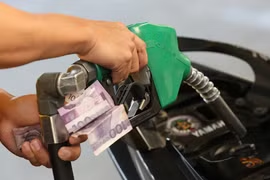
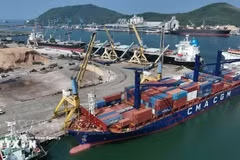
Jakarta (VNA) – Indonesia will officially roll out B50 biofuel nationwide from July 1 following nearly six months of successful trials, Minister of Energy and Mineral Resources Bahlil Lahadalia has said.

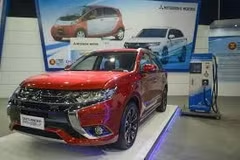
B50 is a fuel blend consisting of 50% crude palm oil (CPO)-based biodiesel and 50% fossil diesel. The programme has been tested across multiple sectors, including heavy equipment, ships, trains and trucks, before the decision to expand its use.

According to Lahadalia, the initiative aims to strengthen national energy security, reduce reliance on imported fuel and promote the use of domestically produced renewable energy. He noted that recent geopolitical tensions in the Middle East have highlighted the risks faced by countries dependent on imported energy, underscoring the need for Indonesia to diversify its energy sources.

Indonesia is currently implementing the B40 programme, which blends 40% palm oil-based biofuel with 60% fossil diesel. Data from the energy ministry shows that B40 has helped cut diesel imports by 3.3 million kilolitres (kL) and reduce carbon emissions by around 38.88 million tonnes of CO₂ equivalent. In 2025, biodiesel consumption reached 14.2 million kL, exceeding the target of 13.5 million kL by 105.2%.

The planned transition to B50 forms part of President Prabowo Subianto’s broader strategy to strengthen the economy’s resilience against global supply disruptions. The government estimates that the programme could reduce fossil fuel consumption by about 4 million kL annually./.
VNA

See more

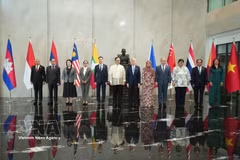
Senior officials from 11 ASEAN member states at the meeting (Photo: VNA)

ASEAN senior officials meet ahead of 48th summit

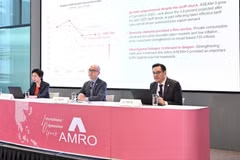
At the meeting, participants reviewed the implementation of agreed commitments and cooperation priorities, preparations for the 48th ASEAN Summit scheduled for this May, and discussed measures to strengthen unity and cooperation amid an increasingly complex and challenging global environment.

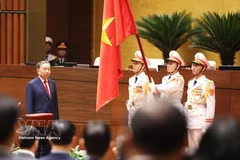
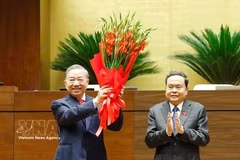
Chairman of the National Assembly Tran Thanh Man, on behalf of Party and State leaders and deputies of the 16th NA of Vietnam, presents flowers to congratulate Party General Secretary and State President To Lam on April 7. (Photo: VNA)

Regional media highlight significant step in Vietnam’s leadership structure

Under General Secretary and President Lam’s leadership, Vietnam is expected to maintain a balanced foreign policy, strengthen its regional standing and accelerate economic development, thereby improving living standards and creating new opportunities for international investors, according to the India-based platform Devdiscourse.

The suspects and seized evidence (Photo: nationthailand.com)

Thailand warns of rising online scam tactics

The centre said this reflected faster and more effective fund freezes, but warned that online job scams had surged to become the single biggest cause of financial damage this week for the first time.

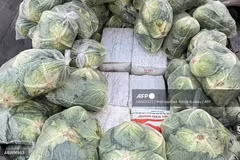
Thai Authorities finds 900 kilograms of ketamine and 700 kilograms of crystal methamphetamine in packages hidden underneath bags of the leafy green vegetable. (Photo: AFP)

Thailand seizes 1.6 tonnes of drugs

Authorities found 900 kg of ketamine and 700 kg of crystal methamphetamine in packages hidden underneath bags of the leafy vegetable, Bangkok police said.

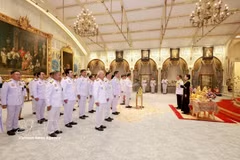
Thai Prime Minister Anutin Charnvirakul and new cabinet ministers take the oath in front of King Maha Vajiralongkorn at Dusit Palace in Bangkok on April 6. (Photo: XINHUA/VNA)

Thailand's new coalition government sworn in

In late March, the King of Thailand approved the new cabinet submitted by PM Anutin Charnvirakul. Members of the Bhumjaithai Party and its allies hold 32 cabinet positions, including key economic and defence portfolios. Minister of Foreign Affairs Sihasak Phuangketkeow retained his position as Thailand’s top diplomat and has also been appointed Deputy Prime Minister.

An artist's impression of the 3D concrete printed pedestrian bridge. (Photo: Singapore's Land Transport Authority)

Singapore to build first 3D-printed concrete pedestrian bridge

The bridge will be 10 metres long and 5 metres wide, designed for both pedestrians and cyclists. The pilot project is part of Singapore’s efforts to adopt 3D concrete printing technology to boost construction productivity amid labour shortages.