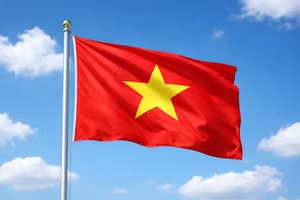
Hanoi (VNA) – Regional and international media on April 7 carried largely positive coverage of Vietnam’s 16th National Assembly electing key state leadership positions.
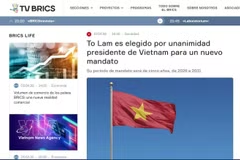
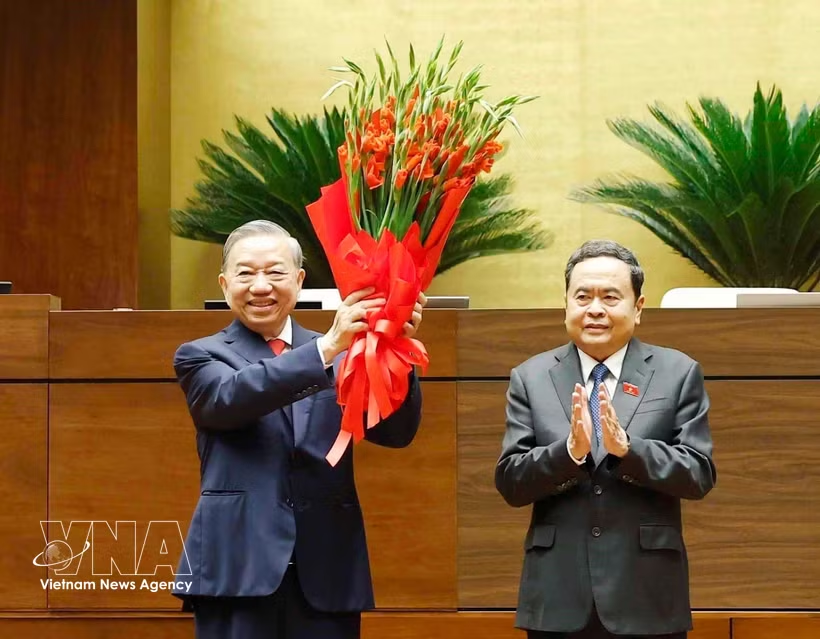
On the same day, Xinhua News Agency, China Central Television (CCTV), and Global Times reported that General Secretary of the Communist Party of Vietnam (CPV) Central Committee To Lam had been elected State President of the country for the 2026-2031 term with the unanimous support of all 495 deputies present.
Xinhua cited President Lam’s inaugural address, in which he affirmed that his key priorities would be maintaining a peaceful and stable environment, promoting rapid and sustainable national development, improving all aspects of people’s livelihoods, and ensuring that citizens fully benefit from development gains.
He also underscored Vietnam’s intention to make greater contributions to peace, stability, development and progress at both regional and global levels. General Secretary of the Communist Party of China Central Committee and President of China Xi Jinping sent a congratulatory message to General Secretary and President Lam, highlighting the importance of building a “community with a shared future” between China and Vietnam. He noted that bilateral relations have achieved significant progress in recent years and expressed readiness to work closely with his Vietnamese counterpart to further advance national development, strengthen bilateral ties, and contribute positively to regional and global stability.
On the same day, Chinese Premier Li Qiang also extended congratulations to Le Minh Hung on his election as Prime Minister of Vietnam. He emphasised the desire to accelerate the development of a mutually beneficial cooperation framework, grounded in high-level consensus between the two Parties and countries, contributing to the strategic development of bilateral relations.
Reporting on the event, Russia’s RIA Novosti noted that Russian President Vladimir Putin had also sent congratulations to Party General Secretary and President Lam. In his message, he welcomed the decision and expressed confidence that the Vietnamese leader’s new role would further strengthen the strategic partnership between Moscow and Hanoi. He affirmed Russia’s willingness to maintain dialogue and close cooperation with Vietnam on regional and international issues, as well as to promote joint economic, trade and cultural projects serving mutual benefits.
Singaporean media outlets likewise reported on the Vietnamese NA’s decision to elect To Lam as President for the next five-year term. The Straits Times and Channel NewsAsia described the move as a significant development in Vietnam’s leadership structure. Analysts cited by these outlets suggested that the consolidation of roles would enhance Vietnam’s capacity to implement economic development policies, improve living standards and maintain political stability, while continuing a balanced foreign policy and deepening international economic integration.
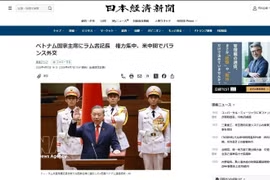
Echoing this view, Thai media, including Nation Thailand, described the election as an important milestone in Vietnam’s leadership structure. Commentaries noted that the development could improve administrative efficiency, accelerate policymaking and create favourable conditions for economic growth, foreign investment and social stability. The reports also highlighted General Secrectary and President Lam’s commitment to transitioning towards an innovation-driven, high-tech economy while maintaining a balanced foreign policy and strengthening international partnerships. From Japan, Nikkei reported on the Vietnamese leader’s dual role, noting that his new term would prioritise economic growth, policy reform, improved governance efficiency and major infrastructure development projects.
Meanwhile, the India-based platform Devdiscourse assessed that the NA’s decision positions Vietnam for sustainable development, with a focus on peace, stability and socio-economic reform. It also highlighted the country’s shift towards a dynamic market-oriented economy, enhanced private sector efficiency, improved infrastructure quality and sustained, stable growth.
Under General Secretary and President Lam’s leadership, Vietnam is expected to maintain a balanced foreign policy, strengthen its regional standing and accelerate economic development, thereby improving living standards and creating new opportunities for international investors, it noted./.
VNA