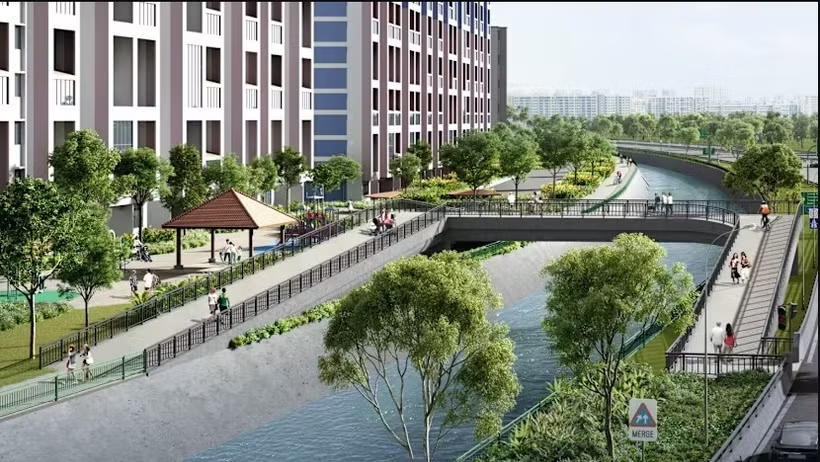
Singapore (VNA) - Singapore’s Land Transport Authority (LTA) has announced plans to build the country’s first 3D-printed concrete pedestrian bridge, expected to be completed and put into operation in 2028, helping shorten travel time between the Jurong West and Tengah residential areas.
The bridge will be 10 metres long and 5 metres wide, designed for both pedestrians and cyclists. The pilot project is part of Singapore’s efforts to adopt 3D concrete printing technology to boost construction productivity amid labour shortages.
The project is being developed in collaboration with the Singapore Centre for 3D Printing at Nanyang Technological University (NTU), engineering consultancy Witteveen+Bos and construction firm CES_Innovfab.
The project team has developed cement-based materials suitable for 3D printing, designed the bridge structure and produced a scaled model to test its structural durability. Structural tests on the model were completed last month, and the results are currently being assessed before construction of the full-scale bridge begins.
3D concrete printing is a highly automated construction method in which concrete is extruded through a nozzle layer by layer to form structures without the need for formwork. According to LTA, the technology could significantly reduce labour requirements and construction time, particularly in labour-constrained environments like Singapore, by minimising the need for temporary structures and manual work.
The technology also allows engineers to create complex geometric forms and distinctive architectural designs that are difficult to achieve using traditional construction methods. However, LTA noted that 3D concrete printing remains an emerging technology in infrastructure development, and the bridge project will serve as a pilot to assess its feasibility for specific infrastructure applications.
The bridge is designed with 10 concrete segments that will be assembled and threaded with steel cables along the entire length. These cables will be anchored to concrete blocks at both ends and tightened using a post-tensioning technique to compress the segments into a single bridge deck.
A scaled model measuring 10 metres in length and 2.5 metres in width, half the width of the actual bridge, was tested using water tanks to evaluate safety and durability. Allan Yeo, Deputy Director for street design and infrastructure technology at LTA, said the bridge’s load-bearing capacity is comparable to that of conventional pedestrian bridges. During testing, 18 water tanks weighing about one tonne each were used to simulate loads.
LTA said testing of the model has been completed and data collected from sensors are being analysed to verify theoretical design calculations and ensure structural integrity. If the results are positive, construction of the full-scale bridge will begin, followed by further evaluations before the structure is opened to the public./.