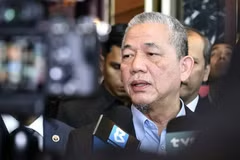
Singapore (VNA) – Singapore’s Deputy Prime Minister Gan Kim Yong has warned that the country’s economy may slow in the coming quarters, while inflation could exceed earlier forecasts, as the prolonged conflict in the Middle East continues to weigh on the global outlook.
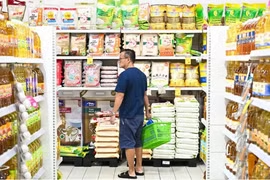
He told Parliament on April 7 that the impact of supply disruptions and higher prices of energy as well as raw materials will cascade through the economy, pushing up business and transport costs and consumer prices.
With the conflict involving the US, Israel and Iran entering its sixth week, Singapore is already suffering from higher petrol prices and electricity tariffs. If the conflict is protracted, higher inflation in Singapore’s source markets could also lead to further import price increases over time, Gan said.
Gan, who also heads the Ministry of Trade and Industry (MTI), said his ministry will continue to monitor economic developments closely and will update its gross domestic product (GDP) forecast in May.
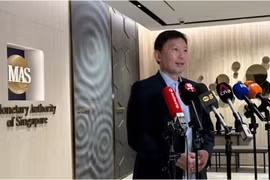
Meanwhile, the Monetary Authority of Singapore (MAS) will take price-related developments into account in its upcoming assessment of the inflation outlook, which it will release on April 14.
MAS had earlier forecast all-items and core inflation – which excludes private transport and accommodation costs – to come in at 1-2% in 2026.
In February, MTI upgraded Singapore’s 2026 GDP growth forecast to a range of 2-4%, driven by strong growth momentum and supported by robust artificial intelligence-related demand.
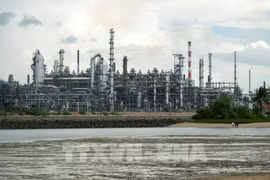
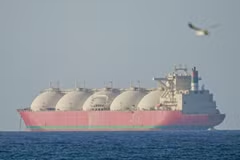
The recently formed Homefront Crisis Ministerial Committee will respond with a coordinated, multi-agency effort to cushion the impact on Singapore. It will focus on securing supplies of fuels, such as liquefied natural gas (LNG) and diesel for power generation, as well as other essential products like jet fuel and petrol, Gan said.
The committee will also look at providing targeted help for those most affected by the crisis, including businesses in the energy and chemicals cluster, platform workers and low-income families.
Meanwhile, Gan said, Singapore will also strengthen its resilience against inflation shocks and supply chain disruptions by building up inventories and diversifying its sources of supply. But it will always remain dependent on imports for its supplies, he noted./.