Malaysia moves to strengthen international trade compliance

Johari said that Malaysia currently has no laws or mechanisms to prohibit the importation of goods produced using forced labour.

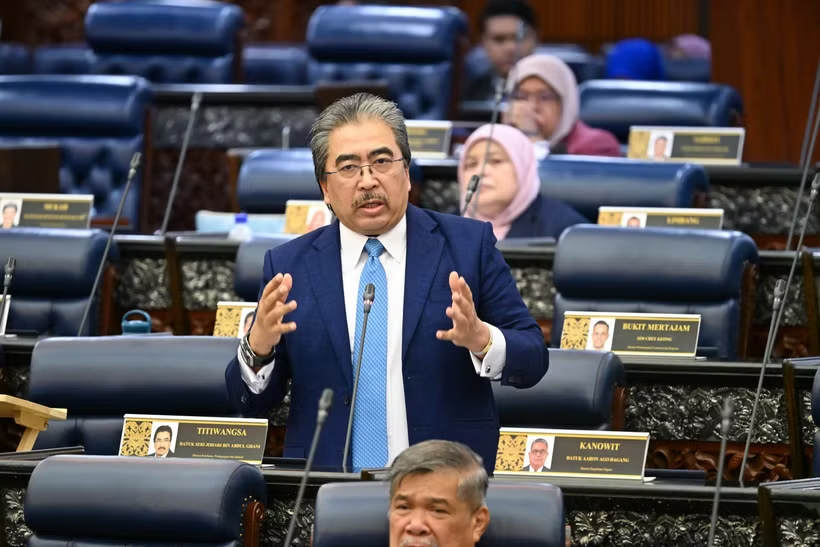
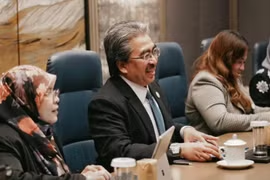
Malaysia's Minister of Investment, Trade and Industry Johari Abdul Ghani speaks during a question-and-answer session in the Malaysian Parliament on June 23. (Photo: Parliament of Malaysia)

Kuala Lumpur (VNA) - Malaysia is developing a mechanism to ban the import of goods produced using forced labour as a proactive measure to strengthen international trade compliance and regulatory requirements of trading partners, said Minister of Investment, Trade and Industry Johari Abdul Ghani.

Johari said the Malaysian Government has established an Inter-Agency Task Force on Forced Labour (IATFL), chaired by the Ministry of Investment, Trade and Industry, to study and formulate the relevant mechanism.

The task force includes relevant ministries and agencies, namely the Ministry of Finance, the Ministry of Foreign Affairs, the Ministry of Home Affairs, the Ministry of Human Resources, and the Ministry of Transport, the Attorney General’s Chambers, the Royal Malaysian Customs Department, the Malaysian Border Control and Protection Agency, the Royal Malaysia Police, the Malaysian Investment Development Authority and the Malaysia External Trade Development Corporation, Johari said.

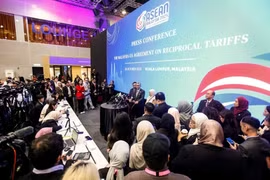
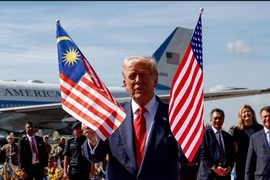
He was speaking at the Parliament of Malaysia regarding the latest status of the implementation of the Agreement on Reciprocal Trade between Malaysia and the US.

Johari said that Malaysia currently has no laws or mechanisms to prohibit the importation of goods produced using forced labour.

He said the implementation of the mechanism will also take into account developments in the US Section 301 investigation, including early indications of a possible 10% indicative tariff on Malaysia after July 24 regarding the issue of forced labour.

The minister said the investigation into forced labour is almost finalised, while the investigation into market access is still in progress.

On June 2, 2026, Johari said the US had announced preliminary findings of an investigation into 60 countries that allegedly failed to enforce import bans on goods made using forced labour.

He said Malaysia was among 54 nations identified as not having specific legal restrictions on the entry of such goods, while six other countries had laws but were found to have failed to enforce them./.
VNA

See more

Tourists in Bangkok, Thailand (Photo: Xinhua/VNA)

Thailand unveils new security strategy

The Thai Prime Minister has instructed all relevant agencies to integrate their work under a unified approach guided by the principles of “relieving hardship, improving public welfare, protecting public peace, eradicating drugs and defeating criminal gangs.

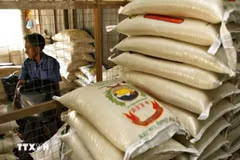
A rice shop in Thailand. (Photo: VNA)

Thailand eyes 7 million tonnes in rice export

Deputy Prime Minister and Minister of Commerce Suphajee Suthumpun said the ministry has held discussions with the Thai Rice Exporters Association to review developments in rice trade and market conditions, and explore measures to further promote rice exports.

Malaysia strengthens cybercrime legislation

Malaysia strengthens cybercrime legislation

According to the blue bill book, Clause 24 provides for the offence of disseminating intimate images of any person by transmitting, distributing, publishing, selling, offering for sale or otherwise making such content available through a computer system.

(Photo: dea.gov)

Thailand warns public about dangers of ‘pink cocaine’

A Thai official described 2C-B as a complex mixture of synthetic substances sold under the name “pink cocaine” and available in powder, tablet and capsule forms. The drug has gained popularity among patrons of nightlife and entertainment venues.

Malaysia adjusts diesel subsidy from July 1

Malaysia adjusts diesel subsidy from July 1

Around 700,000 private diesel vehicle owners will receive a monthly fuel quota of up to 200 litres shared between diesel and RON95. Eligible diesel pickup truck and SUV owners can apply for an extra 100 litres, increasing their monthly quota to 300 litres.

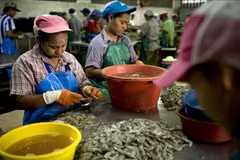
Migrant workers at a shrimp processing factory in Mahachai, on the outskirts of Bangkok, Thailand. (Photo: AFP/VNA)

Thai authorities crack down on nominee firms, illegal foreign workers

Thai authorities are intensifying inspections of businesses suspected of using Thai nationals as nominee shareholders for foreign investors and employing foreign workers illegally in Bangkok, as part of efforts to strengthen investment oversight and ensure fair competition.

Thailand expands probe into illegal crypto mining operations

Thailand expands probe into illegal crypto mining operations

In 2025, the DSI’s Technology and Cyber Crime Bureau dismantled three major networks accused of illegally using electricity for digital currency mining. Authorities seized more than 6,390 cryptocurrency mining machines and found total damage to the Provincial Electricity Authority (PEA) of more than 953 million THB.

​

Laos targets completion of commune-level administrative system by 2027

Lao Party General Secretary and President Thongloun Sisoulith said newly established communes must quickly become fully operational, serving as the primary level for delivering public services, addressing citizens’ concerns and implementing Party policies at the grassroots level.

WB plans over 3 bln USD in financing for Philippines

Thailand attracts over 4.7 billion USD in FDI in first five months of 2026

The top five foreign investors in Thailand during the reviewed period were the US, mainland China, Singapore, Japan, and Hong Kong (China). Investment activities are concentrated in sectors such as engineering, industrial manufacturing, software development, data centres, logistics, electronic components, electric vehicles, and high-tech services.