Thailand targets high-income status within 12 years

To achieve these goals, the Government has adopted a development strategy based on an “economic team” approach centred on three key priorities - maintaining macroeconomic stability and fiscal discipline; developing infrastructure and human resources; and promoting sectors in which Thailand holds competitive advantages.

Bangkok (VNA) – Thailand has set a goal of becoming a high-income country within the next 12 years and joining the world’s top 20 most competitive economies by 2030 under a new development strategy built on close public-private sector cooperation.

Deputy Prime Minister and Finance Minister Ekniti Nitithanprapas was quoted by local media as saying after a meeting of the Joint Public and Private Sector Consultative Committee (JPPCC) on June 22 that the Thai Government and the private sector agreed to develop an economic roadmap with short-, medium- and long-term objectives aimed at strengthening the country’s growth potential.

According to Ekniti, the long-term goal is to help Thailand escape the “middle-income trap” and attain high-income status within 12 years. In the medium term, the Government aims to raise the country’s economic growth potential from around 2.7% currently to above 3%, while placing Thailand among the world’s top 20 most competitive economies by 2030.

To achieve these goals, the Government has adopted a development strategy based on an “economic team” approach centred on three key priorities - maintaining macroeconomic stability and fiscal discipline; developing infrastructure and human resources; and promoting sectors in which Thailand holds competitive advantages.

Growth drivers identified under the strategy include high-value agriculture and food processing, next-generation vehicle manufacturing, smart electronics integrated with artificial intelligence (AI), health care and pharmaceuticals, wellness tourism, international trade and the creative economy.

Meanwhile, Danucha Pichayanan, Secretary-General of the National Economic and Social Development Council, said Thailand must accelerate economic restructuring if it wants to become a high-income country.

He noted that Thailand’s per capita income currently stands at around 8,000–9,000 USD per year, well below the approximately 15,000 USD threshold generally associated with high-income economies.

According to Danucha, Thailand will need to raise its economic growth potential to around 5.5% and sustain annual GDP growth of about 5% in order to achieve high-income status within the next 12 years. He emphasised that stronger public-private cooperation, increased investment and institutional reforms would be critical to the country’s economic restructuring efforts./.

VNA

See more

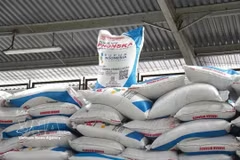
Fertiliser products of PT Pupuk Indonesia (Photo: VNA)

Indonesia in talks with Asian countries on fertiliser exports

Indonesia has an annual fertiliser production capacity of around 14.8 million tonnes, including 9.4 million tonnes of urea. After meeting domestic demand, Indonesia is estimated to have an exportable surplus of between 1.5 million and 2 million tonnes each year.

Cargo ships at Singapore port. (Illustrative photo: Xinhua/VNA)

Singapore’s core inflation remains stable

According to a joint statement released on June 23 by the Monetary Authority of Singapore (MAS) and the Ministry of Trade and Industry (MTI), May’s core inflation came in below the 1.6% median forecast of analysts. Core inflation excludes the costs of accommodation and private transport and is used by the MAS to assess underlying price trends in the economy.

Tourists in Bangkok, Thailand (Photo: Xinhua/VNA)

Thailand unveils new security strategy

The Thai Prime Minister has instructed all relevant agencies to integrate their work under a unified approach guided by the principles of “relieving hardship, improving public welfare, protecting public peace, eradicating drugs and defeating criminal gangs.

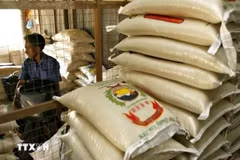
A rice shop in Thailand. (Photo: VNA)

Thailand eyes 7 million tonnes in rice export

Deputy Prime Minister and Minister of Commerce Suphajee Suthumpun said the ministry has held discussions with the Thai Rice Exporters Association to review developments in rice trade and market conditions, and explore measures to further promote rice exports.

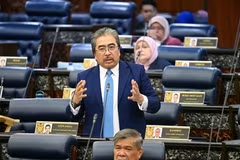
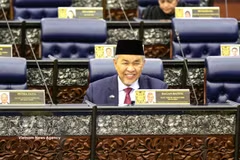
Deputy Prime Minister Ahmad Zahid Hamidi at the session introducing the Cybercrime Bill 2026 in the Parliament of Malaysia on June 22. (Photo: Parliament of Malaysia)

Malaysia strengthens cybercrime legislation

According to the blue bill book, Clause 24 provides for the offence of disseminating intimate images of any person by transmitting, distributing, publishing, selling, offering for sale or otherwise making such content available through a computer system.

(Photo: dea.gov)

Thailand warns public about dangers of ‘pink cocaine’

A Thai official described 2C-B as a complex mixture of synthetic substances sold under the name “pink cocaine” and available in powder, tablet and capsule forms. The drug has gained popularity among patrons of nightlife and entertainment venues.

Malaysia adjusts diesel subsidy from July 1

Malaysia adjusts diesel subsidy from July 1

Around 700,000 private diesel vehicle owners will receive a monthly fuel quota of up to 200 litres shared between diesel and RON95. Eligible diesel pickup truck and SUV owners can apply for an extra 100 litres, increasing their monthly quota to 300 litres.

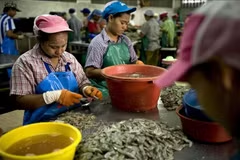
Migrant workers at a shrimp processing factory in Mahachai, on the outskirts of Bangkok, Thailand. (Photo: AFP/VNA)

Thai authorities crack down on nominee firms, illegal foreign workers

Thai authorities are intensifying inspections of businesses suspected of using Thai nationals as nominee shareholders for foreign investors and employing foreign workers illegally in Bangkok, as part of efforts to strengthen investment oversight and ensure fair competition.

​

Laos targets completion of commune-level administrative system by 2027

Lao Party General Secretary and President Thongloun Sisoulith said newly established communes must quickly become fully operational, serving as the primary level for delivering public services, addressing citizens’ concerns and implementing Party policies at the grassroots level.