Vietnam stands out as attractive destination among emerging markets in 2026

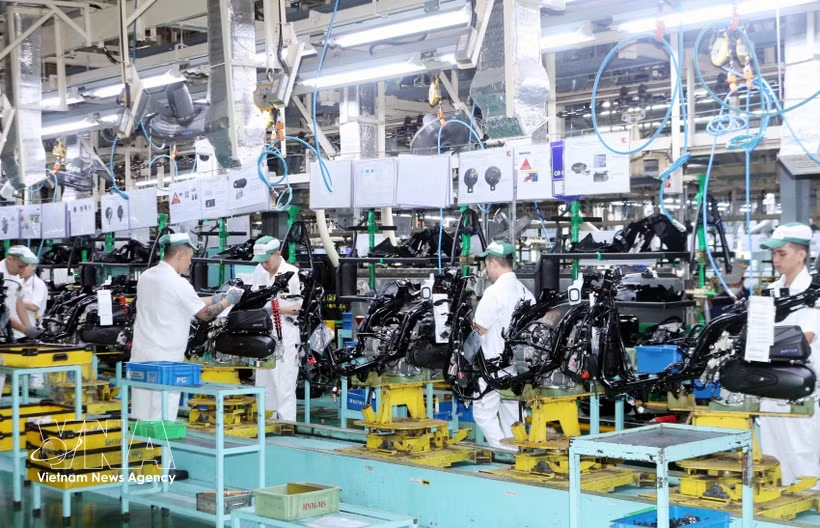
Vietnam has emerged as one of the most attractive investment destinations as the country is reaping substantial benefits from the ongoing global supply chain shift, with an increasing number of hi-tech and manufacturing firms expanding their operations across Southeast Asia.

Production line of Honda Vietnam Company, Dong Van II Industrial Park, Hung Yen province (Photo: VNA)

Rome (VNA) – Vietnam is positioning itself as one of the promising markets among emerging economies in 2026, attracting growing interest from international investors as global capital shifts toward economies with strong fundamentals, technological development and deeper integration into global supply chains.

After years of lagging behind the US stock market, emerging markets are staging a strong comeback in 2026, supported by attractive valuations, a weaker US dollar and stronger economic growth prospects.

According to Italy's La Stampa newspaper, strategists at Goldman Sachs, Lazard and RBC believe the rebound could mark the beginning of a new multi-year growth cycle for emerging markets. However, with increasing divergence among economies, investment success will depend more on selecting markets with solid underlying fundamentals.
vnanet-sx2.jpg
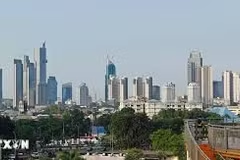
According to Italy's La Stampa newspaper, Vietnam is positioning itself as one of the promising markets among emerging economies in 2026 (Photo: VNA)

Against the backdrop of global capital reallocation, Vietnam has emerged as one of the most attractive investment destinations. Analysts said the country is reaping substantial benefits from the ongoing global supply chain shift, with an increasing number of hi-tech and manufacturing firms expanding their operations across Southeast Asia.

Beyond its role as a rising manufacturing hub, Vietnam's long-term outlook is also supported by advances in digital infrastructure and the energy transition process.

Experts said international investment is increasingly flowing into data centres, digital technologies, and the mining and processing of strategic minerals, including rare earths, to meet rising demand from the digital economy and hi-tech industries.

Elsewhere in Asia, India is expected to maintain robust momentum, with GDP growth projected at around 7% in 2026, driven by its young population and strong domestic consumption. Meanwhile, the rapid expansion of artificial intelligence (AI) continues to fuel demand for semiconductors, boosting growth prospects for Taiwan (China) and the Republic of Korea.

Experts said the era of broad-based investment across emerging markets is giving way to a more selective approach, with global investors increasingly favouring economies that combine sustainable growth, technological innovation and deep integration into global supply chains./.


VNA

See more

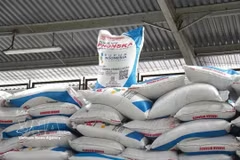
Fertiliser products of PT Pupuk Indonesia (Photo: VNA)

Indonesia in talks with Asian countries on fertiliser exports

Indonesia has an annual fertiliser production capacity of around 14.8 million tonnes, including 9.4 million tonnes of urea. After meeting domestic demand, Indonesia is estimated to have an exportable surplus of between 1.5 million and 2 million tonnes each year.

Cargo ships at Singapore port. (Illustrative photo: Xinhua/VNA)

Singapore’s core inflation remains stable

According to a joint statement released on June 23 by the Monetary Authority of Singapore (MAS) and the Ministry of Trade and Industry (MTI), May’s core inflation came in below the 1.6% median forecast of analysts. Core inflation excludes the costs of accommodation and private transport and is used by the MAS to assess underlying price trends in the economy.

Thailand targets high-income status within 12 years

Thailand targets high-income status within 12 years

To achieve these goals, the Government has adopted a development strategy based on an “economic team” approach centred on three key priorities - maintaining macroeconomic stability and fiscal discipline; developing infrastructure and human resources; and promoting sectors in which Thailand holds competitive advantages.

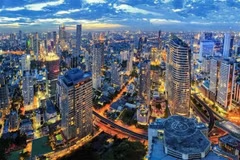
Tourists in Bangkok, Thailand (Photo: Xinhua/VNA)

Thailand unveils new security strategy

The Thai Prime Minister has instructed all relevant agencies to integrate their work under a unified approach guided by the principles of “relieving hardship, improving public welfare, protecting public peace, eradicating drugs and defeating criminal gangs.

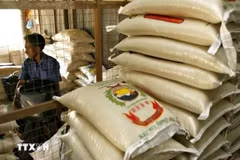
A rice shop in Thailand. (Photo: VNA)

Thailand eyes 7 million tonnes in rice export

Deputy Prime Minister and Minister of Commerce Suphajee Suthumpun said the ministry has held discussions with the Thai Rice Exporters Association to review developments in rice trade and market conditions, and explore measures to further promote rice exports.

Deputy Prime Minister Ahmad Zahid Hamidi at the session introducing the Cybercrime Bill 2026 in the Parliament of Malaysia on June 22. (Photo: Parliament of Malaysia)

Malaysia strengthens cybercrime legislation

According to the blue bill book, Clause 24 provides for the offence of disseminating intimate images of any person by transmitting, distributing, publishing, selling, offering for sale or otherwise making such content available through a computer system.

(Photo: dea.gov)

Thailand warns public about dangers of ‘pink cocaine’

A Thai official described 2C-B as a complex mixture of synthetic substances sold under the name “pink cocaine” and available in powder, tablet and capsule forms. The drug has gained popularity among patrons of nightlife and entertainment venues.

Malaysia adjusts diesel subsidy from July 1

Malaysia adjusts diesel subsidy from July 1

Around 700,000 private diesel vehicle owners will receive a monthly fuel quota of up to 200 litres shared between diesel and RON95. Eligible diesel pickup truck and SUV owners can apply for an extra 100 litres, increasing their monthly quota to 300 litres.

Migrant workers at a shrimp processing factory in Mahachai, on the outskirts of Bangkok, Thailand. (Photo: AFP/VNA)

Thai authorities crack down on nominee firms, illegal foreign workers

Thai authorities are intensifying inspections of businesses suspected of using Thai nationals as nominee shareholders for foreign investors and employing foreign workers illegally in Bangkok, as part of efforts to strengthen investment oversight and ensure fair competition.