Indonesia tightens fiscal spending plans for 2027

Under the 2027 Macroeconomic Framework and Fiscal Policy Principles (KEM PPKF), the Indonesian government targets state expenditure in the range of 13.62% to 14.80% of gross domestic product (GDP).

Jakarta (VNA) – Indonesian Finance Minister Purbaya Yudhi Sadewa has indicated that the Indonesian Government will continue its budget efficiency policy in the 2027 fiscal year as part of efforts to improve the quality and effectiveness of state spending.

Purbaya was quoted by local media as saying on June 9 that the country remains committed to improving the quality of state expenditure through efficiency measures and budget refocusing so that allocations become more productive, better targeted, and capable of delivering tangible benefits to the economy and society.

Under the 2027 Macroeconomic Framework and Fiscal Policy Principles (KEM PPKF), the government targets state expenditure in the range of 13.62% to 14.80% of gross domestic product (GDP).

In line with this objective, the Indonesian Government will continue to strengthen ministry and agency spending in the regions through programme coordination, particularly for initiatives whose beneficiaries are located outside the capital, including the Free Nutritious Meals programme, the development of Red and White village and urban cooperatives, Sekolah Rakyat (People's Schools), and free health screening programmes.

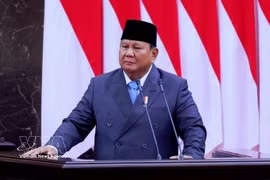
Earlier, Indonesian President Prabowo Subianto presented the country’s macroeconomic framework and fiscal policy direction for the 2027 budget to parliament. The country is targeting economic growth of 5.8 - 6.5%, inflation of 1.5 - 3.5% and a 10-year government bond yield of 6.5 - 7.3%./.
VNA

See more

UK backs Indonesia’s OECD accession

UK backs Indonesia’s OECD accession

The UK and Indonesia have launched an Economic Growth Partnership and pledged to work together to address technical barriers to trade, enhance regulatory transparency, and facilitate investment and business activities.

Thai broadcaster Jasmine International (JAS) inks an eleventh-hour deal for World Cup rights.

Thai broadcaster secures FIFA World Cup 2026 rights at last minute

JAS finalised the 70-million-USD agreement with FIFA on June 11. The deal grants the company exclusive rights to broadcast not only the FIFA World Cup in 2026 and 2030 but also a wide range of FIFA competitions through 2030, including men's and women's football tournaments, futsal, beach soccer, the FIFA Club World Cup and FIFA eSports events.

Underground cooling solution helps Singapore ease energy demand

Laos, Japan agree to strengthen bilateral cooperation

Lao Prime Minister Sonexay Siphandone and his Japanese counterpart Takaichi Sanae have reaffirmed their commitment to deepening the Comprehensive Strategic Partnership between the two countries, with a particular focus on expanding economic, trade, and investment cooperation.

Thailand imposes stricter rules for online advertisers

Thailand imposes stricter rules for online advertisers

Under the regulations, platforms must establish systems to verify the identities of individuals or organisations wishing to place advertisements before they are published. The measure aims to prevent criminal groups from using advertising space to lure victims or commit technology-related crimes that are causing significant damage.

Singapore to negotiate FTA with East African bloc

Singapore to negotiate FTA with East African bloc

Singaporean President Tharman Shanmugaratnam said Singapore welcomes the East African Community (EAC)'s intention to pursue an FTA with the city-state, emphasising that it will be an important step towards enhancing trade flows between the two sides and creating new growth drivers.

Laos reaffirms commitment to eliminate malaria by 2030

Laos reaffirms commitment to eliminate malaria by 2030

Lao PM Sonexay Siphandone highlighted the region’s shared commitment to malaria elimination, recalling the joint declaration signed by Greater Mekong Subregion (GMS) countries in Geneva in 2018, which set a target of eliminating malaria by 2030.

A view of the international roundtable in Russia on June 8 on legal and institutional mechanisms for governmental cooperation to ensure peace and security in the East Sea (Photo: VNA)

Russian scholars propose measures to strengthen trust in addressing East Sea issue

The Russian scholars reaffirmed support for the peaceful settlement of disputes through diplomatic and legal processes, without the threat or use of force, in accordance with international law, particularly the 1982 United Nations Convention on the Law of the Sea (UNCLOS). They also emphasised the importance of maintaining peace and stability, freedom of navigation and overflight in the East Sea, and upholding the rule of law in the seas and oceans.