Singapore (VNA) – As temperatures continue to rise and demand for cooling grows, Singapore is accelerating the development of a cooling system as part of its efforts to improve energy efficiency and climate change adaptation.
Beneath Punggol, a district in northeastern Singapore, lies a network of underground pipelines stretching approximately five kilometres. The system continuously circulates chilled water to buildings above, providing cooling for offices, schools and residential complexes.
The network forms part of a district cooling technology that, while first introduced more than a century ago, is experiencing a resurgence in Singapore.
The country has laid pipes beneath at least eight neighbourhoods so far, with the Marina Bay network – the world’s largest underground system – having begun operations in 2006. More buildings will be linked up to that system, and separate facilities are being rolled out in other parts of the city.
According to experts, cooling demand in Southeast Asia is rising rapidly due to urbanisation, improving incomes, increasing temperatures and the expansion of commercial building space. Against this backdrop, district cooling systems are widely regarded as a more efficient solution than individual air-conditioning units.
Singapore has one of the highest per-capita air-conditioning usage rates in the Asia-Pacific region./.
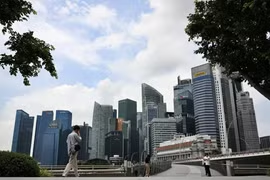
Singapore economy remains resilient amid global uncertainties
Singapore is also pursuing a long-term economic strategy centred on AI and advanced technologies. The country aims to position itself as a trusted hub for developing, testing and deploying AI solutions at scale, while focusing on practical applications to improve productivity and create new industries.