Hanoi (VNA) – Philippine authorities have raised the death toll from a magnitude-7.8 earthquake that struck the country’s south on June 8 to at least 32, with more than 200 people injured and others still missing. The quake also triggered tsunami waves of up to 1.4 metres along parts of the coastline.
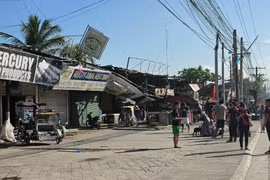
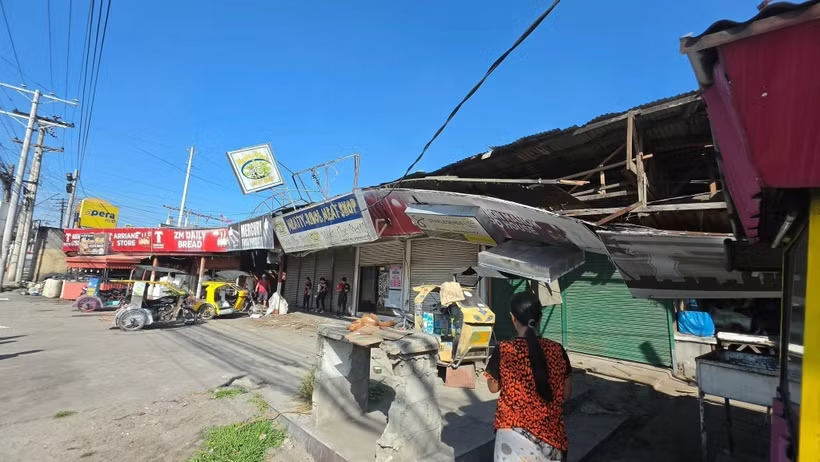
In the hard-hit port city of General Santos, disaster management officials confirmed seven deaths after several buildings collapsed and key infrastructure was damaged. The Philippine Institute of Volcanology and Seismology warned residents to exercise caution before returning to damaged buildings due to the risk of aftershocks.
Authorities are verifying reports that several students may be trapped in a collapsed two-storey school in General Santos. Police said at least 12 people remain missing in the city.
Teresito Bacolcol, Director of the Philippine Institute of Volcanology and Seismology, described the June 8 earthquake as the strongest to hit the country so far this year. The epicentre was located offshore near Mindanao Island at a depth of 33 kilometres, about 32 kilometres southwest of Maasim town in Sarangani province.
Philippine President Ferdinand Marcos Jr. ordered the suspension of classes and directed disaster-response agencies to accelerate relief operations in affected areas.
The Pacific Tsunami Warning Centre said the tsunami threat had largely passed about five hours after the quake. Philippine authorities lifted the tsunami warning later the same day. Waves of around one metre were recorded in Sultan Kudarat and Sarangani provinces, while a 1.4-metre wave was observed in the coastal town of Kiamba, Sarangani. Tsunami-related damage was reported in at least one coastal village.
Smaller tsunami waves were detected in Indonesia, Palau and southern Japan. An 83-centimetre wave was recorded off Indonesia’s Sulawesi Island, while waves of about 30 centimetres were measured in Palau.
Japan’s Meteorological Agency reported tsunami waves of around 20 centimetres in Okinawa and Chichijima Island in the Ogasawara archipelago. More than 190,000 residents in 10 prefectures were advised to evacuate, while Prime Minister Sanae Takaichi instructed relevant agencies to take preventive measures against possible damage./.