Dong Ho folk painting craft added to UNESCO’s urgent safeguarding list

This is Vietnam’s 17th intangible cultural heritage element recognised by the United Nations Educational, Scientific and Cultural Organisation (UNESCO).

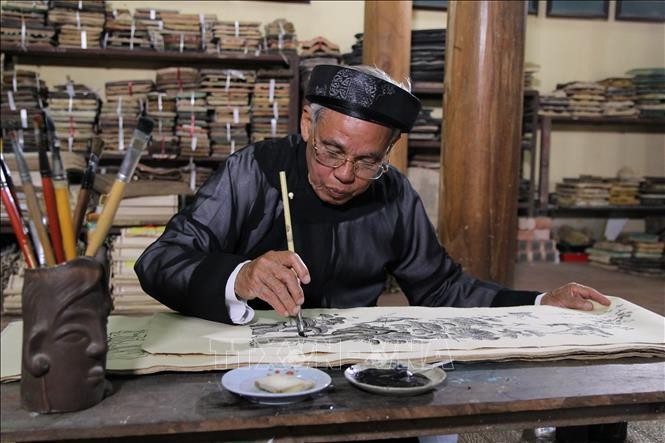
Artisan Nguyen Dang Che, one of the few individuals still practising this ancient craft in Thuan Thanh ward, Bac Ninh province (Photo: VNA)

Hanoi (VNA) – The Dong Ho folk painting craft was included in UNESCO’s List of Intangible Cultural Heritage (ICH) in Need of Urgent Safeguarding at the 20th session of the UNESCO Intergovernmental Committee for the Safeguarding of ICH on December 9 in New Delhi, India, according to the Department of Cultural Heritage under the Ministry of Culture, Sports and Tourism.

This is Vietnam’s 17th intangible cultural heritage element recognised by the United Nations Educational, Scientific and Cultural Organisation (UNESCO).

The committee found that the craft meets all criteria for urgent safeguarding. Dong Ho folk paintings are closely tied to major traditional festivals, including the Lunar New Year and the Mid-Autumn Festival, as well as ancestral and deity worship. However, only a handful of families in Bac Ninh province still practise the craft, passing skills down informally within households. The number of skilled artisans has fallen sharply due to limited economic prospects and declining demand for traditional woodblock prints during festivals, leaving too few practitioners to sustain transmission.

Vietnam’s safeguarding plan includes training classes, systematic inventorying, design development, market diversification, improved access to raw materials, and the provision of protective equipment for artisans. UNESCO assessed these measures as feasible, sustainable and inclusive, with the practising community playing a central role. The nomination file also demonstrated the active involvement of local families in preparing documents and maintaining updated heritage inventories.

UNESCO encouraged Vietnam to integrate the craft into both formal and informal education to foster understanding among younger generations and strengthen long-term preservation efforts.
doan-vietnam.jpg
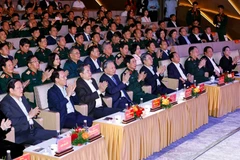
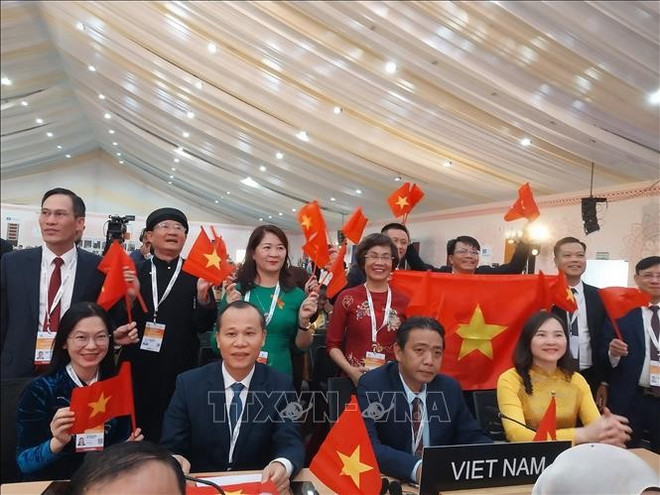
The Vietnamese delegation at the 20th session of the UNESCO Intergovernmental Committee for the Safeguarding of Intangible Cultural Heritage in New Delhi, India. (Photo: VNA)

The craft originated some 500 years ago in Dong Khe street, Thuan Thanh district, Bac Ninh province, where communities developed a distinctive style of woodblock printing. Themes span worship paintings, blessings, historical narratives, daily life and landscapes, traditionally displayed during New Year celebrations and in ancestral altars. Every stage of production — from sketching the design to carving woodblocks, preparing colours and printing — is carried out by hand.

Designs are drawn using brushes and Chinese ink on do (poonah) paper before being carved into wooden blocks. Colours are produced from natural materials such as indigo for green, seashell powder for white, and ash from bamboo leaves or rice straw for black. Prints are made by pressing each coloured woodblock sequentially onto paper coated with diep flakes, with red applied first and black lines added last.

The Department of Cultural Heritage said UNESCO’s recognition affirms the craft’s artistic and historical value and provides fresh momentum for safeguarding a tradition at risk of disappearing. It is expected to raise public awareness, encourage youth engagement and mobilise support from local authorities and cultural organisations. The inscription also enhances Vietnam’s cultural visibility internationally and reinforces pride in the country’s heritage diversity, the department stated.

Vietnam currently has 37 heritage elements recognised on UNESCO’s various lists, including world cultural and natural heritage sites, intangible cultural heritage elements, and documentary heritage entries. Bac Ninh province alone is home to several notable UNESCO-inscribed elements, including Quan ho (love duet singing), Ca tru (ceremonial singing), Mother Goddess worship and Huu Chap tug-of-war tradition, underscoring its role as a major centre of Vietnamese cultural identity./.
VNA

See more

Cover page of Viet Nam hanh phuc (Happy Vietnam) book (Photo: VNA)

VNA publishing house launches books to mark 14th National Party Congress

The three books published by the VNA Publishing House contribute to promoting Vietnam’s image at home and abroad. They also serve as valuable external information products, helping nurture confidence, aspiration and determination to build and safeguard a socialist Vietnam as it advances firmly into a new era of prosperity, strength, civilisation and happiness.

A ceremony to see off the Vietnamese sport delegation to compete at the 13th ASEAN Para Games in Thailand is held at Noi Bai International Airport on January 15, 2025. (Photo: VNA)

Vietnamese delegation sets off for 13th ASEAN Para Games

Vietnam sends 185 members, including 140 athletes, competing in 11 sports including athletics, swimming, weightlifting, badminton, table tennis, chess, judo, boccia, archery, tennis, and fencing. The country aims to win 40–50 gold medals and strives to rank among the top 4–5 countries.

Nguyen Van Than, Chairman of the Vietnam Classical Music Association (VCMA), speaks at a press briefing in Hanoi on January 13. (Photo: The organisers of the concert)

Concert to be held to celebrate 14th National Party Congress

The programme, jointly organised by the VCMA and the Vietnam Association of Small and Medium Enterprises, will feature nearly 150 artists, performers and musicians, representing the finest of Vietnam’s and the international classical music scene.

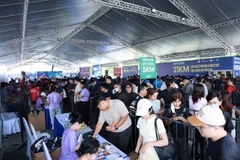
Visitors to Vietnam's booth at International Cultural Festival 2026 (Photo: VNA)

Vietnamese image introduced at International Cultural Festival 2026 in Greece

The Vietnamese Embassy in Greece took part in the International Cultural Festival 2026, organised by the UNESCO Club of Piraeus and Islands in Greece, marking the embassy’s first activity of the new year and highlighting its efforts to bring the image of Vietnam closer to the Greek public and international friends through traditional Vietnamese cuisine.

A dish of Vietnamese fried spring rolls (Photo: VNA)

Vietnamese rice paper makes way into European kitchens

Vietnamese rice paper is increasingly winning the hearts of European diners thanks to its versatility, easy preparation and ability to pair well with a wide range of Western ingredients. This culinary exchange not only broadens the reach of Vietnamese cuisine but also enriches the multicultural culinary landscape of Belgium and many other countries.

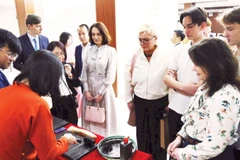
A visitor to the exhibition (Photo: VNA)

Colours of Friendship: Hanoi welcomes Vietnam-RoK artistic encounter

The harmonious mingling of works by artists from both nations conjures a multi-layered, dynamic space where distinct visual languages intersect with shared emotional depth, aesthetic thinking and creative spirit. The result is a rich and refreshing visual experience.

Artists take part in a parade at the Hanoi Creative Design Festival 2024. (Photo the HFCD organiser)

'Creative Meetup' programme takes place in Hanoi

The 'Creative Meetup' programme in Hanoi showcases initiatives from the creative community across eight cultural industry sectors, celebrating creativity and innovative solutions within the creative community.

A student from Nguyen Du Lao-Vietnamese bilingual school participates in a story-telling competition in Vietnamese with the theme "Vinh Moc Tunnel - Quang Tri, where life is immortal" (Photo: VNA)

Culture expected to remain pillar of Vietnam’s sustainable development: ethnologist

Ha noted that the upcoming congress is also expected to improve institutions and infrastructure for cultural industries, intellectual property and the creative economy sector. These fields are not only drivers of identity-based economic growth but also key tools for strengthening soft power and projecting the national image in an increasingly interconnected world.