(Source: VNA)
VNA
(Source: VNA)





According to the Hanoi Department of Health, the city has 4,776 educational institutions with more than 2.2 million preschool and school students. The health campaign will run from August 18 to September 4, targeting 100% coverage before the new school year begins.

The healthcare sector has undergone significant transformation in recent years to realise the Politburo’s Resolution No. 72-NQ/TW on breakthrough solutions to improve healthcare delivery and public health.
The two-day forum features high-level policy discussions and dialogues between State management agencies and the business community, as well as international experiences from Malaysia, China, and other partners.

According to the Hanoi Centre for Disease Control (CDC), 316 dengue cases were recorded across 74 communes and wards in the city from August 7-14, up 81 from the previous week. Eleven new outbreaks were also reported, bringing the total number since the beginning of 2026 to 63, with 24 still active.
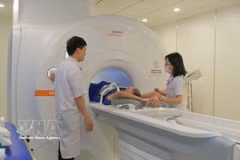
Medical tourists to Vietnam currently mainly comprise overseas Vietnamese and visitors from Cambodia, Laos, the Republic of Korea, Japan, Australia and several European countries. Popular services include cosmetic dentistry, assisted reproduction, aesthetic medicine, general health check-ups and some advanced medical specialties.
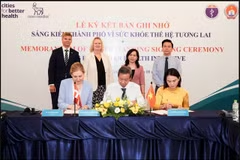
Ho Chi Minh City’s participation in the global Cities for Better Health network marks a step forward in implementing its Action Plan through 2030, with a focus on tackling overweight and obesity, particularly among school-age children.
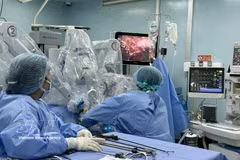
Associate Prof., Dr Tran Vinh Hung, Director of Binh Dan Hospital, said the hospital became Vietnam’s first medical facility to perform robotic surgery on adults in late 2016, marking a major milestone for the country’s surgical sector.
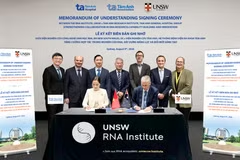
The two sides aim to pursue joint investment, research, scientific publications, and the development of advanced biomedical products, leveraging the strengths of both research institutes and the two countries.
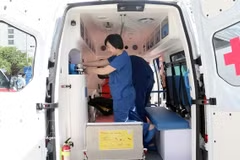
From 2027, the national pre-hospital emergency management platform will be put into operation, connecting data with the 113, 114 and 115 emergency call systems to facilitate rapid emergency dispatch and improve public access to emergency services.

With robot-assisted surgery costing tens of thousands of dollars in the US and Singapore, a growing number of international patients are traveling to Vietnam for robotic cancer surgery, including procedures for prostate, gynecological and gastrointestinal cancers, using the US made da Vinci Xi system at costs starting from just 3,000 USD.
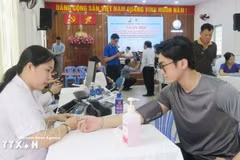
According to the municipal Department of Health, while several localities have achieved coverage rates of more than 60%, some others still have rates below 5%, highlighting considerable disparities in programme implementation.

Officials cut the ribbon on a Vietnam–China cross-border training and exchange centre for infectious disease control, along with a Guangxi facility dedicated to disease surveillance and prevention training.

Under the traditional model, patients must come to specialists. Under the multipolar model, specialist expertise will be brought closer to where people live.

Breast cancer is currently the most common cancer among Vietnamese women, with more than 24,560 new cases diagnosed each year and around 10,000 deaths annually.

Experts emphasised that obesity treatment requires multidisciplinary coordination, targeting not only weight loss but also comprehensive health management.
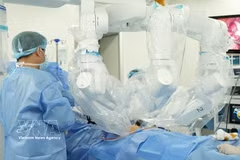
The network links Vinmec Smart City Hospital in Hanoi and Vinmec Can Tho Hospital. Unlike previous standalone remote robotic procedures, the new model allows either establishment to take turns serving as the command centre, creating an interconnected surgical network rather than relying on a single control hub.

Under the new model, healthcare is organised into interconnected levels based on people's needs rather than administrative boundaries. Patients can move seamlessly between levels while their electronic health records and treatment information remain connected through digital platforms, referral systems, telemedicine, electronic medical records, and integrated health databases.
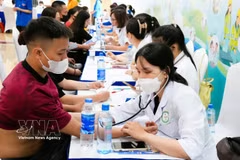
A draft circular guiding the implementation of the National Target Programme on Health Care, Population and Development (2026-2035) marks a shift from focusing solely on elderly care to encouraging healthy and independent ageing through early preparation. It covers healthy lifestyles, regular health check-ups, financial planning, suitable employment and home-based elderly care skills.

The Da Nang Oncology Hospital has successfully treated a patient with non-small cell lung cancer (NSCLC) carrying both EGFR and ALK gene mutations simultaneously – an exceptionally rare condition in both medical literature and clinical practice.
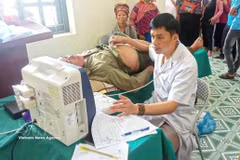
Aiming to ensure all citizens can access quality healthcare close to home, detect diseases earlier and improve quality of life amid rapid population aging, cities and provinces are adopting reforms to enhance healthcare capacity.