Hanoi (VNA) – European Literature Days 2026 will return from May 5 to 15 with a diverse programme of literary exchanges, creative workshops and public reading events, reaffirming its role as an important bridge bringing literature closer to the public.
One of the highlights of this year's festival, themed “The Distance between Us: Loneliness & Solidarity in European Literature,” will see renowned Vietnamese artists joining European authors for public readings and discussions with audiences at a series of "reading stations," bringing literature into the heart of urban life.
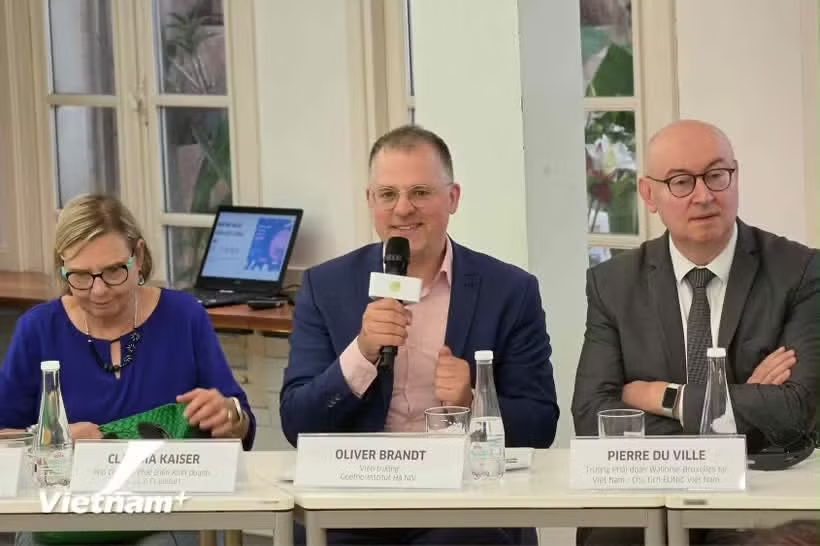
Speaking at a press briefing on May 6, Oliver Brandt, Director of the Goethe-Institut Hanoi, said loneliness has become one of the defining themes of contemporary European literature because it reflects the realities of modern life.
As technology permeates every aspect of daily life and traditional social bonds become increasingly fragile, loneliness has evolved from an individual experience into a broader social phenomenon, he said. At the same time, solidarity and the desire for human connection remain powerful driving forces that literature continues to nurture.
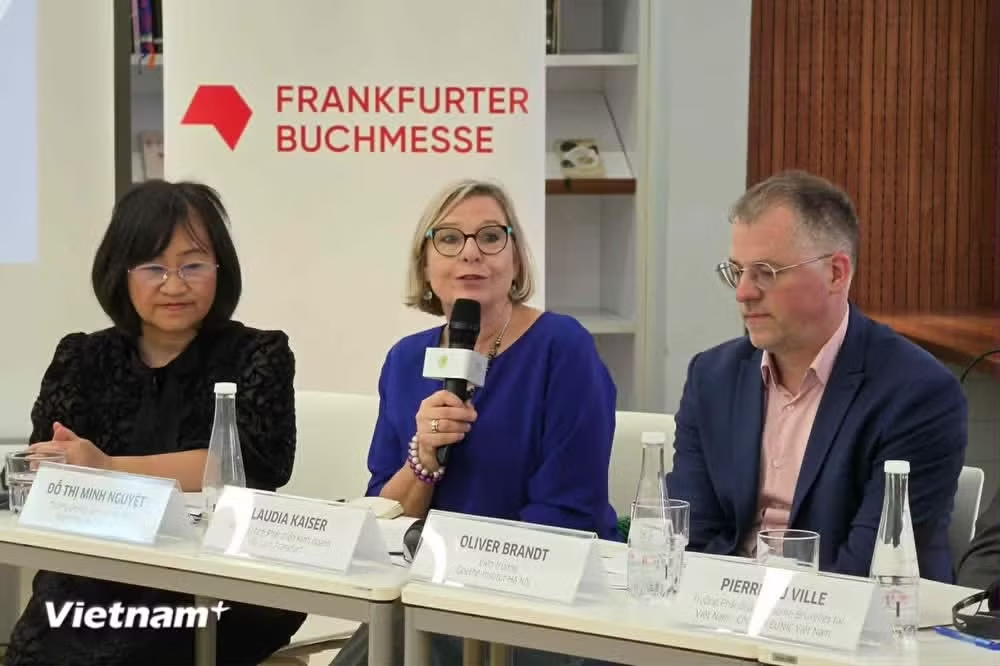
Pierre Du Ville, Head of the Wallonia-Brussels delegation, said that while reading is often viewed as a solitary activity, it is fundamentally an intimate dialogue between readers and authors.
At a time when young people spend much of their lives online, promoting reading culture offers a meaningful way to foster empathy, mutual understanding and genuine human connection, rather than allowing individuals to become isolated in the virtual world, he said.
This year's festival will bring together several of Europe's leading contemporary writers for discussions with Vietnamese audiences.
Among the featured guests are German playwright and novelist Sasha Marianna Salzmann and novelist Miku Sophie Kühmel, whose works explore identity, history and intimacy. British author Rebecca Watson will introduce readers to her innovative fiction examining emotional vulnerability and fractured relationships. Austrian writer Peter Simon Altmann will share reflections on loneliness and displacement shaped by years of living between Europe and East Asia, while French novelist Thibault Clemenceau offers perspectives rooted in travel, intercultural encounters and cross-continental connections.
The programme will be held in Hanoi, Hue and Ho Chi Minh City, featuring four major panel discussions alongside creative writing and playwriting workshops designed to engage students and emerging Vietnamese writers.
The organisers will also introduce new experiential formats, including an evening literary walk through Hanoi combining guided city tours with live readings at different urban locations. The initiative seeks to move literature beyond conventional venues and encourage audiences to experience literary works within the city's living cultural landscape.
The programme will feature renowned Vietnamese artists, including People's Artist Nhu Quynh, actress Tu Oanh, flautist Le Thu Huong, and singer Giang Trang.
Another highlight will be the inauguration of Hanoi's first Poesiomat, an outdoor audio poetry installation donated by the Czech Centre Hanoi to the Complex 01 creative hub on May 12. Marking the project's debut in Southeast Asia, the installation will feature 20 exclusive recordings, including the sounds of Hanoi alongside a traditional Czech folk melody./.
First launched in 2011, European Literature Days has grown into one of Vietnam's leading annual literary events and an important forum for artistic dialogue between Europe and Vietnam. Organised by EUNIC (European Union National Institutes for Culture) Vietnam, the programme reflects a shared commitment to cultural exchange, mutual understanding and artistic cooperation. This year's edition also marks Ukraine's first participation in the festival, further enriching its international dimension.
The event would spur Vietnam's cultural development strategy under Resolution No. 80 and Resolution No. 59 on international integration in the new context by promoting cultural exchange and people-to-people connections through literature.