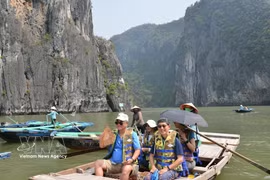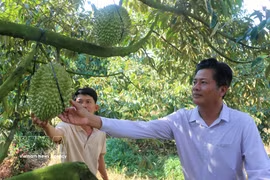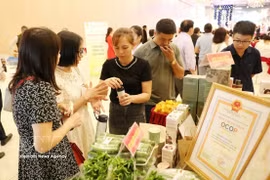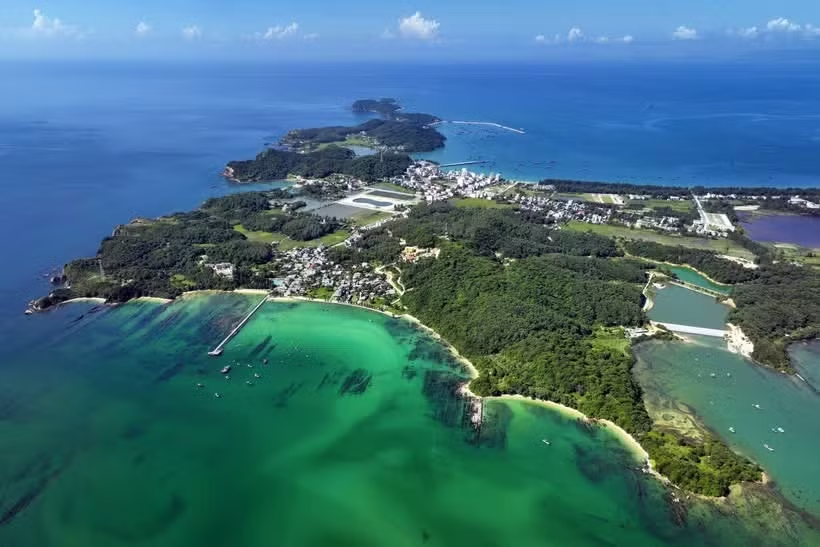
Quang Ninh (VNA) – Welcoming around 300,000 visitors a year, Co To’s tourism industry is a major source of revenue and a key driver of local socio-economic growth. To support this economic spearhead, the Co To special zone, Quang Ninh city, is promoting green, clean and sustainable production, linking agricultural activities with resource conservation, environmental protection and landscape preservation.
Agricultural production in Co To is undergoing a major shift towards greener models, with a focus on quality, added value, greater application of science and technology, and processing.
Fishing remains an important livelihood, with boats typically returning to port from 3am. Le Ba Tung, chairman of the Co To Fisheries Trade Union, said the local fleet of around 190 vessels has been equipped with modern fishing gear, lighting buoys and advanced fish-finding technology.
More importantly, fishermen have shifted towards catching higher-value seafood and improving post-harvest preservation rather than maximising catches, helping maintain freshness, secure better prices and protect natural marine resources.
Co To harvests around 6,000 tonnes of seafood a year on average. More than 5,200 tonnes have been caught since the beginning of 2026, mainly squid, shrimp and fish. Co To squid commands significantly higher prices than the market average thanks to its quality and fishing methods, particularly line fishing and traps that keep the catch alive until it reaches shore.
To increase the value of seafood, more local processing facilities have invested in cold storage systems, including advanced equipment capable of deep-freezing products within eight minutes.
Nguyen Thi Lan, an owner of a seafood processing establishment in the Co To special zone’s Chien Thang hamlet, said modern cold storage helps preserve products almost intact, making them easier to store and use.
In addition to seafood, local agriculture is embracing low-emission rice cultivation, managed grazing for large livestock and the raising of pig and poultry breeds suited to the local climate. Feed mixtures increasingly incorporate agricultural by-products such as cassava, vegetables, distillers’ grains and small fish.
Tran Thi Hoai, Vice Chairwoman of the Co To Farmers’ Association, said these models might yield less than industrial farming and require more time and labour, but they deliver better-quality products at higher prices while ensuring the sustainable development, thus contributing to protecting the environment and maintaing a green, clean landscape in line with the direction set by Co To.
The pilot “Green Fields – Clean Air” model in Nam Hai neighbourhood has also attracted active participation from farmers, who are reducing chemical fertiliser and pesticide use in favour of manual weed control and organic fertilisers. Many fields have also been attractively landscaped and fitted with signs promoting emission reductions in agricultural production, creating appealing photo spots for visitors while raising awareness of and encouraging action to protect the environment in the locality.
Co To authorities is planning to expand the model across the special zone, while continuing to encourage and facilitate the development of green agriculture models as a means of developing a high-value, sustainable sector that complements tourism./.