Hanoi strengthens Hanta virus surveillance following international alerts

CDC Hanoi was instructed to strengthen health monitoring of passengers entering and transiting through Noi Bai International Airport to detect suspected cases early and ensure timely isolation and handling at the point of entry.

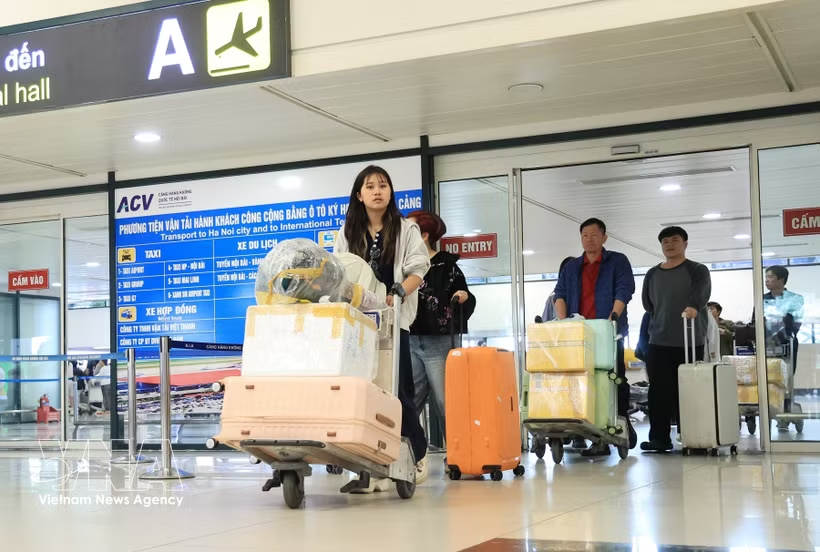
CDC Hanoi is instructed to strengthen health monitoring of passengers entering and transiting through Noi Bai International Airport to detect suspected cases early and ensure timely isolation and handling at the point of entry (Illustrative photo: VNA)

Hanoi (VNA) – The Hanoi Department of Health has ordered stronger surveillance and prevention measures against Hanta virus disease following warnings from the Ministry of Health (MoH) over recent international cases.

Under an urgent dispatch issued by the MoH’s Administration of Disease Prevention on May 5, the municipal Health Department asked the Hanoi Centre for Disease Control (CDC Hanoi) to closely monitor global developments and promptly advise on appropriate response measures.

CDC Hanoi was instructed to strengthen health monitoring of passengers entering and transiting through Noi Bai International Airport to detect suspected cases early and ensure timely isolation and handling at the point of entry.

The centre was also tasked with enhancing inspection and quarantine activities for vehicles and goods to identify potential carriers of Hanta virus pathogens while continuing rodent monitoring and control at entry points in line with ministry guidelines. In addition, CDC Hanoi was asked to organise training for infectious disease control staff and medical quarantine officers in prevention measures and the use of personal protective equipment.

The health authorities also requested public and private hospitals across the city to review and prepare medicines, chemicals, biological products and medical supplies for diagnosis and treatment in case infections are detected.

Hospitals were urged to strengthen patient admission, early diagnosis, isolation and intensive treatment to minimise severe complications and fatalities, while strictly implementing infection prevention measures for patients and caregivers.

Medical facilities detecting confirmed or suspected Hanta virus cases must immediately notify CDC Hanoi or local health stations to coordinate response activities.

Meanwhile, the People's Committees of communes and wards should direct local health stations to strengthen disease surveillance to promptly detect and isolate suspected cases, conduct treatment and implement containment measures to prevent community spread.

Local authorities were also requested to coordinate with medical facilities in conducting epidemiological investigations and collecting test samples from patients with severe acute respiratory infections of unknown causes or symptoms such as fever, haemorrhage and kidney failure suspected to be linked to Hanta virus infection.

vnanet-tau-du-lich.jpg
The cruise ship MV Hondius docks at the Port of Granadilla in Tenerife, Canary Islands, Spain, on May 10, 2026. (Photo: AA/VNA)

According to the World Health Organisation (WHO), from April 1 to May 4, a cluster of severe acute respiratory infections was recorded on a cruise ship travelling from Argentina through the South Atlantic region.

As of May 4, seven cases had been identified, including two confirmed Hanta virus infections and five suspected cases. The outbreak resulted in three deaths, one critically ill patient and three mild cases. The vessel carried 147 people, including 88 passengers and 59 crew members from 23 countries. No Vietnamese nationals were reported among those affected.

Hanta virus disease is an acute infectious disease transmitted from rodents, particularly rats, to humans through contaminated food, rodent bites, contact with infected rodent waste or inhalation of virus-containing dust. Human-to-human transmission is extremely rare but has previously been reported in outbreaks involving the Andes virus strain in South America.

The incubation period ranges from two to four weeks and may extend to eight weeks. Symptoms include fever, chills, headache, muscle pain, nausea and diarrhoea, which can later progress to coughing, breathing difficulties, low blood pressure and respiratory failure.

There is currently no specific treatment for Hanta virus disease, with care mainly focusing on monitoring, supportive treatment and intensive care./.

VNA

See more

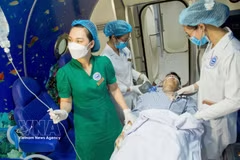
Mr. Gilberto recovered well after treatment at Hong Ngoc General Hospital.

US veteran calls Vietnamese doctors “heroes” after life-saving treatment

After being assisted on a medically supported flight back to the United States for continued treatment, Gilberto’s health condition showed positive improvement. From afar, he later sent a heartfelt video message expressing gratitude to the medical team at Hong Ngoc General Hospital, the people he called “heroes.”

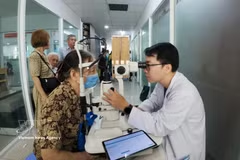
Residents in Hanoi's Bach Mai ward receive free health check-ups. (Photo: VNA)

Vietnam moves toward universal free annual health checkups from 2026

Every Vietnamese citizen from 2026 onward will be entitled to at least one free annual medical checkup or screening. Each individual will also have a digital health record integrated into the national digital identification platform VNeID, enabling authorities and healthcare providers to manage health data in a synchronised and continuous manner.

Ho Chi Minh City's digital citizen application (Photo: nld.com.vn)

Ho Chi Minh City rolls out electronic health records on digital citizen app

Under the plan, each resident will be assigned a unique EHR linked to their personal identification number, ensuring accuracy and consistency while minimising duplication and data discrepancies. Health data will be continuously updated from medical facilities, routine check-ups, and screening programmes, then integrated and centrally displayed on the application.

At the Government’s regular press briefing (Photo: VNA)

Hospital duo on track for Q2 opening as roadblocks vanish

The Health Ministry has worked in lockstep with the Ministry of Construction to clear cost-appraisal and contract-approval bottlenecks, with the process now flowing smoothly. It has also teamed up with the construction and defence ministries to press contractors to accelerate outstanding licensing requirements, including fire safety and waste treatment systems.

A kidney transplant performed at the Hue Central Hospital. (Photo published by VNA)

Six lives extended through single organ donation

When one heart stops beating so that others may live on, it represents not only a medical transfer but also a continuation of compassion and humanity, said Professor Dr Pham Nhu Hiep, Director of the Hue Central Hospital.

Doctors at the University Medical Center Ho Chi Minh City perform colorectal cancer surgery on the Indonesian patient. (Photo: published by VNA)

Indonesian patient travels to Vietnam for colorectal cancer surgery

The successful colorectal cancer surgery for an Indonesian patient once again demonstrates the advances in the professional expertise of Vietnamese doctors and has further strengthened the country’s medical reputation and the trust of patients across the region and beyond.

Illustrative photo (Photo: VNA)

Vietnam intensifies efforts to end malaria by 2030

In 2025, the country reported 246 cases with no deaths, down more than 30% year-on-year. In the first months of 2026, only 25 cases were recorded, again with no fatalities. So far, 26 out of 34 provinces and cities have been officially recognised as malaria-free.

Illustrative image -(Source: Internet)

Vietnam warns of HiPP baby food after Austria’s recall

The Austrian Agency for Health and Food Safety (AGES) has announced that HiPP – a German-Swiss baby food producer – and supermarket chain SPAR had recalled all 190g-jars of HiPP Vegetable Carrot with Potato from 1,500 stores in Austria due to suspected contamination with rat poison.

The caregivers’ club in Coc village, Pu Luong commune, the north-central province of Thanh Hoa, has established a livelihood support fund, helping households develop their economies through models such as rice cultivation, vegetable growing, fish farming and poultry raising. (Photo: VNA)

Community-based child nutrition care model benefits Thanh Hoa’s locality

After more than one year of implementation with the support of World Vision, the model has delivered positive outcomes in improving nutrition and enhancing the quality of childcare. Household livelihoods have improved, mothers’ awareness and caregiving skills have been strengthened, and notably, the rate of child malnutrition in Coc has declined markedly.

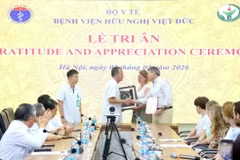
Assoc. Prof. Dr. Duong Duc Hung, Director of Viet Duc University Hospital, presents a token of appreciation in recognition of the noble gesture of the organ donor’s family. (Photo: baochinhphu.vn)

British teen’s organ donation saves three Vietnamese lives

A 19-year-old British tourist who died during a trip to Vietnam has saved the lives of three Vietnamese patients with end-stage organ failure, in a deeply moving act of compassion. The young woman is the first foreign national to donate organs in Vietnam.