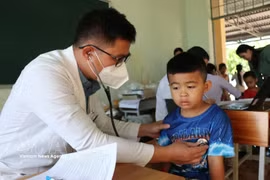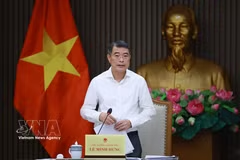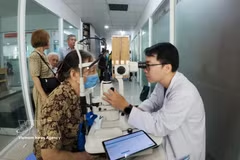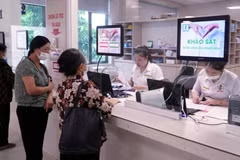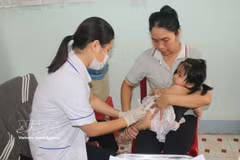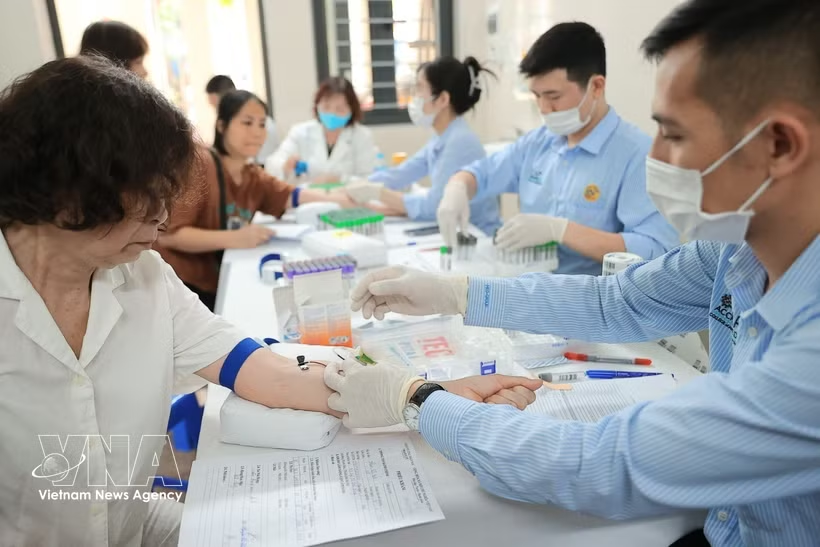
Hanoi (VNA) – Prime Minister Le Minh Hung has issued a new directive aimed at transforming Vietnam’s healthcare system from a treatment-centred model to one focused on prevention, early detection and lifelong health management, with all citizens set to receive at least one free annual health checkup or screening starting 2026.
Issued on May 6, Directive No. 17/CT-TTg outlines a nationwide plan to provide free periodic health examinations and screenings for the public, while establishing electronic health records to support continuous healthcare management throughout a person’s life cycle.
The initiative implements the goals set out in Resolution No. 72-NQ/TW adopted by the Politburo in September 2025, which calls for breakthrough measures to improve public health protection and healthcare services. The resolution emphasises the need for a fundamental shift in healthcare thinking – from prioritising treatment to promoting proactive disease prevention and comprehensive health monitoring.
Under the resolution, every citizen from 2026 onward will be entitled to at least one free annual medical checkup or screening. Each individual will also have a digital health record integrated into the national digital identification platform VNeID, enabling authorities and healthcare providers to manage health data in a synchronised and continuous manner. To ensure effective nationwide rollout, the Prime Minister instructed ministries, sectors and local authorities to treat the programme as a key and enduring political task closely linked to socio-economic development and social security goals.
Provincial and municipal authorities were urged to accelerate preparations so that by the end of 2026, all residents will have access to free health checkups or screenings and have electronic health records issued.
The directive also calls for the mobilisation of the entire political system at the grassroots level, highlighting the role and responsibility of local administrations, Party organisations and relevant agencies in coordinating implementation efforts.
Public communication campaigns will be expanded to encourage citizens to adopt the habit of periodic health examination and early disease screening, thereby fostering greater public awareness of preventive healthcare.
The Ministry of Health was assigned to lead the programme nationwide, issue detailed guidelines on organising free health checkups and screenings, and develop unified standards for health data integration and interoperability with the social insurance database system.
Authorities were instructed to complete the establishment of a synchronised electronic health record system by May 2026. The digital records will be linked with VNeID to facilitate healthcare management and identity verification during medical examinations.
At the same time, the health ministry was tasked with strengthening grassroots healthcare and preventive medicine systems by improving human resources, medical equipment and pharmaceutical supplies, and organising training programmes for healthcare workers participating in the initiative.
The Ministry of Public Security will coordinate the use of the national population database and electronic identification systems to support the management of electronic health records and ensure secure verification of citizens’ information. The ministry was also tasked with safeguarding cybersecurity and protecting personal health data during the collection, storage and sharing of medical information.
Meanwhile, the Ministry of Education and Training will work with localities and healthcare institutions to organise free periodic health examinations for students nationwide from the beginning of the 2026–2027 academic year.
The Ministry of Finance will allocate funding from the state budget and coordinate with relevant agencies to ensure efficient and lawful use of financial resources. The ministry will also oversee the synchronisation of health screening data with social insurance databases and related digital platforms.
Special attention will be given to vulnerable and disadvantaged groups, including the elderly, people with disabilities, low-income households, ethnic minority communities, residents in mountainous and remote areas, and people suffering from chronic diseases./.
See more
US veteran calls Vietnamese doctors “heroes” after life-saving treatment.
After being assisted on a medically supported flight back to the United States for continued treatment, Gilberto’s health condition showed positive improvement. From afar, he later sent a heartfelt video message expressing gratitude to the medical team at Hong Ngoc General Hospital, the people he called “heroes.”
Vietnam to host Asia-Pacific dental congress, set to draw over 5,000 delegates
According to the World Health Organisation, oral diseases affect around 3.5 billion people globally, making them the most prevalent non-communicable conditions. In Vietnam, over 90% of the population has experienced oral health problems to varying degrees.
Hospital duo on track for Q2 opening as roadblocks vanish
The Health Ministry has worked in lockstep with the Ministry of Construction to clear cost-appraisal and contract-approval bottlenecks, with the process now flowing smoothly. It has also teamed up with the construction and defence ministries to press contractors to accelerate outstanding licensing requirements, including fire safety and waste treatment systems.
Six lives extended through single organ donation
When one heart stops beating so that others may live on, it represents not only a medical transfer but also a continuation of compassion and humanity, said Professor Dr Pham Nhu Hiep, Director of the Hue Central Hospital.
Indonesian patient travels to Vietnam for colorectal cancer surgery
The successful colorectal cancer surgery for an Indonesian patient once again demonstrates the advances in the professional expertise of Vietnamese doctors and has further strengthened the country’s medical reputation and the trust of patients across the region and beyond.
Vietnam to join clinical trials of mRNA cancer vaccines
Vietnam is expected to collaborate with international partners, including Russia and France, in conducting clinical trials for new-generation vaccines, particularly those using mRNA technology for cancer treatment.
Vietnam intensifies efforts to end malaria by 2030
In 2025, the country reported 246 cases with no deaths, down more than 30% year-on-year. In the first months of 2026, only 25 cases were recorded, again with no fatalities. So far, 26 out of 34 provinces and cities have been officially recognised as malaria-free.
Vietnam warns of HiPP baby food after Austria’s recall
The Austrian Agency for Health and Food Safety (AGES) has announced that HiPP – a German-Swiss baby food producer – and supermarket chain SPAR had recalled all 190g-jars of HiPP Vegetable Carrot with Potato from 1,500 stores in Austria due to suspected contamination with rat poison.
Hai Phong advances specialised health care for coastal, insular communities
Hai Phong authorities consistently recognise the role of central-level healthcare institutions, including VINIMAM, which plays a particularly important role in providing health care for fishermen and residents in coastal and insular areas.
Community-based child nutrition care model benefits Thanh Hoa’s locality
After more than one year of implementation with the support of World Vision, the model has delivered positive outcomes in improving nutrition and enhancing the quality of childcare. Household livelihoods have improved, mothers’ awareness and caregiving skills have been strengthened, and notably, the rate of child malnutrition in Coc has declined markedly.
Second campuses of Bach Mai, Viet Duc hospitals must open in Q2: PM
Regarding the second campuses of Bach Mai and Viet Duc hospitals, the PM pointed out that the remaining hurdles are largely coordination-related and fall within the purview of the Ministry of Health (MoH) and relevant ministries.
Ho Chi Minh City ready to provide mass health checkups for over 15 million residents
The initiative is designed to bring multi-specialty healthcare closer to communities, with an emphasis on vulnerable and high-risk groups, including the elderly, those with chronic conditions, and disadvantaged populations, enabling early detection and sustained health management.
Hue hospital performs successful bone marrow transplants for three children
With 2,000–2,500 severe thalassemia cases diagnosed each year in Vietnam, expanded access to stem cell transplantation is opening up new prospects for patients to lead healthier, more independent lives.
Cashless payment navigates Vietnam’s hospitals
From the cash-only days, plenty of hospitals have made a fast switch to modern payment options like QR code scans, bank cards, e-wallets, and payments straight through healthcare apps.
Vietnam eyes silver economy to fuel growth amid rapid aging
The silver economy offers a new perspective on population ageing: instead of treating it as a burden, it is seen as a major economic opportunity
British teen’s organ donation saves three Vietnamese lives
A 19-year-old British tourist who died during a trip to Vietnam has saved the lives of three Vietnamese patients with end-stage organ failure, in a deeply moving act of compassion. The young woman is the first foreign national to donate organs in Vietnam.
Bayer, Long Chau join force to advance stroke prevention and management at National Health Day 2026
Bayer Vietnam, in strategic partnership with FPT Long Chau Pharmacy Chain and Vaccination Centre, took part in the 2026 National Health Day event at Thong Nhat Park in Hanoi on April 5, joinning a wide range of stakeholders in advancing public health awareness and preventive care across the country.
Vietnam backs global One Health commitments at Lyon summit
The MAE welcomed the French Government’s organisation of the One Health Summit, describing it as an important forum to advance global political commitments and strengthen international cooperation in preventing zoonotic diseases.
Vietnam emerges as “One Health” frontrunner in disease control
A France-based expert has described Vietnam's “One Health Partnership” as a notable and distinctive platform with strong potential for replication elsewhere.
Maternal, child healthcare remains cornerstone of Vietnam’s sustainable development
Child healthcare is both a humanitarian priority and a long-term investment in population quality and human resources. Early interventions in maternal care, nutrition, immunisation, and neonatal services play a decisive role in shaping physical and intellectual development.