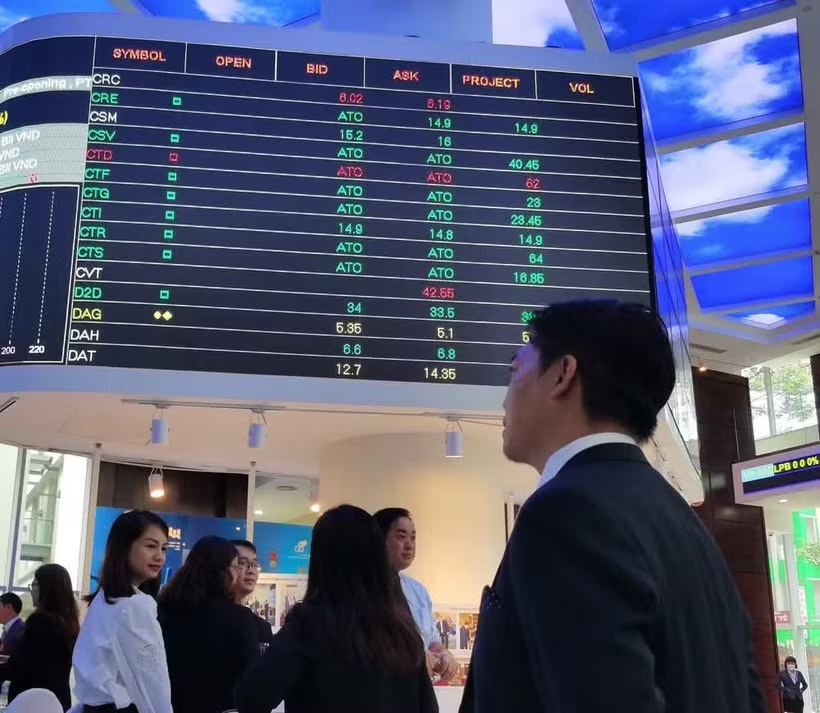
Hanoi (VNA) – Vietnam’s elevation to emerging market status by FTSE Russell in October 2025 marked a watershed moment for the country’s financial market, reflecting years of sustained reform and deepening engagement with international investors.
However, the milestone also ushers in a critical transition period requiring careful policy execution and system readiness.
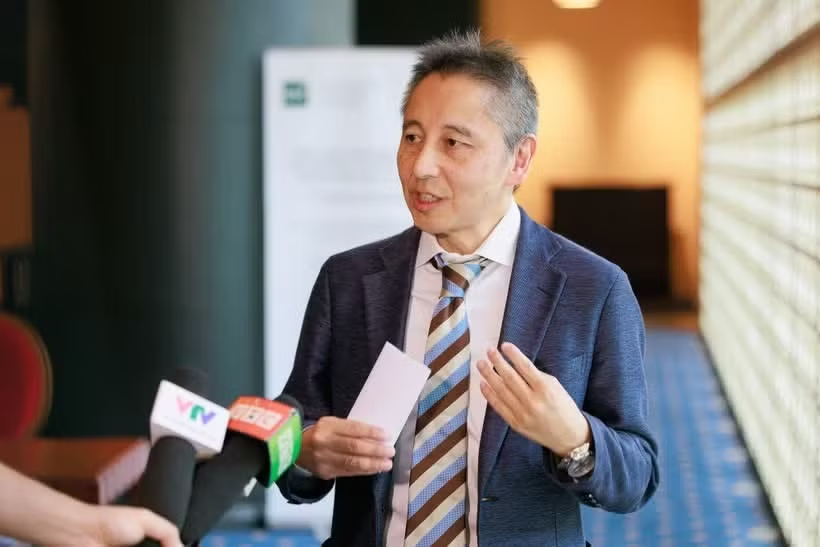
In an interview with VietnamPlus, Kojima Kazunobu, a consultant with the Japan International Cooperation Agency (JICA) from the Daiwa Group Research Institute, offered an in-depth assessment of the forces behind the upgrade and the strategic priorities ahead.
Trust built through sustained dialogue
Reporter: Looking back at Vietnam’s journey from a frontier to an emerging market, what do you consider the most decisive breakthrough?
Mr. Kojima Kazunobu: If I were to capture Vietnam’s breakthrough in one sentence, it would be “trust through dialogue.”
The key shift was not a single regulatory adjustment, but a long-term reform process coupled with increasingly transparent and consistent communication with the global investment community. Reports and public statements from FTSE Russell have repeatedly highlighted improvements in market accessibility, alongside the willingness of Vietnamese regulators to listen and respond to investor concerns.
In this process, the Ministry of Finance and the State Securities Commission played a central role. They maintained close and continuous engagement with FTSE Russell through working sessions, technical discussions and regular updates on reform progress to international stakeholders.
This sustained and constructive exchange helped build confidence that reforms were not only announced, but also properly understood, implemented and monitored. For global investors, that level of credibility and consistency often carries as much weight as the technical substance of individual policy changes.
Reporter: With the mid-term review scheduled for March 2026 and foreign capital expected to flow into indices by September, what should Vietnam prioritise to avoid technical risks?
Mr. Kojima Kazunobu: Transition periods in financial markets are typically the most sensitive in terms of operational risk. At this stage, ensuring smooth and stable system performance must be the top priority.
Whenever new systems or settlement mechanisms are introduced, comprehensive testing, clearly defined procedures, and strong coordination among all stakeholders—including regulators, stock exchanges, clearing and settlement institutions, and market participants - are essential. Even the most advanced systems require time for users to adapt.
Equally important is maintaining close communication with market participants and promptly incorporating practical feedback. Stability does not depend solely on technical capacity, but also on how effectively the system is operated in real-world conditions. A cautious and well-coordinated approach will help minimise risks during this critical transition.
Advancing ESG standards and corporate governance
Reporter: Emerging market status brings higher expectations for transparency and governance. What support is JICA providing to help Vietnamese firms meet ESG standards?
Mr. Kojima Kazunobu: Improving the quality of listed companies has been a consistent focus across JICA’s technical cooperation programmes.
During the previous phase (2019–2023), a key initiative centred on enhancing disclosure practices and investor relations. Notably, a two-day online training programme attracted participation from around 600 listed companies in Vietnam.
Building on that foundation, the current phase (April 2024 - March 2027) places stronger emphasis on sustainability-related disclosures and corporate governance.
JICA experts have been involved in discussions on revising Circular 96/2020 and promoting alignment with international standards such as those developed by the International Sustainability Standards Board (ISSB). At the same time, Japan’s Sustainability Standards Board (SSBJ) is being studied as a reference model, given its compatibility with global frameworks while reflecting practical governance experience.
In addition, we are exploring the potential application of substantive listing assessment mechanisms at stock exchanges. This approach, widely used in international markets, evaluates factors such as disclosure capacity, governance effectiveness and the protection of shareholder rights. It is considered an important tool for improving listing quality and strengthening investor protection over the long term.
Reporter: Beyond the upgrade, what strategic priorities should guide Vietnam’s stock market development towards 2030?
Mr. Kojima Kazunobu: The recent upgrade should be viewed as the beginning of a new phase rather than the end of the reform journey.
The fundamental challenge ahead is to develop the stock market into a robust channel for mobilising medium- and long-term capital in support of sustainable economic growth.
While I am not in a position to comment on or decide on future Japan International Cooperation Agency projects beyond the current framework, from my perspective as chief advisor of the ongoing technical assistance programme, my priority is to contribute to the implementation of Vietnam’s stock market development strategy through 2030.
Key priorities include developing the primary market, particularly improving IPO and listing practices in line with international standards, enhancing the quality and governance of listed companies, and expanding the investment fund market. Encouraging greater participation by retail investors through fund-based investment vehicles is also crucial. Strengthening these pillars will help channel long-term savings into productive investments more effectively.
Regarding the linkage between Vietnam’s and Japan’s capital markets, deeper integration is likely to develop gradually through closer alignment with market practices, disclosure standards and investor protection frameworks, rather than through isolated initiatives. As Vietnam’s market continues to mature and meet international standards, opportunities will expand organically over time for Japanese investors and financial institutions to engage more actively.
Reporter: Thank you for your insights!./.