Malaysia introduces new work-from-home policy

The Public Service Department (PSD) of Malaysia announced that the Cabinet has approved the Hybrid Working Day (HWD) as a new norm in the civil service.

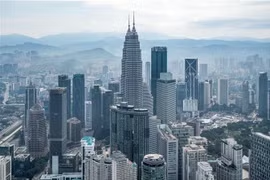
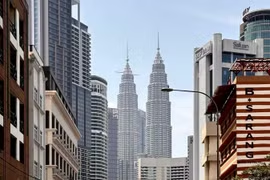
A street in Malaysia - Illustrative image (Photo: VNA)

Kuala Lumpur (VNA) - Civil servants of Malaysia will spend two days working from home or an approved location and three days in the office under a new hybrid working arrangement which will be effective from August 1.

The Public Service Department (PSD) of Malaysia on June 26 announced that the Cabinet has approved the Hybrid Working Day (HWD) as a new norm in the civil service.

Attendance will be aligned with each state’s weekly rest day. Where Sunday is the day off, staff must report in on Monday and Friday. In Kedah, Kelantan and Terengganu, where Friday is the rest day, the mandatory office days will be Sunday and Thursday.

The PSD said it will introduce a monitoring system to ensure integrity, work efficiency, and the highest standards of public service delivery. Work-from-home and remote working arrangements will be approved and implemented according to operational requirements.

It added that the new system will become the new normal for federal civil servants, replacing the previous work arrangement.

The PSD said HWD forms part of a wider public service reform agenda, aimed at modernising work culture through digital tools and performance monitoring.

It stressed that the change will not disrupt essential services. Counters will remain open, and frontline sectors, including security, defence, education, health and the judiciary, will continue to operate as usual./.

VNA

See more

Indonesian-branded cosmetic and personal care products at a supermarket. (Photo: VNA)

Indonesia launches summer shopping campaign

According to the Indonesia Ministry of Tourism, the BINA (Shopping in Indonesia Movement) Holiday & Back to School 2026 programme involves 800 brands, approximately 80,000 outlets, and 414 shopping centres across 24 provinces. It aims to boost domestic consumption and tourist trips throughout the school break.

A fuel station in the Philippines. The Philippine economy expanded 2.8% in the first quarter, down from 3% in the previous quarter, weighed down by higher oil prices linked to the Middle East conflict and weaker public spending. (Photo: Xinhua/VNA)

Philippines to accelerate infrastructure spending to boost economic growth

Infrastructure spending has fallen sharply as government agencies, particularly the Department of Public Works and Highways (DPWH), adopted a more cautious approach to budget disbursement following an investigation into alleged irregularities involving multi-billion-PHP flood control projects.

Visitors to a pagoda in Bangkok, Thailand (Photo: Xinhua/VNA)

Thailand develops luxury rail services to boost tourism

Thailand’s Ministry of Transport is advancing plans to upgrade the country’s railway and tourism sectors by developing world-class luxury train services, leveraging newly enacted railway legislation to attract private investment and stimulate local economic growth.

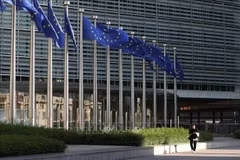
At the European Commission headquarters in Brussels. (Photo: Xinhua/VNA)

Thailand pushes to expedite FTA negotiations with EU

The discussions centred on advancing the Thailand – EU FTA, addressing sensitive agricultural issues and sanitary and phytosanitary (SPS) measures, while laying the groundwork for a long-term strategic economic partnership amid global economic volatility.

Malaysia strengthens aerospace supply chain connectivity

Malaysia strengthens aerospace supply chain connectivity

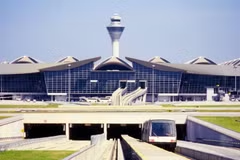
To further support industry expansion, Malaysia has established dedicated aerospace parks such as Subang Aerotech Park, KLIA Aeropolis and Serendah Park, providing ready-built infrastructure designed to streamline operations, strengthen supply chains and reduce logistics costs for investors.

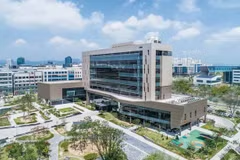
The Korea Internet & Security Agency (KISA) in Naju, South Jeolla province, the Republic of Korea. (Photo courtesy of KISA)

RoK to help Philippines strengthen cybersecurity capabilities

KISA said on June 24 that it has been selected as the implementing agency for the Korea International Cooperation Agency (KOICA)'s "project to establish a national cyber security centre to strengthen the Philippines' cyber crisis response capabilities" and will launch the project.

Thailand holds policy interest rate at 1%

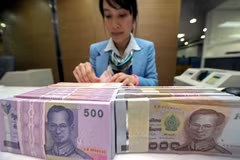
Thailand holds policy interest rate at 1%

MPC Secretary Don Nakornthab said the Monetary Policy Committee considers the current policy rate appropriate to support the country's economic recovery. While Thailand's economic outlook has improved compared to previous forecasts, growth is expected to remain moderate and uneven, he noted.