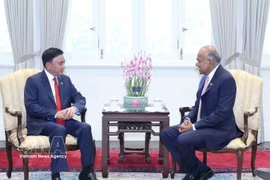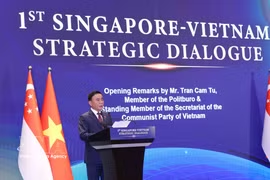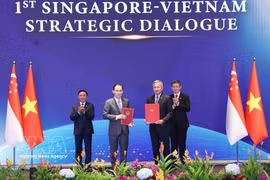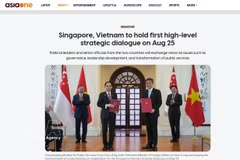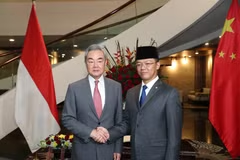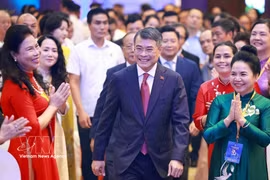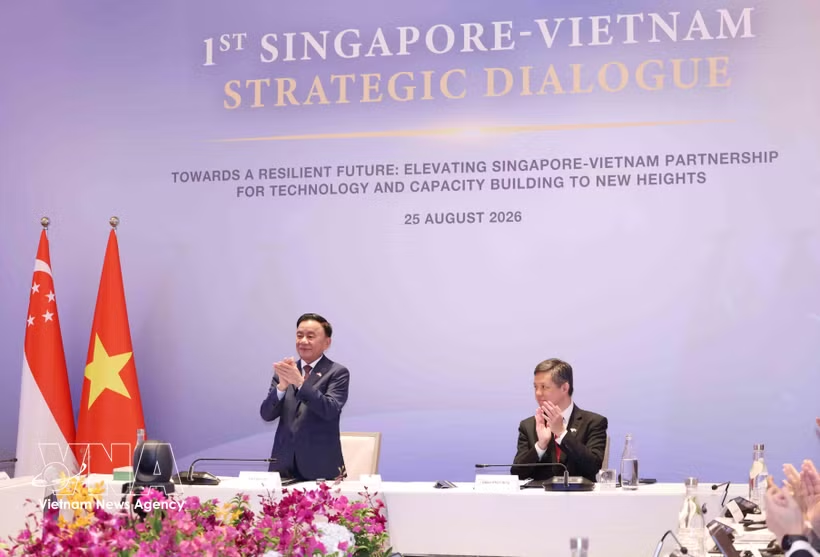
Singapore (VNA) – Major Singaporean media outlets on August 24-25 gave extensive coverage to the official visit to Singapore by Politburo member, Standing member of the Secretariat of the Communist Party of Vietnam (CPV) Central Committee Tran Cam Tu and the first Singapore-Vietnam Strategic Dialogue.
The Straits Times highlighted the two countries’ agreement to deepen leadership exchanges and expand technology cooperation, reached within the framework of the dialogue on August 25. The two sides also issued a Joint Statement on Vietnam-Singapore Technology Connectivity Strategy.
Singaporean Coordinating Minister for Public Services and Minister for Defence Chan Chun Sing, who co-chaired the dialogue with the Vietnamese leader, said the two nations established the new high-level forum because strong bilateral relations have provided the foundations for the South-east Asian neighbours to look ahead together.
He said Singapore and Vietnam share a warm and longstanding friendship because successive generations of leaders invested in strengthening ties and building mutual trust. Both sides want the next generation of their leaders to also build relationships, and the new platform is where they can exchange perspectives on emerging challenges and identify areas where they can work together, the minister added.
The dialogue was established during General Secretary of the Communist Party of Vietnam Central Committee and President To Lam’s state visit to Singapore in May 2026, and followed the elevation of bilateral ties to a Comprehensive Strategic Partnership in 2025.
Addressing the dialogue, Chan said Singapore’s view is that the quality and capability of governments will increasingly distinguish successful nations from the rest.
This is as countries now operate in a more complex environment where many of the conditions that have helped their economies to grow are weakening, while the boundaries between economic policy, technology policy, and national security are blurring.
Aspirations within societies are also becoming more diverse, while the emergence of artificial intelligence and other technologies offers both tremendous opportunities and also creates new risks and divides, he added.
The city-state’s approach is to invest deliberately in leadership as a strategic national capability, and to place considerable emphasis on identifying and developing leaders with the integrity, judgment and instinct to consider the long-term interests of the country, said Chan.
Singapore also seeks to develop “pi-shaped” leaders that have the depth and expertise in one or two sectors, but also sufficient breadth to understand issues across sectors, work across organisational boundaries and connect different perspectives.
“This is increasingly important because many of the challenges governments face today do not fit neatly within a single ministry,” he noted. “Good outcomes depend not only on having strong individuals with deep expertise, but also having officers who can marshal resources and collaborate across government.”
For his part, Tu said Vietnam is interested in learning from Singapore’s experience in building a modern public administration and effective national governance, as well as in identifying and developing leaders with the vision and capacity to meet the country’s development needs in the new era.
Vietnam also seeks to develop a pool of potential leaders and managers, particularly those already identified for leadership positions and promising young graduates, he said.
On technology cooperation, Tu called on the two sides to bring together the State, scientific community and businesses to move ideas towards commercialisation. The goal is not only to attract investment and technology transfers, but also to jointly research, develop and master technologies and build innovative products and ecosystems that serve both countries’ development and contribute to the region.
Meanwhile, in its article titled “Government quality, capability set successful nations apart in a contested world: Chan Chun Sing”, Channel NewsAsia (CNA) focused on Chan’s remarks at the dialogue.
The quality and capability of government will increasingly distinguish successful nations from the rest amid a weakening rules-based international order and rising geopolitical competition, Chan said as quoted by CNA.
With intensifying geopolitical competition, the boundaries between economic policy, technology policy and national security are blurring. Supply chains and investment decisions are also being shaped by strategic and security considerations, beyond commercial ones, he said.
For Singapore and Vietnam, as small, open and trade-dependent economies, strong institutions and effective governance are becoming increasingly important, CNA reported.
AsiaOne, meanwhile, highlighted Chan’s emphasis on government quality, institutional capacity and public trust. Strong institutions help countries anticipate change and adapt to external shocks, while policy consistency, regulatory effectiveness and public-service quality affect economic competitiveness and businesses’ long-term investment decisions.
The Singaporean minister also said public trust enables governments to build consensus, mobilise society and undertake difficult reforms whose benefits may only become apparent years later, according to the news portal.
On technology, Chan said leaders do not necessarily need to be technology experts but should have sufficient understanding and judgment to identify opportunities, assess risks and make informed decisions on technology deployment. Singapore and Vietnam can also work together on common approaches and greater interoperability to facilitate cross-border data flows and support digital economic integration.
Rounding up his opening remarks, Chan said both Singapore and Vietnam recognise that in an increasingly uncertain world, long-term success depends on regional stability and cooperation, capable governments, and good investments in innovation and technology./.
VNA