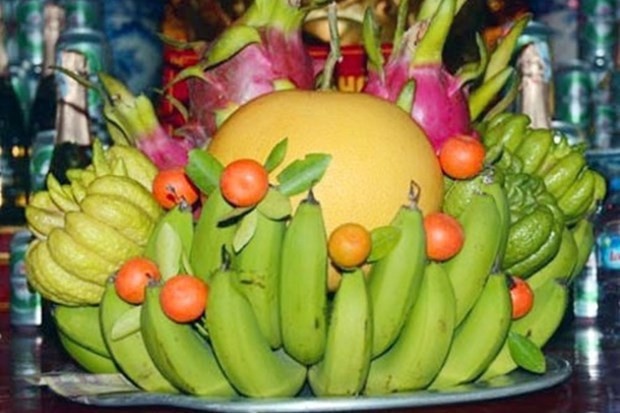
Tet fruit tray, indispensible part of Vietnamese culture

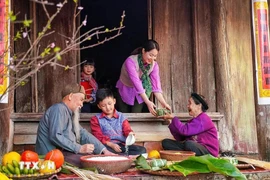
A “Mam Ngu Qua” or five-fruit tray is indispensable for each Vietnamese family as among the numerous offerings that are required to decorate ancestral altars during the traditional Lunar New Year (Tet) festival.

Five-fruit tray is indispensable for each Vietnamese family to decorate ancestral altars during the traditional Lunar New Year (Tet) festival. (Photo: VNA)

Hanoi (VNA) – A “Mam Ngu Qua” or five-fruit tray is indispensable for each Vietnamese family as among the numerous offerings that are required to decorate ancestral altars during the traditional Lunar New Year (Tet) festival.

The tray symbolises the wholeheartedness and gratitude of the present generation towards their ancestors and the Genie of the Land during Tet.

Like other popular rituals, the preparation of a five‑fruit tray for Tet has become an established convention.

During the few days just before Tet, the Vietnamese begin to buy the necessary fruits for this purpose.

A five‑fruit tray is usually composed of a hand of green bananas, a ripe pomelo (or a Buddha's hand, a shaddock), oranges, persimmons, sapodilla plums, a bunch of kumquat, and in recent years, one can add mangoes and grapes from southern Vietnam, or apples and pears from China. Although it is called a five‑fruit tray, it does not necessarily contain exactly five kinds of fruit.

Arranging fruits on the crimson, hourglass‑shaped wooden tray is really an art. One has to combine the colours and shapes of the different fruits in arranging them on the tray to make it look like a still life picture.

To ensure balance on the tray, the hand of bananas is usually put in the middle with the bananas pointing upright and the pomelo on the concave surface of the hand of bananas. Then the oranges, sapodilla plums, apples are added in the gaps between the bananas and the pomelo.

The last little gaps are filled in with little kumquats to create a full, compact tray of fruits.

In colours, the fruit‑tray presents a harmonious combination of the different colours of fruits: dark green of banana, light yellow of pomelo, deep red of persimmon, reddish yellow of orange and kumquat, light green of apple, and dark brown of sapodilla plum. To complete the picture, the fruit tray will be covered here and there with some small, fresh leaves of kumquat.

The five-fruit tray, together with horizontal lacquered boards engraved with Chinese characters, parallel sentences written on red paper, ornamental kumquat and peach trees, and popular Hang Trong and Dong Ho pictures, has transcended its material value to become a spiritual symbol, an original national product in the spiritual life of the Vietnamese.

At present, while many of the ancient spiritual values have sunk into oblivion, the custom of arranging the five‑fruit tray on the altar during the lunar New Year days is being jealously preserved as a fine legacy of Vietnam's traditional culture.

The “Mam Ngu Qua” in Tet festival represent the quintessence that Heaven and Earth bless humans. This is one of the general perceptions of life of the Vietnamese, which is “An qua nho ke trong cay” (When taking fruit, you should think of the grower)./.

VNA

See more

The statue of Vietnam's King Ly Thai To ( (974 - 1028) in Bonghwa county (Photo: VNA)

RoK to develop K-Vietnam Valley project linked to Ly Dynasty heritage

With the designation in place, Bonghwa will carry out eight specialised projects worth a combined 347.6 billion KRW (245.1 million USD) from 2026 to 2030 – among them the K-Vietnam Valley itself, tourism development around Changpyeong Reservoir, rental smart farms, and a Baekdudaegan healing ‘pet village.’

The organising committee presents awards to outstanding martial artists at the festival. (Photo: VNA)

9th Int’l Festival of Vietnamese Traditional Martial Arts wraps up

The ninth International Festival of Vietnamese Traditional Martial Arts has fostered the martial spirit, strengthened national pride, promoted cultural exchanges and reinforced the aspiration to bring Vietnamese traditional martial arts to a wider international audience.

An appetising bowl of My Quang features a rich combination of ingredients. (Photo: VNA)

Da Nang to host festival honouring Quang Nam-style noodle soup

My Quang is not only a signature dish of the Quang region but also reflects the history, culture and daily life of communities in central Vietnam. With its diverse ingredients, preparation methods and distinctive flavours, the noodle soup has become one of Vietnam's best-known culinary specialities, helping strengthen Da Nang's position on the culinary tourism map.

Hanoi’s traditional silk weaving craft continues to be preserved and developed today. (Photo: VNA)

Van Phuc silk weaving village officially recognised as Hanoi tourist destination

With its millennia-old heritage and growing integration of preservation and innovation, Van Phuc silk weaving village is poised to become a distinctive cultural destination, helping promote Hanoi’s sustainable cultural tourism and bring the quintessence of Vietnamese silk weaving closer to domestic and international visitors.

Minister of Construction Tran Hong Minh speaks at the session (Photo: VNA)

Lawmakers mull over changes to architecture law

On architectural management, the draft Law amending and supplementing several articles of the Law on Architecture clarifies the concept of “national cultural identity in architecture”, tying design to the preservation and promotion of regional heritage. It pushes architecture that mirrors local identity and fits each locality’s natural, historical and social conditions, while setting criteria to identify, assess and protect architecturally valuable buildings as a distinct form of cultural heritage.

The top 14 contestants of Top Chef Vietnam 2026. (Photo: vtv.vn)

Top Chef Vietnam returns with mission to elevate Vietnamese cuisine globally

Vietnam currently ranks 16th among the world's top 100 cuisines in the latest TasteAtlas rankings, up three places from 2024 and six from 2023. Meanwhile, Travel + Leisure has described Vietnamese cuisine as "exceptional" and listed Vietnam among the leading destinations for travellers seeking cultural experiences through food.

Organisers, sponsors and officials pose for a commemorative photo at the launch ceremony. (Photo: VNA)

Halong Bay Heritage Marathon 2026 expected to attract 18,000 runners

Competitors will race in the 42.195 km marathon, 21.0975 km half marathon, 10 km and 5 km events. Starting and finishing at the Quang Ninh Planning, Fair and Exhibition Palace, the course will once again feature fully closed roads along Ha Long Bay, a route named by Runner's World UK among the world's 50 most scenic running courses.