Top Vietnamese leader’s address at UNGA 81 reflects global technology landscape: US expert

US technology expert David Ho said the top Vietnamese leader’s assessment of opportunities and challenges in science and technology, innovation, digital transformation and artificial intelligence (AI) is in line with global trends.

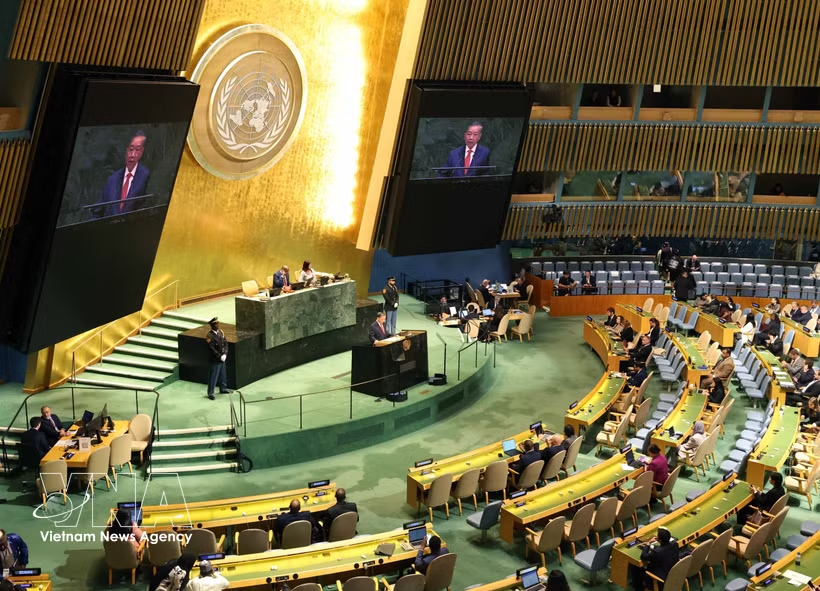
General Secretary of the Communist Party of Vietnam Central Committee and President To Lam delivers a speech at the High-Level General Debate of the 81st Session of the United Nations General Assembly in the US (Photo: VNA)

Washington D.C (VNA) – US technology expert David Ho said General Secretary of the Communist Party of Vietnam Central Committee and President To Lam’s address at the High-Level General Debate of the 81st Session of the United Nations General Assembly in the US accurately reflected the global technology landscape.

Talking to Vietnam News Agency correspondents in the US, Ho, Chief Scientific Officer, Founder and President at HeMemics Biotechnologies Inc., said the top Vietnamese leader’s assessment of opportunities and challenges in science and technology, innovation, digital transformation and artificial intelligence (AI) is in line with global trends.

According to Ho, breakthroughs in AI and digital transformation require a corresponding hardware foundation. While economies such as the Republic of Korea, Japan and Taiwan (China) are investing heavily in AI and hardware manufacturing, particularly traditional silicon chips, the physical limits of existing technologies are approaching.

He said this presents an opportunity for Vietnam to enter at the most fundamental level by mastering chips and technology at the molecular level. Mastering 2D materials such as graphene, he said, could provide a foundation for next-generation science and enable Vietnam to make a “leap” towards a leading position in next-generation microchips and energy.

However, only a small group of countries, including the US, Japan, the RoK and Spain, can currently produce graphene, he noted, urging Vietnam to move quickly to master the technology to avoid dependence on major powers in the era of green energy and smart healthcare.

The US expert described General Secretary and President Lam’s call for inclusive, safe, transparent and responsible technology governance, while respecting national and digital sovereignty and the right to development autonomy, as a highly strategic vision.
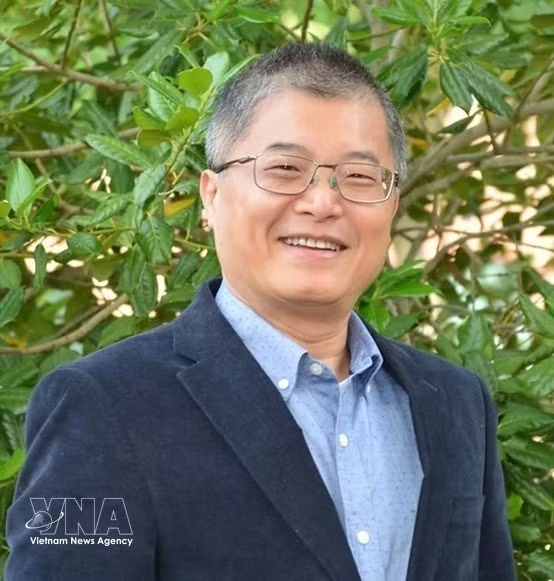
vnanet-ho.jpg
David Ho, Chief Scientific Officer, Founder and President at HeMemics Biotechnologies Inc., (Photo: VNA)

He stressed that digital sovereignty and development autonomy depend on mastering the physical foundations of technology, noting that control of 2D materials such as graphene could give Vietnam a unique strategic position by unlocking new areas of innovation at the molecular level.

A country that masters graphene technology will have a decisive voice in global technology governance, as it controls a critical material for energy security, including batteries and solar power, as well as healthcare security through biosensors, he said.

Ho suggested Vietnam establish regulatory sandboxes and breakthrough incentives to attract companies such as HeMemics to bring core technologies to the country, helping strengthen technological autonomy and enable Vietnam to have a greater role in shaping international rules.

To realise General Secretary and President Lam’s vision and reduce the risk of dependence, Vietnam should not merely import technology but become a place where its technological foundations are produced, Ho said, suggesting Vietnam make use of the global trend of “friend-shoring” – shifting core technology supply chains to trusted partner countries.

The expert highlighted the need for Vietnam to prioritise three main policy areas – establishing sandbox mechanisms and special incentives for deep-tech and advanced-material projects such as graphene; providing co-financing or infrastructure support, including land and administrative procedures, to build research and development (R&D) ecosystems around high-tech manufacturing plants; and linking national policies with strategic investment funds of partner governments such as the US to attract capital for hardware infrastructure manufacturing rather than focusing solely on software.

He also underlined the importance of bringing advanced core technologies to Vietnam, scale up production and create economic value, noting that mastering the production of core materials for global industries could reduce the country’s dependence on foreign technology.

Ho said Vietnam-US cooperation could create opportunities in emerging technologies, particularly AI, new materials, biotechnology and energy. He described cooperation in new technologies as being at a “historic golden moment”, driven by US policies to reduce reliance on risky supply chains and promote “friend-shoring”.

Regarding the global graphene market, Ho said most graphene remains in raw, low-quality forms unsuitable for high-tech applications such as next-generation AI chips, advanced biosensors and high-performance batteries. He viewed this as a strategic gap that Vietnam and the US could jointly address.

According to the expert, HeMemics has been working directly with the US International Development Finance Corporation (DFC), which has shown strong interest in financing and supporting the company in building a graphene manufacturing plant in Khanh Hoa province.

The project aims to bring high-tech manufacturing technology to Vietnam to produce high-purity graphene at a commercially viable breakthrough price, providing Vietnam, the US, and partner countries with a stable supply of high-quality 2D materials for advanced products and R&D activities./.
VNA

See more

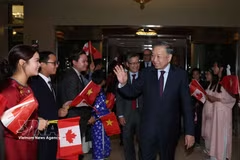
Vietnamese Embassy officials and staff, and representatives of the Vietnamese community in Canada welcome General Secretary of the Communist Party of Vietnam Central Committee and President To Lam. Photo: VNA

Top leader begins state visit to Canada

The state visit by Party General Secretary and President To Lam to Canada will generate strong political momentum. It aims to foster an increasingly substantive, balanced, and effective Vietnam-Canada relationship, in line with the potential, strengths, and needs of both nations.

General Secretary of the Communist Party of Vietnam Central Committee and President To Lam (R) receives President and Chief Operating Officer of SpaceX Gwynne Shotwell in New York on September 23 afternoon (local time). (Photo: VNA)

General Secretary and President To Lam receives leaders of major US corporations

General Secretary of the Communist Party of Vietnam Central Committee and President To Lam met with representatives of several US corporation in New York on September 23 afternoon (local time), as part of his trip to the US to attend the high-level general debate of the 81st session of the United Nations General Assembly and conduct bilateral activities.

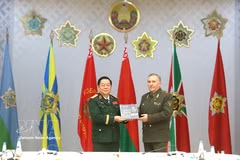
General Nguyen Trong Nghia, Director of the General Department of Politics of the Vietnam People's Army, presents a gift to Lieutenant General Viktor Khrenin, Belarusian Minister of Defence, in Minsk on September 23, 2026. (Photo: VNA)

Vietnam, Belarus strengthen defence cooperation

Belarus always considers Vietnam one of its priorities in its foreign policy towards the Asia-Pacific region and wishes to continue consolidating and developing bilateral ties, while promoting and further deepening defence cooperation in the spirit of the traditional friendship and multifaceted collaboration between the two countries.

Delegates attend a reception marking the 96th National Day of Saudi Arabia (Photo: VNA)

Vietnam, Saudi Arabia poised to elevate bilateral ties: Deputy FM

Nearly three decades since the establishment of diplomatic relations, friendship and cooperation between Vietnam and Saudi Arabia have grown increasingly strong and dynamic, based on mutual respect, understanding and a shared aspiration for peace and prosperity.

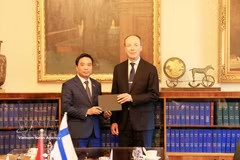
National Assembly (NA) Vice President Nguyen Doan Anh (L) meets with Finnish Parliament Speaker Jussi Halla-aho. (Photo: VNA)

New impetus for Vietnam–Finland Strategic Partnership

National Assembly Vice President Nguyen Doan Anh proposed Vietnam and Finland enhance cooperation in science and technology, innovation, digital transformation, green and circular economies, as well as economic, trade and investment ties, high technology, artificial intelligence, semiconductors, 5G/6G, renewable energy, education and high-quality human resources development.

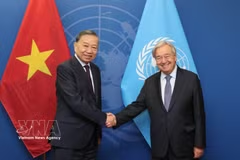
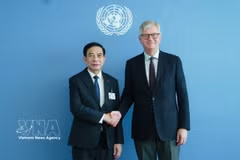
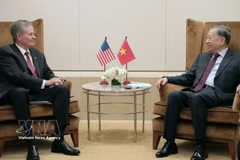
General Secretary of the Communist Party of Vietnam Central Committee and President To Lam (L) meets with United Nations Secretary-General Antonio Guterres at the UN headquarters on September 23. (Photo: VNA)

General Secretary and President To Lam meets UN Secretary-General Antonio Guterres

Appreciating Vietnam’s active and pioneering engagement in security, political affairs, sustainable development and a just energy transition, Secretary-General Guterres expressed his hope that Vietnam will continue to play a strong role in the world’s transformation, contribute to efforts to address climate change under the Just Energy Transition Partnership (JETP), and promote emerging technologies, including artificial intelligence (AI).

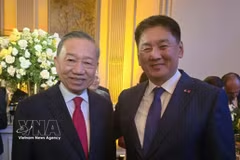
General Secretary of the Communist Party of Vietnam Central Committee and President To Lam (L) meets with Mongolian President Ukhnaagiin Khürelsükh in New York. (Photo: VNA)

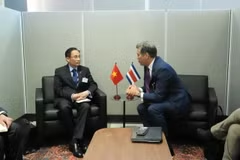
Top leaders of Vietnam and Mongolia meet on sidelines of UNGA 81

General Secretary and President Lam affirmed that the Party, State, and people of Vietnam highly value and stand ready to engage in close, comprehensive, and extensive cooperation with Mongolia across all sectors in line with the Vietnam-Mongolia Comprehensive Partnership framework, with a particular focus on economy, trade, investment, and cultural and people-to-people exchanges.

President of the National Assembly Tran Thanh Man speaks at the event. (Photo: VNA)

National Assembly Standing Committee reviews draft data security law

The draft Draft Law on Data Security adopts a lifecycle approach and proposes managing data security risks related to the digital economy, digital infrastructure, investment, technology transfer, artificial intelligence (AI), emerging technologies, supply chains and cross-border data flows.

A delegation from the National Assembly's Committee on Culture and Social Affairs meets with France's Regulatory Authority for Audiovisual and Digital Communication (ARCOM). ( Photo: VNA)

Vietnam, France share experience in developing cultural industries

During meetings with agencies in charge of cultural enterprises and social media platform management under the French Ministry of Culture, the delegation from the National Assembly (NA)’s Committee on Cultural and Social Affairs learned about France's policies for developing cultural and creative industries, digital transformation and the application of artificial intelligence (AI) in culture, as well as measures to protect children online.

☕ Afternoon briefing on September 23

☕ Afternoon briefing on September 23

General Secretary and President To Lam's speech at the high-level general debate of the UNGA 81, his meetings with world leaders ont the sidelines of the event, and Level-2 Field Hospital Rotation 8's departure for the UN mission in South Sudan are among news highlights on September 23.