Vietnam can’t win high-tech investment on land alone: 2026 Autumn Economic Forum

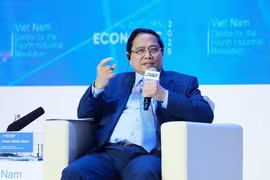
Bill Giannikos, Director of the Global Services Centre and Data Centre at Aurecon Vietnam, said data centre development has to be planned alongside land, power, telecoms and supporting services. Investors need clear information on land availability, power capacity, supply timelines and connectivity before committing to large projects.

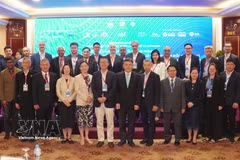
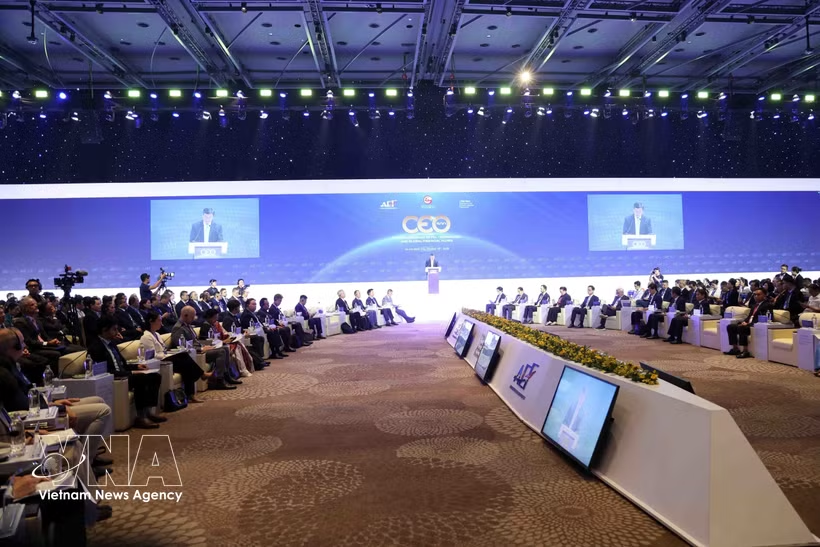
The CEO 500 programme takes place as part of the 2026 Autumn Economic Forum in Ho Chi Minh City on October 26. (Photo: VNA)

Ho Chi Minh City (VNA) – As Vietnam reworks its growth model around science – technology, innovation and productivity, it needs high-tech investment that adds value to the economy.

Land alone can’t attract tech projects

Vietnam has a major opportunity in the global digital shift as AI, cloud computing and digital services increasingly shape economic activity. Capturing it requires planning infrastructure as a whole rather than project by project, Bill Giannikos, Director of the Global Services Centre and Data Centre at Aurecon Vietnam, told the CEO 500 programme, themed “The Convergence of FDI, Technology and Global Financial Flows,” at the 2026 Autumn Economic Forum on October 26.

According to him, data centre development has to be planned alongside land, power, telecoms and supporting services. Investors need clear information on land availability, power capacity, supply timelines and connectivity before committing to large projects.

Giannikos pointed to Australia’s Victoria state, which coordinates land, energy and connectivity planning to build its digital ecosystem. He proposed that Vietnam, particularly Ho Chi Minh City, study creating dedicated zones for digital infrastructure, with essential requirements built into planning from the start.

Beyond infrastructure, he stressed linking computing capacity with universities, enterprises and the workforce to speed up AI adoption in manufacturing, logistics, health care, education and public services. Returns on investment therefore depend not only on data centre capacity, but on how the technology is adopted and the value it creates for the economy.

Infrastructure must also scale up and adapt to new technologies while taking into account energy and water efficiency and long-term resilience. That demands coordination among authorities, utilities, operators and technology suppliers from the planning stage.
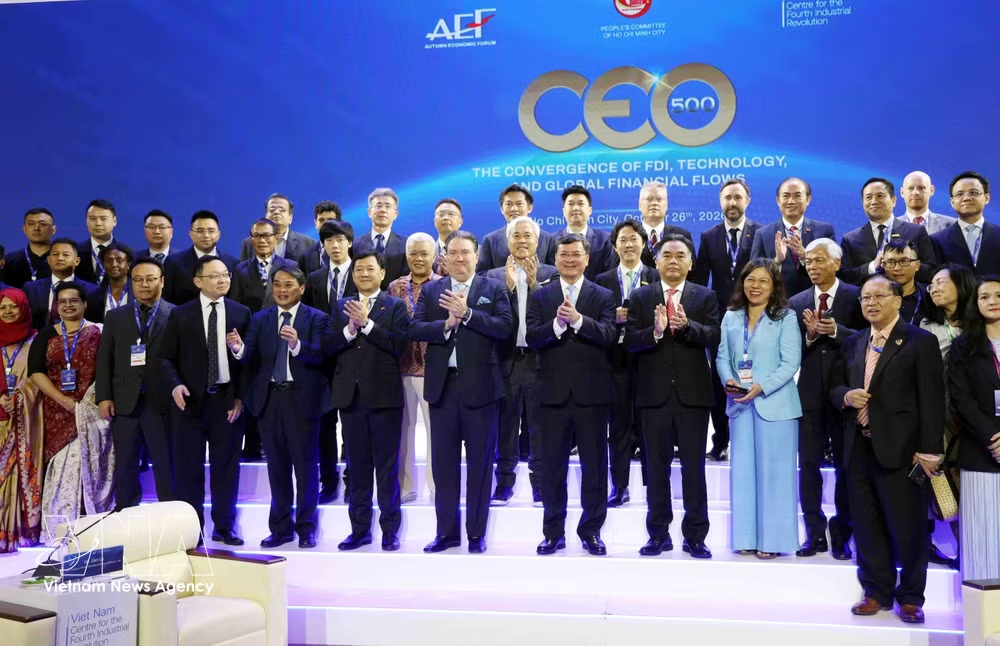
Ho Chi Minh City officials and attendees at the CEO 500 programme (Photo: VNA)

Ho Chi Minh City officials and attendees at the CEO 500 programme (Photo: VNA)

Nguyen The Duy, Vice Chairman of the Board of Directors and Deputy CEO of Becamex Group, said the larger development space after the merger gives Ho Chi Minh City a chance to build high-tech industrial hubs and modern urban areas.

According to Duy, a new generation of FDI investors is looking beyond land and factory space, paying attention also to connectivity infrastructure, technology access, workforce and an ecosystem of production support services. Becamex is developing next-generation industrial parks that are smart, eco-friendly and sustainable, linking production infrastructure with research, technology transfer, automation and workforce training.

Notably, Becamex aims to develop a science and technology urban area in northern Ho Chi Minh City into an integrated ecosystem of high-tech industry, research and development, innovation, training and modern urban living. The area is planned to connect to the city downtown via expressways, railways, metro lines and regional logistics networks.

To realise this vision, its representative proposed that the city continue building breakthrough mechanisms to foster an industrial and sci-tech ecosystem capable of attracting high-added-value FDI projects.

Clearing bottlenecks so technology adds value

Jesse Choi, General Director of Sunwah Southeast Asia, suggested that the city create conditions for firms to test technological solutions in real-world environments. The city could support pilot sites, develop technical standards and risk management mechanisms, and set out a roadmap for bringing qualified technologies into commercial application, he said.

Citing the AI use to optimise wastewater treatment as an example, Choi said the solution could cut operating costs by about 20–25%. Technologies such as drones and self-driving electric vehicles also have potential for use in logistics and urban services.

San Eng, Chairman of the Singapore-based WorkOptional.ai, said beyond data centres and computing power, the market is seeing growing demand for services that support AI agents capable of performing work in place of humans. This trend is driving demand for communication, transaction, payment, identity, authentication and risk management systems. These could become important components of digital economy infrastructure in the next phase.

He also said Vietnam has advantages in absorbing technology from many markets, developing domestic digital platforms and pooling a workforce capable of adapting to new technologies. In his view, the city should study developing infrastructure for an AI-agent economy, while tightening links between its Vietnam International Financial Centre and investors and technology companies.

Working sessions with partners in Vietnam before the 2027 first quarter to seek cooperation opportunities and develop technology and financial platforms in line with the AI economy trend are also needed, he said./.
VNA

See more

Vietnamese Ambassador to Mozambique Tran Thi Thu Thin (first, left) and Mozambique's Minister of Agriculture, Environment and Fisheries Roberto Mito Albino, along with other delegates, exchange views on measures to promote bilateral agricultural cooperation. (Photo: VNA)

Mozambique considers Vietnam a leading strategic partner in agricultural cooperation

A highlight of bilateral agricultural cooperation was the project on rice, soybean and vegetable production in central Mozambique during the 2013-2017 period. The project delivered tangible results, particularly by helping local farmers gain access to advanced farming techniques and high-quality crop varieties, thereby contributing to higher yields of key crops in the region.

Hanoi affirms role as core, growth pole of Capital region

Hanoi affirms role as core, growth pole of Capital region

Hanoi is facing a growing imperative to shift from development mindset limited by administrative boundaries toward one focused on regional spatial growth. Politburo’s Resolution No. 27-NQ/TW, issued on August 28, 2026, on regional development and the organisation of national development space for the new period, identifies the Hanoi metropolitan area as one of the country’s two major growth poles and urges stronger connections in infrastructure, economy, science and technology, and resources between the capital and localities.

At a coconut orchard in Dong Thap province (Photo: VNA)

Vietnam eyes APEC 2027 to push green farming, food security agenda

Hosting APEC 2027, Vietnam plans to work with the APEC Secretariat on a policy dialogue on rice-sector innovation, and a workshop on public-private partnerships for regenerative agriculture on the sidelines of the first APEC Senior Officials Meeting (SOM1). The events will give economies a platform to share lessons and practical experience in green, low-emission farming.

Various dishes made from Ca Mau crabs and shrimps. (Photo: VNA)

Ca Mau connects businesses to expand markets

The southernmost province of Ca Mau is stepping up trade promotion and business networking to expand markets for local products, turning its natural, economic and ecological advantages into drivers of rapid and sustainable growth in the Mekong Delta.

Aircraft of Vietnamese airlines at Noi Bai International Airport. (Photo: VNA)

Domestic airlines urged to resume, expand domestic air routes by year-end

Director of the Civil Aviation Authority of Vietnam (CAAV) suggested that airlines should identify routes to be resumed or newly launched, as well as existing routes on which flight frequencies could be increased. They should also outline implementation plans and timelines for the final months of 2026 and 2027, assess market demand, and evaluate fleet deployment options and operational sustainability.

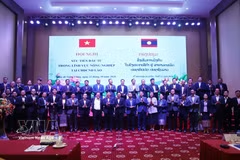
Delegates at the Vietnam-Laos agricultural investment promotion conference. (Photo: VNA)

Vietnam, Laos drive agricultural collaboration

Some 208 Vietnamese companies are investing in crops, forestry and livestock in Laos, with registered capital of about 1.4 billion USD. Authorities in both countries are also upgrading transport and energy infrastructure as they aim to lift bilateral trade to 10 billion USD by 2030, while pressing ahead with efforts to draw more investment.

(Illustrative photo: VNA)

Vietnam promotes adoption of GS1 standards

Vietnam is stepping up cooperation with GS1, the global organisation that develops and manages standards for product identification, barcodes and supply chain data, to help businesses improve efficiency and competitiveness in digital supply chains.

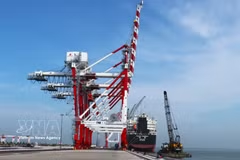
Long An International Port is identified as one of the sites supporting Tay Ninh’s plans to develop logistics hubs, helping leverage maritime transport advantages, facilitate trade connectivity and improve cargo circulation and distribution. (Photo: VNA)

Tay Ninh targets at least three logistics centres by 2030

The southern province of Tay Ninh aims to attract investment in at least three logistics centres, two wholesale markets and three to five shopping malls and supermarkets by 2030 as part of efforts to develop modern commercial infrastructure, improve goods circulation and capitalise on regional connectivity and international trade.

Participants pose for a photo at the 18th Annual Meeting of the Asia-Pacific Roundtable on Sustainable Consumption and Production (APRSCP). (Photo: VNA)

Science–industry links key to green transition: conference

The 18th Asia-Pacific Roundtable for Sustainable Consumption and Production (APRSCP) aims to turn sustainable production and consumption goals into practical, measurable and scalable solutions while strengthening cooperation among authorities, researchers, businesses and international partners.

Ben Thanh Station of Metro Line No. 2 (Ben Thanh–Tham Luong). (Photo published by VNA)

Ho Chi Minh City accelerates major infrastructure projects to boost growth

Expanded metro networks could encourage a shift towards public transport and transit-oriented development, with residential, commercial and service hubs emerging around stations. Meanwhile, the combined connectivity of Long Thanh and Tan Son Nhat airports could strengthen the city’s role as a regional aviation, financial and logistics centre.

Nghe An province attracts more than 108.27 trillion VND (4.18 billion USD) in investment in the first nine months of 2026, including around 2.49 billion USD in FDI – ranking sixth nationwide. (Illustrative photo: nhandan.vn)

Nghe An steps up efforts to attract high-quality FDI

Economic experts say that together with available cleared land, an abundant workforce and ongoing infrastructure and logistics projects, streamlined and faster administrative procedures will make the province more attractive to foreign investors.

A key traffic route connecting Da Nang city's downtown zone with new designed Free Trade Zone (Photo courtesy of Quoc Vuong)

Da Nang approves Free Trade Zone 7 investment plan

The Da Nang Special Economic Zone Authority (DSEZA) said the project, the last location of the 1,881ha Da Nang FTZ, would start construction from the fourth quarter of 2027 and begin full operation in 2032.

The 2026 Vietnam–China international trade fair opens in Vietnam’s Tuyen Quang province on October 24. (Photo: VNA)

Vietnam–China international trade fair opens in Tuyen Quang

This year’s fair features 300 booths across 10,000 square metres, including 250 Vietnamese booths and 50 run by Chinese partners. They showcase a wide range of products, including agricultural produce, food, medicinal herbs, consumer goods, machinery, equipment, and handicrafts.