Vietnamese leaders congratulate India on 80th Independence Day

General Secretary of the Communist Party of Vietnam Central Committee and President To Lam on August 15 sent a congratulatory message to Indian President Droupadi Murmu on the occasion of India’s 80th Independence Day.

Hanoi (VNA) - General Secretary of the Communist Party of Vietnam Central Committee and President To Lam on August 15 sent a congratulatory message to Indian President Droupadi Murmu on the occasion of India’s 80th Independence Day.

Prime Minister Le Minh Hung sent greetings to his Indian counterpart Narendra Modi, while National Assembly President Tran Thanh Man sent a congratulatory message to Lok Sabha Speaker Om Birla.

The same day, Minister of Foreign Affairs Le Hoai Trung sent a message of congratulations to his Indian counterpart Subrahmanyam Jaishankar./.

VNA

See more

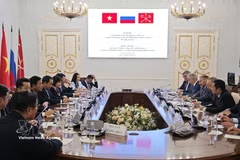
At atheworking session between the delegation and authorities of St. Petersburg. (Photo: VNA)

Hanoi seeks cooperation with Russian localities in developing urban railways

Russia has advanced technologies and expertise in transport, while Hanoi and Ho Chi Minh City - Vietnam's two special cities and economic locomotives - are prioritising the development of urban transport, urban railways and smart infrastructure, offering significant potential for expanded cooperation.

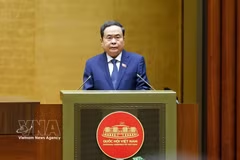
NA President Tran Thanh Man speaks at the opening session of the 16th NA's first extraordinary session. (Photo: VNA)

16th NA’s first extraordinary session seeks to create new development space

The first phase ended with a five-day break from August 14-18, during which relevant agencies will urgently review, explain, and revise draft laws and resolutions. The NA is scheduled to resume the second phase from August 19-24 to vote on the legislation, with the aim of removing bottlenecks, unlocking resources and creating fresh momentum for national development.

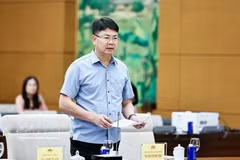
At the NA Standing Committee's session on August 4. (Photo: VNA)

National Assembly Standing Committee to look into 25 draft laws, resolutions

The committee will take up 25 draft laws and resolutions, including the revised Penal Code, the revised Law on Organisation of Criminal Investigation Agencies, and the review of the draft law amending Article 6 and Appendix IV on conditional business sectors and lines under the Law on Investment, among others.

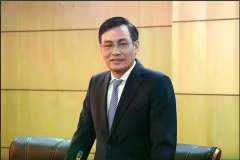
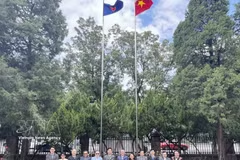
ASEAN ambassadors in Beijing and the Secretary-General of the ASEAN-China Centre pose for a group photo. (Photo:VNA)

Vietnam underscores ASEAN unity, centrality

Vietnamese Ambassador to China Pham Thanh Binh highlighted ASEAN’s ability to listen to one another, respect diversity, manage differences and build consensus as among the key lessons underpinning the bloc’s strength and enabling it to move forward together.

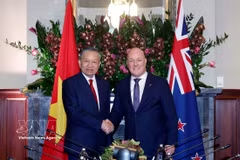
General Secretary of the Communist Party of Vietnam Central Committee and President To Lam (L) and New Zealand Prime Minister Christopher Luxon (Photo: VNA)

Top Vietnamese leader’s New Zealand visit draws media attention

Reports, articles and assessments published on August 12-13 highlighted that Vietnam-New Zealand relations are shifting strongly from high-level political commitments to concrete cooperation programmes, with a focus on trade, investment, education, agriculture, science and technology, defence and security, and climate change response.

☕ Afternoon briefing on August 13

☕ Afternoon briefing on August 13

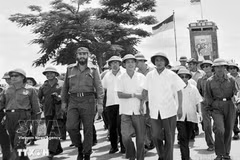
Activities during Party General Secretary and President To Lam's state visit to New Zealand, a ceremony marking the 100th birth anniversary of Cuban leader Fidel Castro in Quang Tri, and a series of expos opened at the Saigon Exhibition and Convention Centre are among news highlights on August 13.

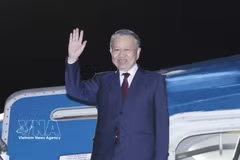
Party General Secretary and President To Lam leaves Auckland on August 13 evening (local time), concluding a state visit to New Zealand. (Photo: VNA)

Party General Secretary, President To Lam concludes state visit to New Zealand

At the meetings during the visit, the two sides agreed to further strengthen political trust and advance bilateral relations comprehensively by stepping up high-level and all-level exchanges through Party, State, parliamentary and people-to-people channels, thereby making more effective use of existing policy dialogue mechanisms.