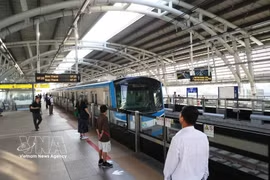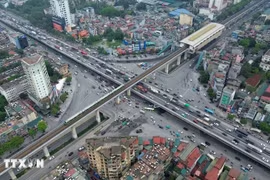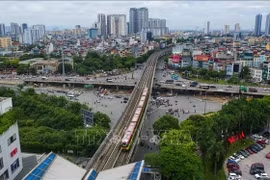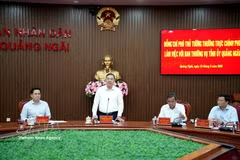
Moscow (VNA) - An inter-agency delegation led by Politburo member and Secretary of the Hanoi Party Committee Tran Duc Thang has held meetings with officials in Moscow and St. Petersburg to discuss railway and urban railway development and expand cooperation between Hanoi and Russian localities.
Thang met with Russian State Secretary and Deputy Minister of Transport Dmitry Zverev and leaders of Russian Railways (RZD) in Moscow on August 13, affirming that Vietnam always values the support and valuable experience of Russian partners in national construction and development.
He noted that Russia has advanced technologies and expertise in transport, while Hanoi and Ho Chi Minh City - Vietnam's two special cities and economic locomotives - are prioritising the development of urban transport, urban railways and smart infrastructure, offering significant potential for expanded cooperation.
Thang said that Hanoi has approved a 100-year master plan envisioning a smart city, underground space, and low- and high-altitude economy, while investing in urban railway lines and inter-regional transport links.
Against this backdrop, Hanoi hopes that Russia's Ministry of Transport and partners will share experience in policymaking and technical standards for urban railways and underground infrastructure, and support design, technology integration, training and technology transfer. The city also invited Russian businesses to explore investment in metro projects under Hanoi's transport development plan to 2030, with a vision to 2050.
Hanoi also proposed studying flexible investment models suited to local needs and conditions, while enhancing expert exchanges and sharing experience in metro construction, management and operation. The two sides were encouraged to explore the use of artificial intelligence (AI) and big data in traffic management and regulation to help ease congestion.
Hanoi is also interested in designing underground structures and stations as architectural landmarks reflecting the city's cultural and historical identity, integrating technologies across metro lines, developing a centralised control centre and forming consortia to implement urban railway projects, said the official.
Regarding Ho Chi Minh City, Thang called on Russia to work with Vietnamese authorities to study investment in, and supply equipment and technologies for, key metro projects. Hanoi and Ho Chi Minh City are ready to facilitate the participation of Russian businesses and experts in transport infrastructure projects in Vietnam.
At a meeting with leaders of RZD, Thang said Vietnam considers railway development a priority transport sector, aimed at efficiently combining different modes of transport to meet demand for large-volume, fast, safe, cost-effective and environmentally friendly transport while strengthening domestic and international connectivity.
Hanoi seeks cooperation with Russia in investment, policy consultancy, development of technical standards for urban railway networks connected with the national railway system, and railway management and operation. The city also hopes to benefit from Russian experience, technology transfer and human resource training, he added.
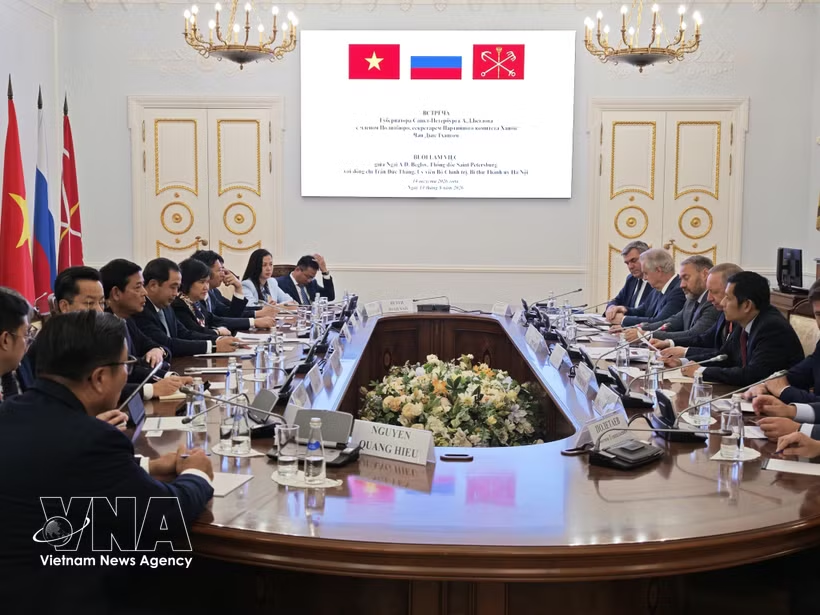
On August 14, in St. Petersburg, the delegation held a meeting with Governor Alexander Beglov, who affirmed that it remains among the leading Russian cities in promoting Russia-Vietnam relations and stands ready to share experience with Vietnamese localities.
St. Petersburg welcomed Hanoi as its fifth sister city in Vietnam, following Ho Chi Minh City, Hai Phong, Khanh Hoa and Dien Bien. A cooperation agreement between St. Petersburg and Hanoi, signed in May 2025, covers economic, trade, tourism, education, healthcare, sports and cultural cooperation, while promoting investment projects, business connections and joint promotional activities.
Notably, St. Petersburg expressed its interest in expanding cooperation with Hanoi in urban railways. The city has extensive experience in building metro systems under complex geological conditions, with an underground network whose average depth is among the greatest in the world. The St. Petersburg Metro, which began operation in 1955, continues to expand while adopting new technologies in construction, operation and ticketing.
The discussions in Moscow and St. Petersburg highlighted urban railways as a promising area of cooperation between Hanoi and Russian partners. With growing demand for metro networks, underground infrastructure and smart transport, Hanoi has more opportunities to access the experience, technologies and implementation models of Russian localities and specialised companies.
Thang affirmed that Hanoi's specialised agencies will continue coordinating with Russian counterparts to implement the agreements reached and promote cooperation based on each side's needs and strengths.
During their stay in Russia, the delegation is scheduled to hold additional meetings with leaders of relevant agencies and major businesses in St. Petersburg and Moscow from August 15-17./.
VNA