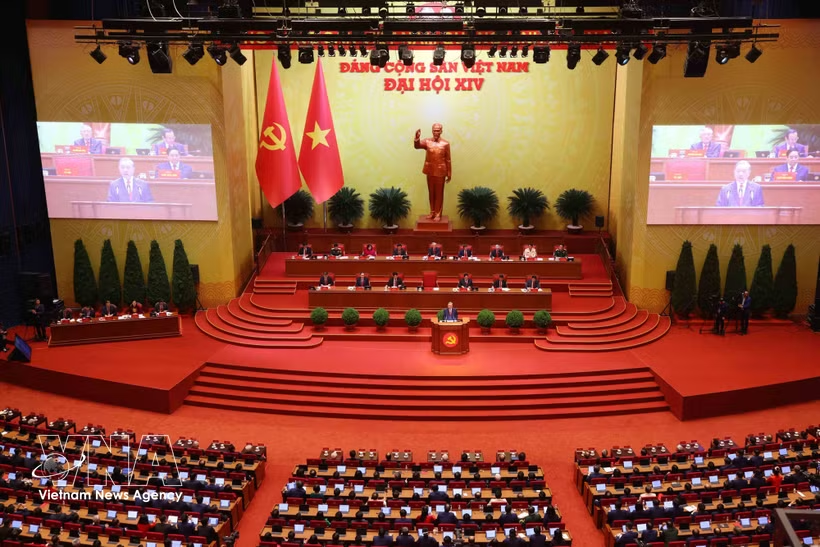
Hanoi (VNA) – The 14th National Congress of the Communist Party of Vietnam (CPV) is taking place at a moment of special significance in the country’s future development, linked with two historic milestones: the 100th anniversary of the CPV’s founding (1930–2030) and the 100th anniversary of the founding of the Socialist Republic of Vietnam (1945–2045).
The congress is expected to mark a major turning point, reviewing 40 years of Doi moi (renewal) process while opening a new era of national development amid changing global dynamics and rising aspirations. It reflects the determination to strengthen strategic autonomy, self-reliance and national pride while reaffirming confidence in the path chosen by the Party, President Ho Chi Minh and the Vietnamese people.
Entering a new historical era
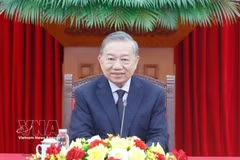
At the opening session, Party General Secretary To Lam presented the report of the 13th Party Central Committee on draft documents submitted to the congress, describing the event as a particularly important political occasion for the entire Party, the people, and the armed forces.
Looking back on 40 years of renewal, marked by significant achievements, the Party leader affirmed that Vietnam has every reason to conclude that the Party’s renewal guideline is entirely correct and fully aligned with Vietnam’s realities and development trends of the time.
This guideline clearly identifies the people as the centre and the subject of the revolutionary cause. It steadfastly upholds the goal of national independence associated with socialism. It consistently builds and perfects three foundational pillars: a socialist-oriented market economy, a socialist rule-of-law state, and socialist democracy.
Against this backdrop, the Party chief stressed that the 14th National Congress bears a historic responsibility to set out decisions that serve as a “launch pad” for the successful realisation of the country’s two centennial strategic goals.
Vietnam’s objective for the 2026–2030 period and vision to 2045 is to safeguard a peaceful and stable environment, rapidly and sustainably develop the country and improve people’s living standards while enhancing strategic self-reliance, self-strengthening and confidence, and strongly advance into a new era of the nation.
By 2030, Vietnam aims to become a developing country with modern industry and upper-middle-income status, and to fulfil the vision of becoming a developed country with high income by 2045, and of a peaceful, independent, democratic, strong, prosperous, civilised, and happy socialist Vietnam.
The Congress documents also set targets for average annual gross domestic product (GDP) growth of over 10% during 2026–2030, with GDP per capita reaching about 8,500 USD by 2030.
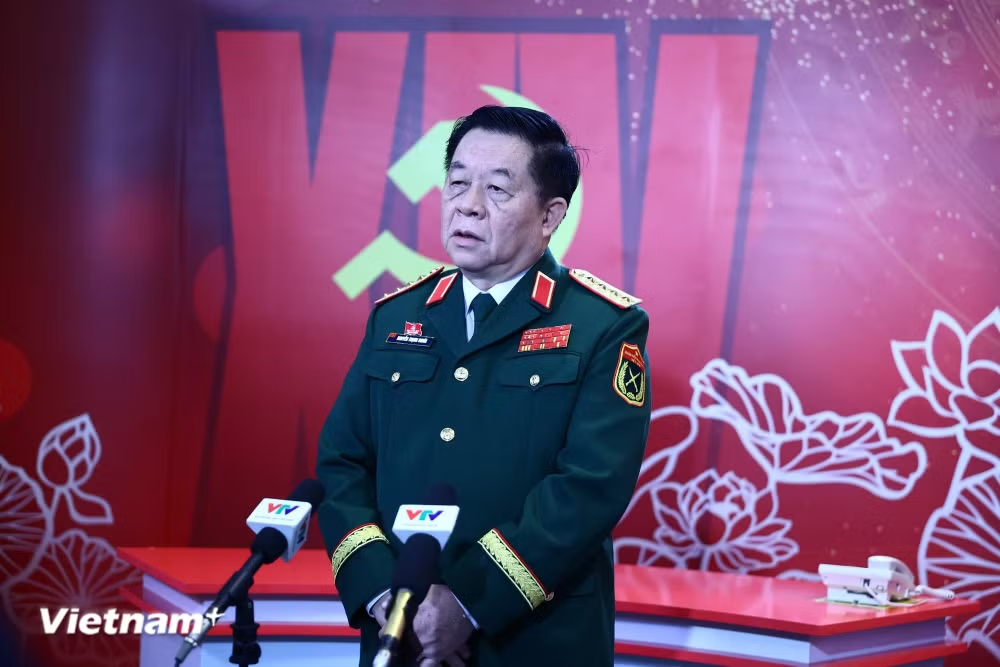
To realise these goals, the political report outlines 12 major orientations, six key tasks and three strategic breakthroughs, along with an action programme designed for implementation immediately after the congress.
Politburo member and permanent member of the Party Central Committee’s Secretariat Tran Cam Tu said the documents of the 14th National Congress not only review 40 years of renewal and five years of implementing the resolution of the 13th Party Congress but also define strategic orientations for the country’s next stage of development.
Development aspirations reflected in major policies
Professor Ta Ngoc Tan, former member of the Party Central Committee and former permanent vice chairman of the Central Theoretical Council, said combining three major reports - the Political Report, the Socio-economic Report, and the Report reviewing Party building work - into a single political report submitted to the congress represents an important innovation.
The report also introduces new theoretical perspectives, including the systematic presentation of the Party’s renewal theory and the emphasis on building a synchronised institutional framework for rapid and sustainable development.
Public engagement in the drafting process has been notable. In just one month, more than 4.5 million people contributed over 14 million comments to the congress documents, reflecting strong public interest and a sense of responsibility.
People-centred development
Vice Chairwoman of the National Assembly Nguyen Thi Thanh stressed the need to enhance Party characteristics and deepen the NA’s people-centred approach to meet development requirements in the new era. She noted that all policies must harmonise the Party’s will with the people’s aspirations, with public satisfaction and trust as the ultimate goal.
Localities are also preparing new strategies. Permanent Deputy Secretary of the Hanoi Party Committee Nguyen Van Phong said the capital is focusing on addressing major bottlenecks such as traffic congestion, environmental pollution and urban management while promoting digital transformation and innovation-driven growth.
Meanwhile, Ho Chi Minh City is aiming to reaffirm its role as the country’s economic locomotive by developing into an international centre for science, technology and innovation, with institutional reform, technological advancement and high-quality human resources identified as key drivers of future growth./.