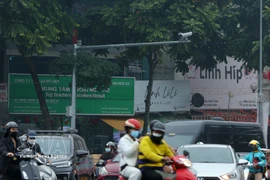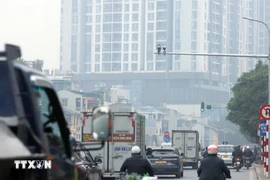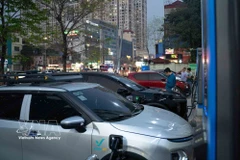
Hanoi (VNS/VNA) – At busy intersections, traffic is flowing more smoothly, signals appear better timed and enforcement less arbitrary, pointing to a broader shift in how Hanoi manages its rapidly expanding urban transport network.
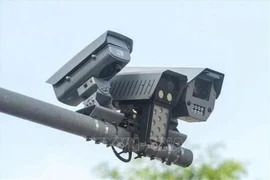
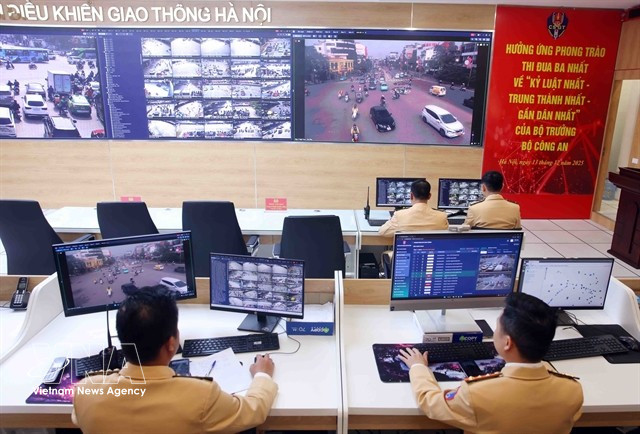
Since December 13, 2025, the intelligent traffic control centre operated by the Traffic Police Division under Hanoi Police has processed more than 19,300 traffic violations using an artificial intelligence (AI)-enabled camera system.
Beyond the headline figure, officials say the technology is reshaping urban management, not merely identifying breaches.
For years, traffic control in the capital relied heavily on manpower and on-the-spot judgement, often reacting to congestion rather than anticipating it. The new system marks a move away from that model.
With 1,837 AI cameras integrated into traffic signals at 195 key intersections, Hanoi now operates a citywide network capable of monitoring and regulating traffic in real time. Authorities say this allows data to be shared continuously, supporting faster and more consistent decision-making.
The approach represents a shift towards more proactive management. Instead of waiting for congestion to build, the system enables earlier intervention by adjusting signal cycles, coordinating traffic flows and maintaining stability across multiple routes simultaneously.
A similar transition is underway in enforcement procedures.
From January 1, Hanoi Police began piloting a fully digital sanctioning process via the iHanoi application, with 7,810 cases already processed through the system. The initiative replaces traditional administrative procedures with a streamlined digital process.
Residents can check violations, confirm details and pay fines online without visiting police offices, while authorities say the system helps reduce administrative workload, improve transparency and limit direct contact.
Public response has been broadly positive, although some say adaptation will take time.
“The system makes enforcement feel more consistent, but people still need time to get used to it,” said Le Van Hung, a motorbike driver in Vinh Hung ward.
Others have raised concerns about awareness and the pace of adaptation.
“Not everyone is familiar with using apps to handle fines yet, especially older people,” said Nguyen Thi Yen, a retiree. “There should be more guidance to help people adapt.”
At a broader level, the shift reflects a governance approach that prioritises efficiency and accessibility.
One of its most significant aspects is the focus on behaviour. Congestion in Hanoi has long been linked not only to infrastructure constraints but also to inconsistent compliance with traffic rules.
The system automatically detects and fines common offences such as running red lights, illegal stopping or parking and encroaching on pavements, allowing authorities to address violations at their source. Enforcement becomes more consistent and visible, encouraging behavioural change rather than serving as an occasional response.
At the same time, data generated by the system is being used to refine traffic organisation.
Authorities have adjusted operations at 188 intersections and established 22 green wave corridors along key routes such as Pho Hue – Hang Bai, Tran Hung Dao and Vo Chi Cong. Hundreds of signal recalibrations and technical interventions have helped ensure stable and continuous operation.
Initial results suggest the approach is having an impact. Traffic flow through intersections has improved by between 4% and more than 18%, including at some of the capital’s most congested junctions. While incremental, these gains point to the cumulative effect of a more coordinated and data-driven system.
Hanoi is moving away from a model defined by manual control and fragmented processes towards one built on integration, real-time data and digital platforms.
The intelligent traffic control centre, in this sense, represents more than an operational upgrade. It forms part of a broader effort to build digital government and a smarter urban environment, where technology underpins not only infrastructure but also decision-making.
More consistent enforcement is also influencing behaviour on the streets.
“People are more careful now, especially at red lights and no-parking zones. You know the cameras are always there,” Hung said.
However, some caution that lasting change will depend on public awareness.
“Technology helps, but improving traffic culture still requires long-term education,” Yen said.
A new model of urban management is taking shape, more proactive, better connected and increasingly aligned with the demands of a growing city./.
See more
Metro, buses, electric vehicles becoming top choice for Hainoians
For young people today, transport is no longer merely about moving from one place to another but also about comfort and emotional experience. Modern metro lines and smooth electric buses have largely met these expectations. Elevated metro stations with minimalist, contemporary designs have become popular “check-in” spots, while images of young commuters enjoying coffee and music as they overlook the city from train windows have become familiar on social media.
Ho Chi Minh City targets global Top 50 smart cities by 2030
Ho Chi Minh City targets becoming one of three national-level smart urban operation centres by 2035, serving as a hub for data coordination, technology and innovation nationwide.
Exhibition spotlights highland women’s role in climate-resilient ecotourism
The exhibition aims to foster public understanding of the human – nature relationship, the value of indigenous knowledge, and the growing role of women in climate change adaptation.
Earth Hour 2026 links energy saving to national security
The lights-off event will take place from 20:30 to 21:30 on March 28, but authorities stress the goal is to build long-term habits of efficient energy use rather than focus on a single hour.
Da Nang secures 2.79 million USD in international NGO aid
As part of the 2026–2030 foreign NGO aid mobilisation plan, the Da Nang Union of Friendship Organisations formalised cooperation with six partners, including Habitat for Humanity International and the Social Assistance Program for Vietnam (US); Korea Food for the Hungry International and Share Sarangbat (Republic of Korea); Activity International (the Netherlands); and Catalyste+ (Canada).
Publishing sector accelerates digital ecosystem development
According to the Department of Publishing, Printing and Distribution, the country currently has 52 publishing houses. In 2025, the industry produced more than 51,000 publications, with around 543 million copies and online accesses, generating total revenue of over 4.1 trillion VND (nearly 155.64 million USD).
Vietnam sends students to “Red study tour” of Ho Chi Minh’s footsteps in China
Initiated by Party General Secretary To Lam, State President Luong Cuong and Chinese Party General Secretary and President Xi Jinping during the Vietnam-China friendship meeting in April last year, the activity is run by the Communist Youth League of China (CYLC) and coincides with the 95th anniversary of the Ho Chi Minh Communist Youth Union (HCYU) (March 26).
Meeting pushes early establishment of Vietnam Studies Centre at Thailand’s Khon Kaen University
A Vietnam Studies Centre at Thailand's Khon Kaen University (KKU) will build a platform to promote cultural exchanges and educational cooperation, thereby strengthening Vietnam–Thailand friendship.
Vietnamese universities climb global rankings in multiple disciplines
In the broad subject rankings, seven Vietnamese universities were listed, three more than last year. Van Lang University ranked 260th globally in arts and humanities, the highest position for Vietnam in this category. Duy Tan University maintained a strong standing in engineering and technology, placing 346th worldwide.
Hanoi residents embrace green transport alternatives
Experts note that for major urban centres like Hanoi, grappling with pollution and traffic congestion, the transition to electric mobility is an inevitable trend.
Top 10 Vietnamese Outstanding Young Faces of 2025 honoured
Among the 10 outstanding young Vietnamese of 2025 are Dr. Pham Anh Tuan from KTH Royal Institute of Technology in Sweden, listed among the world’s top 2% most influential scientists, and Dr. Dang Thi Le Hang from the Vietnam Academy of Science and Technology, recognised for her work in biomedical materials.
Vietnam makes progress in reducing proportion of out-of-school children
Since 2000, the number of students worldwide has increased by 327 million, reaching 1.4 billion in 2024. On average, more than 25 additional children have been able to attend school every minute.
Public transport demand surges in Ho Chi Minh City amid fuel price fluctuations
The metro line is consistently crowded and often reaches full capacity not only during peak hours but also throughout the day, with a growing number of commuters opting for this method of transportation for university or work.
Young trailblazers power Vietnam’s digital future
Digital transformation is an unstoppable trend, driving the renewal of growth models, enhancing governance, and improving the quality of life. In this shift, young people – armed with knowledge, adaptability to new technologies, and creativity – are stepping up as a leading force.
Thanh Hoa ramps up investment to modernise fishing ports
The move includes upgrading port infrastructure, digitalising vessel management and tightening seafood traceability in line with recommendations from the European Commission.
Former Health Minister Nguyen Thi Kim Tien prosecuted
The Supreme People's Procuracy has prosecuted former Minister of Health Nguyen Thi Kim Tien for “violating regulations on management and use of State property, causing losses and wastefulness” in a case related to the construction of the second campuses of Bach Mai Hospital and Viet Duc University Hospital.
Ho Chi Minh City to pour over 46 million USD in Rach Tra tidal sluice
The sluice is designed to work in tandem with the local irrigation system to prevent tidal intrusion and improve drainage, thereby reducing flooding across 37,162 hectares in the northwest of the city.
Lam Dong holds mock trial to promote fight against IUU fishing
The mock trial aimed to contribute to the sustainable development of the fisheries sector and support efforts to have the European Commission (EC)’s “yellow card” warning against Vietnamese seafood lifted.
Youth Month: Restoring portraits to honour war heroes
The initiative on restoring and digitising portraits of Heroic Mothers and martyrs across Ho Chi Minh City not only helps safeguard valuable historical records but also highlights the creativity and volunteer spirit of young people in applying technology to meaningful community projects.
Abundant workforce still lacks skills: experts
The shortage of highly skilled workers and inadequate skill levels to meet production demands have left many businesses in Vietnam in dire need of technical personnel.