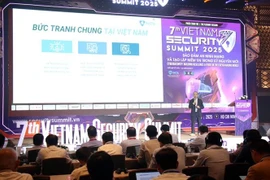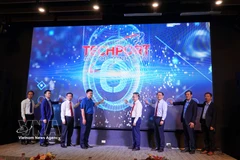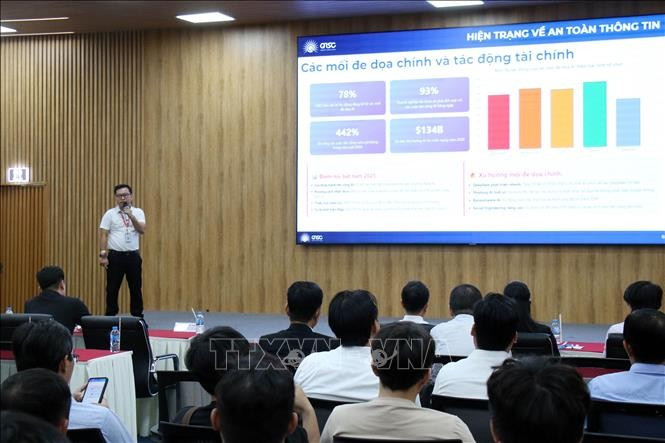
HCM City (VNA) – While artificial intelligence (AI) is ushering in remarkable opportunities for innovation, it also poses major cybersecurity challenges, as the technology is being exploited as a tool for sophisticated cyberattacks, heard a workshop in HCM City on July 9.
The workshop, co-organised by the Quang Trung Software City (QTSC) and the Ho Chi Minh City Computer Association (HCA), aimed to review current AI application models, thereby improving digital capabilities, strengthening cyber defence, and ensuring the safety of cyberspace for both organisations and the national digital infrastructure.
According to Nguyen Thanh Lam, head of QTSC's Cybersecurity Centre, a key concern is the sharp increase in AI-powered attacks, noting that 67.4% of phishing attacks in 2024 involved the use of AI. However, awareness remains limited, with 66% of organisations recognising AI as a major disruptor, but only 37% having protective measures in place.
Lam outlined several emerging threats, including the rapid growth of deepfake technology, which increased tenfold between 2022 and 2023, with basic deepfakes now created in just 45 minutes. AI-based phishing is also becoming increasingly sophisticated, leveraging machine learning (ML) to craft personalised content. Other threats include the automation of code encryption and evasion of endpoint detection and response (EDR) systems, as well as the use of AI to analyse user behaviour and design targeted attack scenarios.
Statistics from the Ministry of Science and Technology revealed that by the end of 2024, Vietnam had nearly 74,000 digital technology enterprises, a year-on-year increase of 10.1%, that contributed around 11% to the national GDP. AI-powered solutions are being widely applied in management, production, and operations, underlining the far-reaching impact of the technology across all areas of life.
Tran Huu Dung, Director of QTSC and Vice Chairman of HCA, said that alongside the exceptional opportunities brought by AI, there are increasingly serious cybersecurity threats. He noted a rise in the scale and sophistication of attack campaigns, particularly those targeting critical information systems in sectors such as telecommunications, energy, finance, and logistics.
A report from Fortinet in June revealed that automated scanning attempts had surged to 36,000 per second, a 17% increase from the previous year. Alarmingly, 42% of these were account takeover attacks, and leaks involving 1.7 billion sets of credentials. In Vietnam, data from the National Cybersecurity Association showed that 659,000 cyberattacks were recorded in 2024, affecting approximately 46.15% of government agencies and enterprises.
Dung emphasised that digital transformation must be integrated with security and operational optimisation. He also mentioned that the use of AI not only allows businesses to process data more intelligently but also enables them to address increasingly sophisticated cyber threats./.
See more
Outstanding achievements/events in science, technology, innovation, digital transformation announced
The selected achievements and events reflect the increasingly important role of science, technology, innovation and digital transformation in improving institutions, promoting socio-economic development, ensuring national defence and security, and enhancing Vietnam’s position amid deep international integration.
Resolution No 57: Vietnam begins operating first state-of-the-art supercomputer
The platform represents the world’s most advanced high-performance computing infrastructure, designed to support research and development of next-generation artificial intelligence (AI) models.
Digital economy helps power breakthrough growth
The application of digital technologies, big data, artificial intelligence, e-commerce and digital platforms is creating new opportunities for businesses and citizens across production, business activities and social governance. Sectors such as e-commerce, digital finance, smart logistics and digital platform-based services are generating significant added value, while online public services, cashless payments, digital education and digital healthcare are increasingly improving quality of life and the transparency and efficiency of state management.
Resolution No. 57: Vietnam moves to create favourable legal framework for technology transfer
The Ministry of Science and Technology has sought feedback on a draft decree amending the Government's Decree No. 76/2018/ND-CP, aiming to strengthen the legal framework for technology appraisal and transfer, improve support policies for participating entities, and enhance risk management to ensure sustainable development, environmental protection and public health.
Glorious Spring Fair 2026: technology underpins product quality
With the Politburo's rollout of Resolution No. 57-NQ/TW on breakthroughs in science, technology, innovation, and national digital transformation, along with Resolution No. 68-NQ/TW on developing the private economic sector, a key focus is on applying scientific and technological advances to produce essential consumer goods.
Hanoi rolls out technology exchange, digital transformation marketplace
The technology exchange and digital transformation marketplace are not meant to showcase technologies, but to ensure that technology delivers real economic value, with effectiveness and scalability as the key criteria.
International scientists discuss biotechnology for sustainable development in Gia Lai
A key highlight was the official announcement of the establishment of the AFOB liaison office in Vietnam, based at the International Centre for Interdisciplinary Science and Education (ICISE) in Gia Lai’s Quy Nhon Nam.
Resolution No. 57: Vietnamese intellectuals in France contribute to sci-tech development at home
Discussions at the event underscored support from Vietnamese intellectuals in France to the Party and State’s strategic vision, particularly the view that science – technology, innovation and digital transformation are key breakthroughs and primary drivers of fast and sustainable growth.
PM orders tougher IP enforcement under new decree
The move aims to promptly combat, curb, and minimise IP violations; safeguard the legitimate rights and interests of citizens and businesses; build a transparent and healthy business environment; spread the nation’s image and prestige to advance rapid and sustainable development.
Vietnamese intellectuals in France join hands to advance science, technology at home
Held amid the nationwide efforts to implement the Resolution of the 14th National Party Congress and the Politburo’s Resolution No. 57-NQ/TW on breakthroughs in science, technology, innovation, and national digital transformation, the seminar served not only as an academic forum but also as a platform reflecting the sense of responsibility, intellectual engagement and aspiration to contribute among overseas Vietnamese intellectuals in the nation’s new development era.
STEM Innovation Petrovietnam helps cultivate knowledge in technological era
The programme connected three sites in Hanoi, Nguyen Hue High School in Lao Cai, and Chau Thanh High School in Ho Chi Minh City, bringing together educators, students, representatives of businesses, and industry–energy engineers, and those directly supporting schools in implementing STEM (science, technology, engineering, and mathematics) education in practice.
Top 10 university start-ups in Vietnam secure innovation backing
The selected projects share a strong technology-driven orientation, particularly in artificial intelligence (AI), digital solutions and advanced materials. Their innovations address large-scale, real-world issues across sectors including healthcare, education, legal services, agriculture, energy, environmental protection and public governance.
Breakthroughs under Resolution No. 57 affirm leadership in digital era
After one year of implementing the Politburo’s Resolution No. 57-NQ/TW on breakthroughs in science, technology, innovation, and national digital transformation, numerous digital models and knowledge-based initiatives have been rolled out, bringing digital transformation to communities and contributing to the fulfilment of socio-economic development targets.
Resolution 57: Vinh Long makes clear shift in green agriculture development
Resolution 57-NQ/TW has opened up new space and momentum for Vinh Long’s agriculture to transform towards modernity, sustainability and climate resilience.
VinFuture opens call for excellent scientific breakthroughs for 6th season
The evaluation process is scheduled to be completed by September 2026, with the 6th VinFuture Prize Award Ceremony slated for early December 2026. Nominations submitted after April 17, 2026, will automatically be considered for the 2027 season.
Science - technology paves way for “second wave of Doi moi”: expert
Assoc. Prof. Dr. Tran Le Hung, lecturer at the ESIEE Paris - an engineering school of University Gustave Eiffel, said future “Make in Vietnam” science and technology products will not only directly serve domestic demands, improve the people’s livelihoods, and boost labour productivity, but also have the potential to compete in international markets.
High-quality training key to Vietnam’s technological self-reliance: VietNuc
Training must undergo a fundamental overhaul, with quality as the core focus. Curricula should be updated to international standards and developed in a comprehensive manner, said members of the executive board of the network of overseas Vietnamese nuclear energy experts (VietNuc)
Vietnam promotes On-chain financial infrastructure cooperation at Davos 2026
Jointly organised by the municipal People’s Committee, the Centre for the Fourth Industrial Revolution (C4IR) in the city (HCMC C4IR) and the Vietnam International Financial Centre in Ho Chi Minh City (VIFC-HCMC), the event was part of a series of activities showcasing the vision for building VIFC-HCMC, while expanding cooperation with global partners in finance, technology and innovation.
Trio of core drivers of new growth model highlighted at 14th National Party Congress
Member of the Party Central Committee and Minister of Science and Technology Nguyen Manh Hung emphasised that in moving from middle-income to high-income status, Vietnam must rely on science and technology, innovation, and digital transformation. These three drivers have been expanded and redefined by the Party under a new approach, creating broader development space and unlocking new resources for growth. With this trio, Vietnam has the potential to achieve double-digit growth.
AI strategy seen as engine for innovation-driven growth in Vietnam: scholar
Vietnam is standing at a historic moment to achieve a meaningful breakthrough based on science, technology and innovation.