Hanoi (VNA) – As Vietnam races to rewire its economy for green growth, the Ministry of Agriculture and Environment is casting the Extended Producer Responsibility (EPR) mechanism as a cornerstone policy tool.
Enshrined in the Politburo’s Resolution 68-NQ/TW dated May 4, 2025, on private sector development, EPR demands coordinated action from the State, business, and the public to convert environmental accountability into a sustainable development engine.
Still a “throw-it-anywhere” habit persists
EPR is billed as one of the sharpest advances in modern environmental policy. Rather than a tax, it forces producers and importers to take responsibility for the entire lifecycle of their products, especially what happens after consumers are done with them. That means companies don’t just make and sell; they must collect, recycle, or treat the resulting waste.
Starting in 2024, the roadmap requires enterprises to shoulder recycling obligations for packaging, including plastics, paper, metals, glass, plus batteries, accumulators, electronics, and tires. They can self-recycle, hire intermediaries, or pay into the Vietnam Environment Protection Fund for state-run handling.
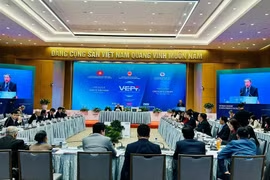
Speaking at an April 14 forum, Tran Van Cao, Deputy Editor-in-Chief of the Agriculture and Environment newspaper, called EPR a progressive policy that stretches corporate responsibility while propelling the circular economy and sustainable development.
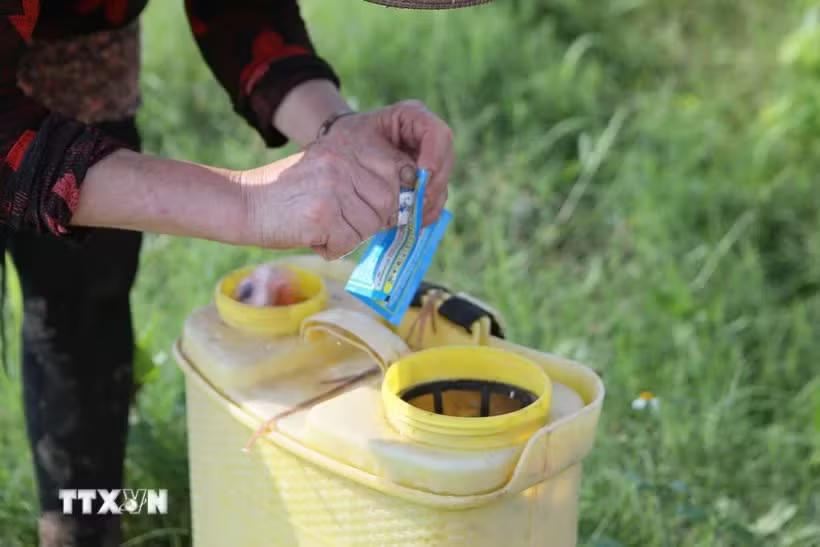
Luong Ngoc Quang, Deputy Head of the Food Safety and Environment Division in the ministry’s Department of Plant Production and Protection, laid out the numbers: nearly 2,500 tonnes of used pesticide packaging were gathered nationwide from 2022 through 2024. Yet more than 550 tonnes still await treatment. And of the total collected, only about 1,400 tonnes were properly processed. The rest were either dumped by residents or stuck in storage.
Indiscriminate disposal of pesticide containers in fields and irrigation canals remains rife, a “throw-it-anywhere” reflex that threatens soil and water. Collection infrastructure is falling short, too. More than 450,000 collection pits have been dug and over 11,700 training sessions run, but many sites are substandard or degrading, and pickup is patchy. Funding, crucially, remains the tightest choke point.
Multi-sector coordination needed
Forum participants agreed that EPR can’t work without a full-spectrum fix, ranging from institutional upgrades and behavioral changes to far tighter cross-sector coordination.
On the policy front, freshly issued regulations have laid a critical foundation. Nguyen Thanh Yen, deputy head of the Policy and Legal Division at the ministry’s Department of Environment, said under current rules, localities must file reports by June 25, via the provincial Departments of Agriculture and Environment, advising provincial People’s Committees on solid waste treatment needs. Those reports will feed into the ministry’s review.
As for financial contributions into the waste treatment fund, Yen said by April 1 each year, organisations and individuals must declare the amount linked to pesticide products they manufactured or imported and placed on the market the previous year. Filings must go through the national EPR information system at epr.mae.gov.vn.
He pushed for stronger communication to reshape public behaviour, better infrastructure, and clear the funding logjam so hazardous waste treatment is done properly and sustainably.
Through a business lens, EPR demands a mindset overhaul from the “produce-consume-discard” model to “design-recycle-reuse”. That fits perfectly into the Resolution 68-NQ/TW, which calls the private sector the economy’s lead engine. In that light, EPR isn’t a cost to bemoan, but a chance to sharpen competitiveness, build a green brand, and lock into global supply chains./.