FDI surge fuels new real estate demand

According to Savills experts, FDI continues to flow into manufacturing, logistics, technology and digital infrastructure, changing property requirements for investors.

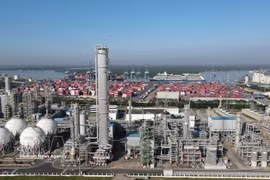
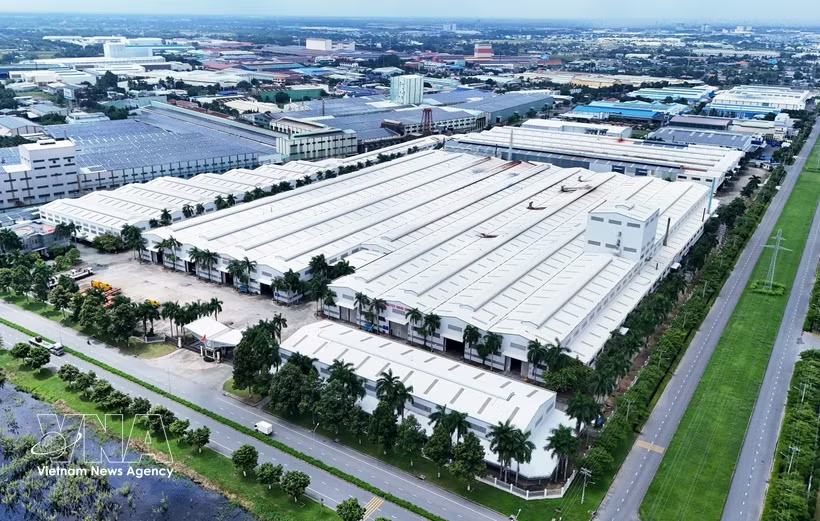
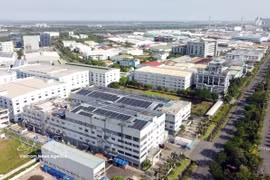
A view of Vinh Loc 2 Industrial Park in My Yen commune, Tay Ninh province (Photo: VNA)

Hanoi (VNA) – Stronger foreign direct investment (FDI), together with the growth of manufacturing, logistics and technology, is creating new demand for real estate in Vietnam, ranging from ready-built factories to specialised facilities such as data centres.

Vietnam attracted about 34.65 billion USD in registered FDI in the first six months of 2026, up 61% year on year, while disbursed FDI reached around 13.03 billion USD, the highest level for the first half of a year in the past five years.

According to Savills experts, FDI continues to flow into manufacturing, logistics, technology and digital infrastructure, changing property requirements for investors.

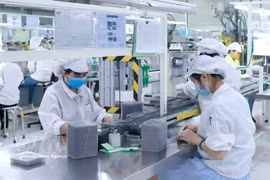
Manufacturing remains a major driver of FDI as international companies diversify their supply chains in Asia. This continues to support demand for industrial land, ready-built factories and customised production facilities.

However, investors are looking beyond location and costs. Power supply, workforce quality, logistics connectivity, ESG standards, expansion potential and the time needed to put facilities into operation are becoming increasingly important.

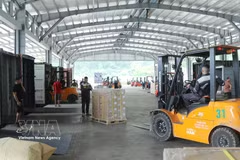
According to Savills data, roughly two-thirds of new manufacturing investments are tied to projects opting for ready-built factories instead of leasing industrial land.

John Campbell, Director of Industrial Services at Savills Vietnam, said Vietnam’s industrial real estate is entering a new phase where competitive advantage no longer lies in land bank size, but in infrastructure readiness, operational capability and the ability to serve high-value industries.

Demand therefore extends beyond assembly plants to

capable of integrating full supply chains, from component manufacturing to logistics and technical services. Parks located near production hubs, seaports and major industrial corridors are benefiting significantly.

As transport infrastructure expands, areas outside traditional manufacturing hubs are also gaining opportunities to attract industrial, logistics and supply-chain projects.

Campbell said flexibility and strategic accessibility are becoming key criteria in site selection. Areas with strong infrastructure links, access to supply chains and room for expansion therefore have greater potential to attract new investment.

The shift towards high-tech industries is creating another category of specialised real estate demand. Electronics, semiconductors, data centres and other technology-intensive industries require higher standards for power supply, data connectivity, technical infrastructure and uninterrupted operations.

Data centres are a notable example. According to the Savills Vietnam Industrial Outlook 2026, the total operational design capacity of data centres in Vietnam stood at about 524.7 MW in 2025 and is forecast to reach 950 MW by 2030, an increase of about 81%.

This growth is not simply creating demand for more floor space. Large data centres require stable electricity, telecommunications connectivity, high technical standards and continuous operations, creating a specialised property segment that differs considerably from conventional industrial facilities.

Campbell said the growth of e-commerce, data centres and high-tech manufacturing is reshaping industrial real estate demand. These sectors need not only space but also reliable power, advanced infrastructure and high operational standards.

Infrastructure development is also expanding the geographical scope of investment. In northern Vietnam, Hai Phong, Bac Ninh, Hung Yen, Quang Ninh and neighbouring areas are developing increasingly interconnected manufacturing and logistics networks. In the south, Ho Chi Minh City, Dong Nai and areas around Long Thanh are benefiting from major infrastructure projects./.

VNA
See more

Lien Chieu Port is under construction in central Da Nang city. (Photo: VNA)

Energy infrastructure underpins marine economy development

The integrated investment in energy infrastructure will provide a vital infrastructure foundation for effectively harnessing the marine potential, helping realise the goal of making Vietnam a strong maritime nation and achieving sustainable and prosperous development from the sea./.

The Australia-Vietnam Policy Institute Forum in Ho Chi Minh City on August 25, 2026 discusses how Australian expertise, partnerships and capital can support Vietnam's growth, and how to build stronger connections between the two countries' business communities. (Photo: VNA)

Vietnam, Australia seek new space for economic cooperation

The Australia–Vietnam Policy Institute Forum was held in Ho Chi Minh City on August 25, bringing together policymakers, businesses, and organisations for discussing how the business communities of Australia and Vietnam can build stronger connections.

Officers from Thanh Hai Border Guard Station (Phu Thuy ward, Lam Dong province) patrol and monitor fishing vessels entering and leaving the port. (Photo: VNA)

Lam Dong province deploys 10 key measures to combat IUU fishing

The measures target key gaps, including ineligible fishing vessels, port controls, electronic fishing-trip data, seafood traceability and vessel monitoring system (VMS) violations. Authorities will also act against vessels detained by foreign authorities, submit weekly progress reports and draw up specific action plans.

Speakers at the seminar (Photo: VNA)

Legal transparency key to making VIFC more attractive: experts

Dominic Scriven, Chairman and Founder of Dragon Capital, said legal clarity, consistency and predictability are essential to strengthening investor confidence, enabling long-term business planning and encouraging firm capital commitments to Vietnam.

Illustrative photo (Photo: VNA)

Vietnam promotes cooperation to remove barriers to rice trade with Philippines

Vietnam proposed studying a higher-level cooperation framework on rice trade to provide a more stable and long-term foundation for Vietnam-Philippine rice trade while balancing the interests of farmers, businesses and consumers, and providing sustainable livelihoods for rice growers and stable living conditions for Philippine consumers.

An overview of the 11th APEC Food Security Ministerial Meeting in Hangzhou on August 25. (Photo: VNA)

Vietnam proposes four strategic cooperation directions at APEC Food Security Ministerial Meeting

Vietnam’s proposals at the 11th APEC Food Security Ministerial Meeting, which took place in Hangzhou, China received broad support and consensus from participating economies. Several members expressed their desire to work with Vietnam to further build consensus, with a view to ensuring that the APEC Food Security Ministerial Meeting in Vietnam in 2027 will produce a shared vision and a substantive action programme.

Vietnam Post accelerates the adoption of modern technology, elevates logistics capabilities, and boosts the digital economy. (Photo: VNA)

Breakthrough opportunities for businesses in digital economy

Only when businesses view digital transformation as a fundamental change in their business models, while the State provides an enabling framework, data infrastructure and sufficiently broad markets for innovation, can the digital economy become a substantive growth driver.

A lecturer guides students on how to diagnose diseases in aquatic animals. (Photo: VNA)

Vietnam leans on digital workforce to unlock productivity boom

Vietnam needs a cohesive national strategy linking the State, enterprises, and training establishments. The strategy must prioritise standardising training to international norms and investing in technological infrastructure to boost national productivity.

A factory in Bac Ninh province (Photo: VNA)

Vietnam directs more credit to SMEs

With deposit rates still relatively high, banks’ room to cut lending rates sharply is limited. Lenders must stay efficient and cannot fund at high cost while lending at very low rates.