Hanoi (VNA) - More than two years after implementing the Extended Producer Responsibility (EPR) policy, Vietnam has seen encouraging results, with the volume of packaging collected and recycled rising sharply.
More importantly, what began as a legal requirement under the 2020 Law on Environmental Protection is increasingly becoming a catalyst for the circular economy, improving resource efficiency and fostering a sustainable recycling value chain.
According to the Ministry of Agriculture and Environment (MAE), Vietnam generates around 25.3 million tonnes of household waste each year, placing immense pressure on the country's waste collection, sorting and treatment infrastructure. In reality, as much as 60% of waste is still disposed of through landfilling.
To address the challenge, the Government has issued Decree No. 110/2026/ND-CP on the 2020 Law on Environmental Protection for waste management of producers and importers under the EPR scheme. The decree took effect on May 25, 2026.
Under the new regulations, producers and importers must recycle products and packaging placed on the Vietnamese market in line with mandatory recycling requirements, making post-consumption waste management a legally binding obligation.
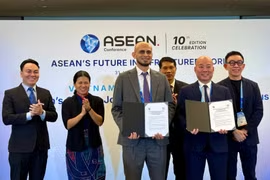
According to the Packaging Recycling Organisation Vietnam (PRO Vietnam), by the end of May 2026, more than 60,000 tonnes of packaging had been officially registered, authorised and approved for recycling nationwide, with over 30,000 tonnes already collected and recycled.
Pham Phu Ngoc Trai, Chairman of PRO Vietnam, said the scale of EPR implementation is expected to expand by around 90% in 2026 compared with 2025, reflecting a marked shift in business awareness of environmental responsibility.
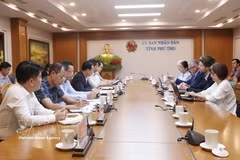
From the regulator's perspective, Ho Kien Trung, Deputy Director of MAE’s Environmental Department, said more than two years of EPR implementation had delivered encouraging results. Businesses have become more aware of their environmental responsibilities, the recycling market has continued to develop, and new partnerships have emerged between manufacturers, collection companies and recycling facilities.
According to the Environmental Department, while the initial phase of EPR focused on putting policy into practice, the next stage will require building a circular system that is efficient, transparent and scalable.
That task is becoming increasingly urgent as larger volumes of packaging enter the system, bringing greater challenges related to implementation costs, recycling capacity, traceability data and reporting quality. The focus must now shift from isolated initiatives to building a well-governed, data-driven and scalable circular system.
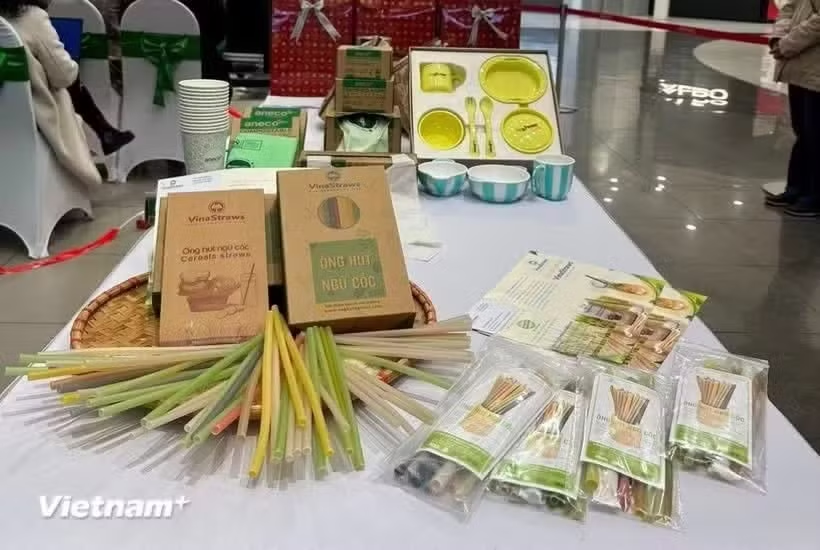
New technologies are being developed to improve the recovery of hard-to-recycle materials such as flexible plastics and multi-layer packaging. The development of post-consumer recycled (PCR) materials will help establish a closed-loop system for used packaging, reducing reliance on virgin materials.
Trung said advances in science, technology and digital transformation are creating new opportunities to strengthen EPR implementation. Eco-friendly packaging design, digital tracking of material flows, traceability systems, and advanced waste sorting, collection and recycling technologies all help improve resource efficiency while reducing environmental impacts.
However, he stressed that the effectiveness of EPR depends not only on businesses and regulators but also on the capacity of waste collection infrastructure, the development of the recycling industry, waste segregation at source, and active public participation.
Do Xuan Thuan, a representative of the Vietnam EPR Office, said the EPR mechanism is neither a tax nor a fee, but a financial contribution made by businesses to support solid waste treatment. He added that Decree No. 05/2025/ND-CP, which amends and supplements Decree No. 08/2022/ND-CP, also introduces significant adjustments to EPR obligations.
As Vietnam's policy framework improves and technology is more widely adopted, stakeholder participation will deepen. Experts believe EPR will evolve beyond compliance to a powerful catalyst for greener production and consumption models, accelerating the country's transition towards a circular economy./.