A new “shield” against climate change

Smart urban areas are no longer simply about technology; they are becoming a tool that enables authorities to forecast risks, adapt quickly and protect their residents.

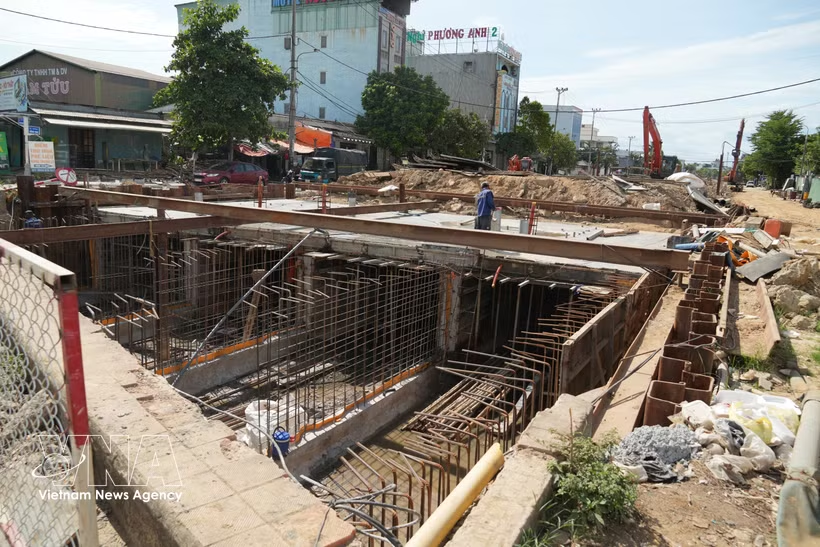
Construction workers reinforce steel and pour concrete to cover the underground drainage channel, helping collect rainwater and tackle flooding in Da Nang. (Photo: VNA)

Hanoi (VNA) – The 14th Party Central Committee's recent Conclusion No. 75-KL/TW on environmental protection and proactive response to climate change in the new period has called for the development of climate-resilient urban areas in response to increasingly extreme impacts from nature.

Smart urban areas are no longer simply about technology; they are becoming a tool that enables authorities to forecast risks, adapt quickly and protect their residents. A city can issue early warnings about areas at risk of flooding, adjust traffic flows when incidents occur, monitor air quality in real time or simulate the impact of a project before it is implemented. These capabilities are gradually becoming a new standard in modern urban management.

According to Tran Quoc Thai, Director of the Department of Urban Development under the Ministry of Construction, Vietnam currently has more than 900 urban areas, with the urbanisation rate continuing to rise rapidly. Cities are the main drivers of economic growth, but they are also highly vulnerable to climate change due to their high population density, heavy pressure on infrastructure and concentration of economic assets.

The World Bank (WB) likewise considers Vietnam one of the countries most severely affected by climate change. Without stronger adaptive capacity, climate impacts could significantly affect long-term growth, particularly in coastal urban areas and low-lying delta regions.

Da Nang has emerged as one of the localities at the forefront of smart urban development, with the establishment of an information, monitoring and smart operations centre that connects data from multiple areas, including transport, public services, the environment and residents’ feedback, to support governance.

The distinctive feature of this model is its shift from management based on manual reporting to data-driven one. Rather than waiting for incidents to occur before taking action, authorities can monitor the state of the central coastal city in real time and respond earlier.

According to planning experts, the new generation of smart cities should not be measured by the number of cameras or sensors deployed, but by their ability to turn data into decisions.

Do Thanh Tung, former Director of the Vietnam Institute of Architecture, said smart urban development should begin with planning and management, with technology serving as a tool to improve operational efficiency. A city can only truly be considered smart when it is capable of adapting to changes in the environment, climate and social needs.

This trend is also consistent with recommendations from the United Nations Human Settlements Programme (UN-Habitat). The organisation said cities of the future must address three challenges simultaneously: developing the economy, improving quality of life and strengthening resilience to shocks such as natural disasters and climate change.

In major urban areas, the most pressing challenge today is how to connect data across different sectors. This is also a challenge highlighted by many experts as Vietnam rolls out smart-city initiatives. Technology is not the biggest barrier; the difficulties lie in data standardisation, information-sharing mechanisms and the capacity to operate the systems.

Domestic technology companies such as Viettel Solutions and CMC Technology & Solution are currently involved in developing data platforms, operations centres and digital solutions for numerous localities. However, experts noted that technology companies can only provide the tools, while the development of effective governance models depends on how authorities organise data and make decisions.

Investing in climate resilience not only helps reduce damage caused by natural disasters but also creates a foundation for sustainable growth. For rapidly urbanising countries such as Vietnam, integrating climate considerations from the planning stage is considered a decisive factor, the WB suggested./.

VNA
See more

Vietnam is exerting efforts to cope with climate change. (Illustrative photo: VNA)

Vietnam approves carbon credit pact with Singapore under Paris Agreement

Signed on September 16, 2025, the Implementation Agreement on carbon credits collaboration under Article 6 of the Paris Agreement on climate change affirms Vietnam and Singapore’s pioneering role and commitment to close cooperation in the international carbon market, making a substantive contribution to global climate response.

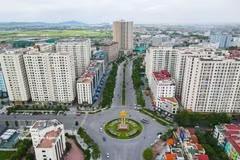
A view of Vo Cuong ward, Bac Ninh province (Photo: VNA)

Bac Ninh earmarks over 1.7 billion USD for environmental protection

By 2030, Bac Ninh aims to ensure that all operating industrial clusters and industrial parks have centralised wastewater treatment systems meeting standards, while at least 95% of wastewater in Grade-I urban areas and 70% in Grade-II urban areas is collected and treated to required standards.

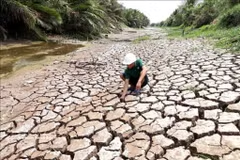
Many inland canals in Can Tho city dries up following a prolonged period of extreme heat. (Photo: VNA)

Government adopts action programme on environmental protection, climate resilience

The programme aims to translate the Party's orientations into concrete actions while strengthening environmental governance, enhancing climate resilience, and promoting a green, circular and low-carbon economy. It will serve as the basis for ministries, sectors and localities to formulate implementation plans for the 2026–2030 period, with a vision to 2045.

Dray Sap Waterfall lies within the UNESCO Dak Nong Global Geopark in Nam Da commune, Lam Dong province. (Photo: VNA)

Lam Dong steps up efforts to retain UNESCO global geopark status

Covering nearly 4,760 square kilometres across 22 communes and wards in western Lam Dong (equivalent to 73.1% of the former Dak Nong province's natural area), the geopark was shaped by millions of years of geological activity and successive volcanic eruptions.

A stump-tailed macaque (Macaca arctoides) is handed over to the Cam Lo–Dong Ha forest ranger station in Quang Tri province on January 27, 2026 (Photo: VNA)

Rare primate handed over to Phong Nha - Ke Bang National Park

A stump-tailed macaque (Macaca arctoides) was handed over to the Centre for Rescue, Conservation, and Development of Creatures under the Management Board of Phong Nha - Ke Bang National Park in Quang Tri province on July 21, for rehabilitation and eventual release into the wild.

Two Red Lories (Eos rubra) found among the 104 wild animals being kept without documentation proving their lawful origin in Phuoc Thanh commune, Tay Ninh province. (Photo published by VNA)

Criminal proceedings launched against case of illegal keeping, trading of 104 wild animals

They recorded a total of 104 wild animals, comprising 92 African spurred tortoises (Geochelone sulcata) of various sizes, six Red Lories (Eos rubra) and six Green-cheeked Parakeets (Pyrrhura molinae). Authorities said the animals are subject to management under Vietnam's forestry legal regulations and are listed in Appendix II of the Convention on International Trade in Endangered Species of Wild Fauna and Flora (CITES).

BUYO Bioplastics' biodegradable plastic products are made from brewer's grains and sugarcane bagasse. (Photo: nhandan.vn)

Vietnam urged to shift from plastic waste treatment to full life-cycle management

For years, efforts to tackle plastic pollution in Vietnam have focused mainly on waste collection, recycling and disposal. However, as sustainable development and green trade standards become increasingly important, specialists argued that a broader approach is needed, covering everything from product design and material selection to production, consumption and recycling.

Bang Mo volcano in Lam Dong province (Photo published by VNA)

Lam Dong optimises value of UNESCO Dak Nong Global Geopark

Alongside conservation, Lam Dong aims to tap the geopark's tourism potential through geological, ecological and community-based tourism. Infrastructure and tourism development projects must ensure that heritage values, landscapes and the natural environment are preserved.

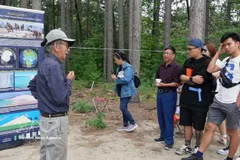
Dr. Dang Trung Phuoc (left) is introducing the history and origin of the Pinhey sand dunes (Photo: VNA)

Vietnamese Canadian scientist revives forgotten ecosystems

From restoring an ancient sand dune ecosystem in Canada to promoting the conservation of Vietnam's coastal dunes, native forests and ecological corridors, Vietnamese-born scientist Dang Trung Phuoc has remained committed to using science to revive ecosystems long misunderstood or neglected. His quiet but sustained efforts reflect both a scientist's responsibility to the communities he serves and the enduring commitment of a Vietnamese expatriate to his homeland.

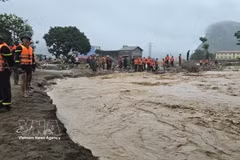
Police and military forces work together to rescue people and assist local residents in affected areas. (Photo: VNA)

PM orders proactive response to heavy rainfall in northern mountainous region

To minimise casualties and damage to public and private property, the PM instructed ministries, sectors and local authorities to strictly implement directions issued by Party General Secretary and State President To Lam, as well as the Government's directives on strengthening disaster prevention and response in 2026.