New Politburo resolution expected to harness role of Vietnamese community in Canada

Resolution No. 23 marks a new development in mindset, as its identification of overseas Vietnamese not only as an inseparable part of the Vietnamese national community but also as one of the country’s important strategic resources has more clearly affirmed their role in the cause of national construction and development.

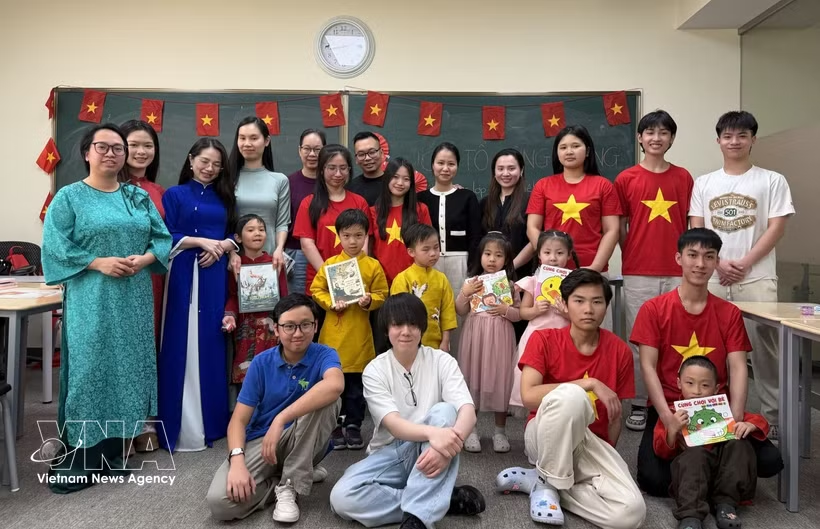
Phan Thi Quynh Trang (far left, second row) poses for a commemorative photo with the Vietnamese youth group at an event organised by the Canada-Vietnam Culture and Education Council to provide Vietnamese language lessons for second-generation Vietnamese-Canadian children. (Photo: VNA)

Ottawa (VNA) – The approach set out in the Politburo's Resolution No. 23-NQ/TW on overseas Vietnamese affairs is of particular significance to the Vietnamese community in Canada, home to a large number of experts, intellectuals, entrepreneurs and young people educated in an international environment, an educational expert has said.

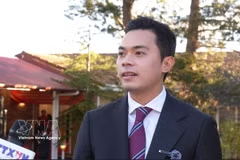
Speaking to a Vietnam News Agency correspondent in Canada, Phan Thi Quynh Trang, President of the Canada-Vietnam Culture and Education Council (CVCEC), said that with an open, proactive and transparent mechanism, the community could make more effective contributions in areas such as digital transformation, education, modern governance, sustainable urban development and international market connectivity.

Beyond being a source of intellectual resources, Vietnamese people in Canada can also serve as a bridge, introducing their Canadian friends to a modern, dynamic Vietnam rich in cultural identity.

She said Resolution No. 23 marks a new development in mindset, as its identification of overseas Vietnamese not only as an inseparable part of the Vietnamese national community but also as one of the country’s important strategic resources has more clearly affirmed their role in the cause of national construction and development.

From her experience in Canada, the CVCEC representative said that mobilising resources from overseas Vietnamese still faced a number of difficulties. Many Vietnamese experts, young intellectuals and scientists working at major Canadian universities wish to participate in projects in Vietnam, but cooperation has largely remained limited to short-term exchange programmes, without long-term coordination mechanisms or specific assignments.

Information gaps also affect the ability of overseas Vietnamese to participate. Domestic policies, guidelines and cooperation needs are sometimes not communicated widely or regularly to associations and organisations across Canada. Meanwhile, younger generations born or raised in a digital environment need convenient channels for direct information and dialogue through which they can learn about policies, put forward initiatives and participate in activities oriented towards their homeland.

Drawing on her experience in implementing education and youth connectivity projects, Trang said it is necessary to develop a digital dialogue platform connecting domestic agencies with overseas Vietnamese experts, intellectuals, entrepreneurs, artists and young people according to their respective fields.

Through such a platform, agencies could provide information or share specific needs, while overseas Vietnamese could propose initiatives and register to participate in programmes suited to their expertise and professions.

She also proposed establishing a shared digital data repository containing Vietnamese-language teaching materials, historical documents, films, photographs, music and cultural products that are legally available for use. An authoritative data source would help associations and non-profit organisations develop more systematic programmes, while reducing the situation in which each organisation has to search for and compile materials independently.

The CVCEC is currently implementing a platform combining technology and artificial intelligence (AI) in teaching the Vietnamese language, history and culture. If supplemented with digitised materials and authoritative historical resources as proposed, the project could improve the quality of its content while gradually expanding to more provinces across Canada.

Trang also stressed the neccessity to bring Vietnamese culture into shared spaces within Canadian society through exhibitions, artistic programmes, heritage showcases and inter-community exchange activities.

From the perspective of a person working in education, culture and youth development, she noted the spirit of Resolution No. 23 needs to be translated into concrete action by creating an environment in which young people could take the initiative and contribute actively./.

VNA
See more

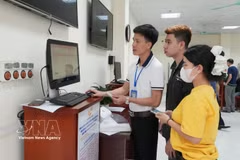
Hanoi police officers issue Level-2 electronic identification accounts. (Photo: VNA)

Digital ID holders get fee waivers, discounts

The Ministry of Finance has issued circular No. 117/2026/TT-BTC, effective from August 15, 2026 to February 28, 2027, offering incentives to citizens who meet the prescribed conditions.

Candidates familiarise themselves with the computers before sitting the Vietnamese language proficiency assessment in Osaka on August 15, 2026. (Photo: VNA)

Vietnamese language celebrated as first computer-based proficiency test held overseas

For Vietnamese communities overseas, Vietnamese is not merely a means of communication but also an important part of cultural identity and a bond connecting people with their homeland. For foreigners who have developed an affection for Vietnam, learning the language opens another door to a deeper understanding of the country's culture, history and people.

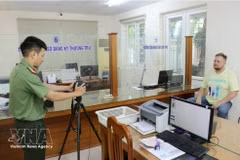
A police officer introduces a foreign visitor to the “Smart police station” kiosk, making it easier for international visitors to access police support services. (Photo: VNA)

Pilot "Smart police station" kiosk launched in Hanoi

During the pilot phase, the "Smart police station" provides five core functions: crime/incident reporting; SOS emergency calls; crime alert; finding the nearest police stations and administrative offices; and legal Q&A.

A public servant at the Public Administrative Service Centre of Vinh Yen ward, Phu Tho province, guides residents through the marriage registration process on the online public service portal. (Photo: VNA)

Digital literacy campaign lays foundation for digital citizens in Phu Tho province

After nearly a year, the “Digital Literacy for All” campaign in Phu Tho is demonstrating its effectiveness through tangible results. Residents who were once hesitant about technology are becoming increasingly familiar with VNeID, online public services, cashless payments, and digital platforms for learning, production, and business.

Firefighters and rescue personnel deploy specialised equipment to rescue two truck drivers trapped in their cabins. (Photo: VNA)

Road accident fund to provide support from September

Under Decree No. 279/2025/ND-CP and Circular No. 126/2026/TT-BCA, injured victims with bodily injury rates of over 31% to below 81% may receive up to 10 million VND (381 USD) per case, while families of deceased victims may receive up to 20 million VND.

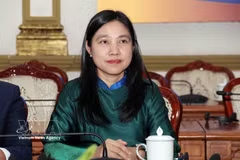
Ha Thanh, Chairwoman of the Ho Chi Minh City Union of Friendship Organisations and head of the advisory council for international integration, people-to-people diplomacy and overseas Vietnamese affairs under the Vietnam Fatherland Front Committee of the city (Photo: VNA)

New resolution seeks to unlock OV resources for national development

Ha Thanh, Chairwoman of the Ho Chi Minh City Union of Friendship Organisations and head of the advisory council for international integration, people-to-people diplomacy and overseas Vietnamese affairs under the Vietnam Fatherland Front Committee of the city, said Resolution No. 23 builds on the fundamental viewpoints of the Politburo's Resolution No. 36-NQ/TW issued in 2004, reaffirming that overseas Vietnamese are an inseparable part of the nation and a bridge connecting Vietnam with the world.

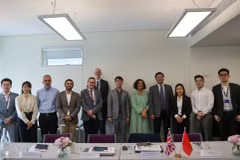
The Vietnamese Embassy in London's Education Section and representatives from the Department of Higher Education (Ministry of Education and Training) visit and hold a working session at Queen Mary University of London. (Photo published by VNA)

Vietnam-UK education cooperation: From market to partnership

In the 2024/25 academic year, about 3,725 Vietnamese students studied in the UK, while 13,285 enrolled in UK programmes delivered in Vietnam. Both flows are growing, but the balance is increasingly shifting towards UK education being delivered to learners in Vietnam. If managed strategically, this could enable Vietnam to expand access to international education at home while improving the quality of its workforce.

A bus picks up passengers on National Highway 22 (Le Quang Dao Street), near An Suong Bus Station. (Photo: VNA)

Free bus fares drive sharp rise in ridership in Ho Chi Minh City

As of August 12, the city’s bus network had served nearly 12 million passenger trips, up about 44% year on year. On August 12 alone, around 306,000 passengers used free buses, an increase of roughly 55%, despite students having yet to officially return to school.