Hanoi targets 7 million sq.m of housing this year

The capital city of Hanoi targets to build nearly 7 million sq.m of housing this year, in order to raise the per capita housing area to 28.2 sq.m.
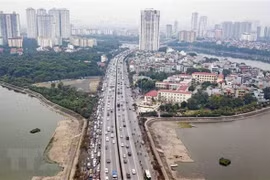
Hanoi targets 7 million sq.m of housing this year ảnh 1Illustrative photo (Source: VNA)

Hanoi (VNA) – The capital city of Hanoi targets to build nearly 7 million sq.m of housing this year, in order to raise the per capita housing area to 28.2 sq.m.

The target is set in a housing development plan for 2023, which has been approved by the municipal People’s Committee.

The new housing area will include 4.5 million sq.m of floor of independent houses, over 2.33 million sq.m of commercial housing, 32,000 sq.m of social housing 94,000 sq.m of resettlement housing.

The city administration will focus on rolling out mechanisms and policies to remove difficulties in the implementation of urban projects that have been stalled for a long time while encouraging new housing projects.

It will also accelerate the approval of investment plans for building social housing or housing for workers. Investors’ responsibilities will be clarified and projects that are behind the schedule will be strictly dealt with.

Departments, agencies and People's Committees of districts will be tasked with promptly relocating households out of old apartment buildings that are deemed dangerous and devise planning relating to the renovation of old apartment buildings, namely those in Giang Vo, Trung Tu and Khuong Thuong residential areas.

According to the municipal Department of Construction, the city added 1.3 million sq.m of housing in 2022, which was equivalent to 109% of the year’s target. The figure includes 985,000 sq.m of commercial housing in 16 projects and 257,000 sq.m of social housing in three projects.

From 2010-2020, the city completed approximately 50 million sq.m of residential housing. However, it is predicted that from 2021 to 2030, the capital city will need around 89 million sq.m of housing.

The housing demand for 2021-2025 is projected to be 44 million sq.m, while the demand for 2021-2030 is estimated to be around 45 million sq.m.

In line with the housing development plan for 2021 - 2025, which has been endorsed by the municipal People’s Committee, the city aims to have an average housing area of 29.5 sq.m per person.

Hanoi will spend 437 trillion VND (18.3 billion USD) to implement the plan.

The capital city will also build 550,000 sq.m of housing for the purpose of relocating residents and speed up the renovation of old apartment buildings, especially those deemed dangerous for living.

Regarding commercial projects, the city will strive to complete 109 projects with 19.4 million sq.m of floor.

Hanoi will continue to abolish makeshift houses and raise the permanent housing rate in the city to 90%.

Of the total investment of 437 trillion VND, 5.8 trillion VND will be used for social housing, resettlement housing projects, and apartment upgrading. The investment will be sourced from the city’s budget.

The city will also mobilise investment from possible sources for the development of commercial houses and other real estate projects.

The municipal People’s Committee requested that agencies comply with the city's housing development plan to ensure a balance between housing supply and demand as well as to fulfill the set targets. Legal documents will be reviewed to remove difficulties relating to housing and construction investment management of infrastructure works.

Between now and 2030, the city will focus on developing satellite towns and areas that are expected to become urban districts while diversifying housing types to meet the needs of people of different income levels. Priority will be given to social housing, apartment buildings and housing for workers in industrial zones.

The development of apartment buildings in the downtown area will be limited to minimise population growth and infrastructure overload, except for those aimed at renovating and rebuilding old apartment buildings and resettlement projects. Meanwhile, the development of apartment buildings in other areas will be given priority so as to use the land effectively.

Urban and residential areas will be planned and invested in line with building technical and social infrastructure./.
VNA

See more

Participants pose for a photo at the 18th Annual Meeting of the Asia-Pacific Roundtable on Sustainable Consumption and Production (APRSCP). (Photo: VNA)

Science–industry links key to green transition: conference

The 18th Asia-Pacific Roundtable for Sustainable Consumption and Production (APRSCP) aims to turn sustainable production and consumption goals into practical, measurable and scalable solutions while strengthening cooperation among authorities, researchers, businesses and international partners.

Ben Thanh Station of Metro Line No. 2 (Ben Thanh–Tham Luong). (Photo published by VNA)

Ho Chi Minh City accelerates major infrastructure projects to boost growth

Expanded metro networks could encourage a shift towards public transport and transit-oriented development, with residential, commercial and service hubs emerging around stations. Meanwhile, the combined connectivity of Long Thanh and Tan Son Nhat airports could strengthen the city’s role as a regional aviation, financial and logistics centre.

Nghe An province attracts more than 108.27 trillion VND (4.18 billion USD) in investment in the first nine months of 2026, including around 2.49 billion USD in FDI – ranking sixth nationwide. (Illustrative photo: nhandan.vn)

Nghe An steps up efforts to attract high-quality FDI

Economic experts say that together with available cleared land, an abundant workforce and ongoing infrastructure and logistics projects, streamlined and faster administrative procedures will make the province more attractive to foreign investors.

A key traffic route connecting Da Nang city's downtown zone with new designed Free Trade Zone (Photo courtesy of Quoc Vuong)

Da Nang approves Free Trade Zone 7 investment plan

The Da Nang Special Economic Zone Authority (DSEZA) said the project, the last location of the 1,881ha Da Nang FTZ, would start construction from the fourth quarter of 2027 and begin full operation in 2032.

The 2026 Vietnam–China international trade fair opens in Vietnam’s Tuyen Quang province on October 24. (Photo: VNA)

Vietnam–China international trade fair opens in Tuyen Quang

This year’s fair features 300 booths across 10,000 square metres, including 250 Vietnamese booths and 50 run by Chinese partners. They showcase a wide range of products, including agricultural produce, food, medicinal herbs, consumer goods, machinery, equipment, and handicrafts.

Germany’s Karcher Group puts its cleaning equipment manufacturing plant into operation at the the Tam Hiep Port and Logistics Industrial Park in Nui Thanh commune, Da Nang city (Photo: VNA)

Da Nang boosts FDI attraction to drive industrial growth

The central city of Da Nang is ramping up efforts to attract foreign direct investment, leveraging its upgraded infrastructure and welcoming business environment to boost industrial growth and establish a new economic driver.

Vietnamese Ambassador to Mozambique Tran Thi Thu Thin (third from right) poses with IAM Director and staff (Photo published by VNA)

Vietnam, Mozambique seek stronger agricultural ties

Vietnamese Ambassador to Mozambique Tran Thi Thu Thin praised the industry’s potential and its contribution to the economy, livelihoods and exports in the southeastern African nation. She also shared Vietnam’s experience in developing the industry, particularly in boosting processing capacity and adding value to products.

A solar power system installed on the roof of a factory operating in the rice sector in Truong Xuan commune, Dong Thap province. (Photo: VNA)

Rooftop solar power helps businesses go green

Dong Thap Power Company reported that as of September 2026, the province had 6,150 rooftop solar customers, with total installed capacity of 287.09 MWp. Of these, 751 customers operated self-produced and self-consumed systems with a combined capacity of 42.76 MWp.