Dong Thap (VNA) – Businesses in the Mekong Delta province of Dong Thap are investing in solar-powered equipment and rooftop solar systems to cut electricity costs, reduce reliance on the national grid and support greener production, particularly during peak hours.
These solutions also help improve working conditions in factories and meet environmental standards which are increasingly required by export markets.
P&K Development Co. Ltd.’s Dong Thap branch, based in Tan Thanh commune, processes medicinal herbs into products such as tea and incense. Electricity consumption, particularly during the drying process, used to place considerable pressure on its operating costs.
Nguyen Thi Bich Van, the branch’s director, said the company previously used fan-assisted drying machines continuously for six to seven days after washing freshly purchased medicinal herbs. The process consumed large amounts of electricity.
In 2021, the company invested in a solar-powered drying machine that allows better control of temperature and humidity, reducing drying time to just 12 hours and improving product quality. Each drying cycle saves more than 200 kWh of electricity compared with the traditional method, she said.
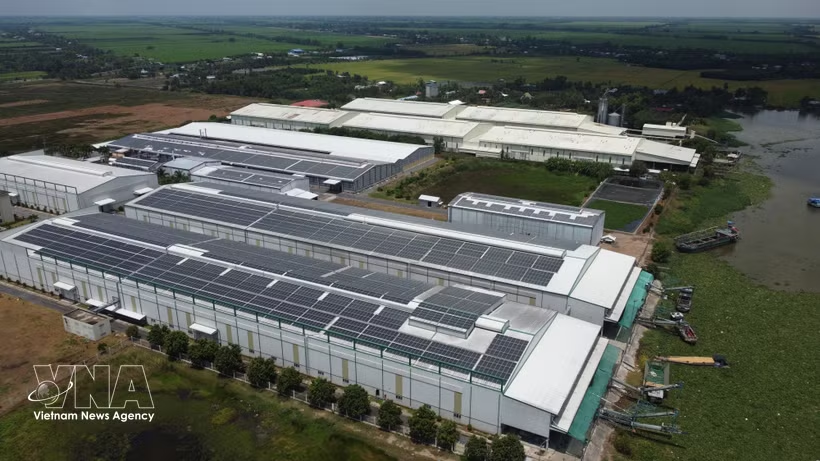
Cai Lay Veterinary Pharmaceutical Plant, known as Mekovet, in Cai Lay ward has also been operating a rooftop solar power system for more than six months.
The system has an installed capacity of 173.6 kWp, comprising 280 solar panels covering more than 1,400 sq.m of factory rooftops. With average annual output of about 582.89 MWh, it can meet around 65% of the plant’s electricity demand, reducing its dependence on grid power during peak production hours.
According to the plant’s representative, solar power supplies key operations, including production lines, heating, ventilation and air-conditioning systems serving cleanrooms, medicine storage facilities, laboratories and supporting equipment.
The system helps optimise operating costs and maintain stable power for sensitive equipment, supporting production quality in facilities with strict technical requirements. It also contributes to reducing greenhouse gas emissions.
Mavin Austfeed Dong Thap, an animal feed producer in Phu Huu commune, is building its own rooftop solar system, which is expected to begin operation in November 2026. Trương Thanh Liem, the plant’s representative, said the system could reduce energy-related costs by 25–30% compared with conventional electricity, freeing up funds for further investment in production efficiency.
Rooftop solar power, particularly systems designed for self-production and self-consumption, is attracting growing interest from seafood and agricultural processors, rice dryers, milling facilities and cold-storage operators in the province. Hybrid systems combining solar power with battery energy storage can also help keep cooling equipment, aquaculture aerators and packaging lines running during grid disruptions.
Dong Thap Power Company reported that as of September 2026, the province had 6,150 rooftop solar customers, with total installed capacity of 287.09 MWp. Of these, 751 customers operated self-produced and self-consumed systems with a combined capacity of 42.76 MWp.
Rooftop solar systems fed 20.58 million kWh into the grid in September, bringing the total for the first nine months of 2026 to 206.82 million kWh.
Provincial authorities are promoting energy-saving measures and encouraging businesses to install rooftop solar systems, battery storage and solar water heaters.
Vice Chairman of the provincial People's Committee Nguyen Thanh Dieu said the province would continue implementing Government Decree No. 58/2025/ND-CP on renewable and new energy development under the Law on Electricity.
These efforts support the goals of Politburo Resolution No. 70-NQ/TW on ensuring national energy security and promoting a green energy transition./.