Historic relic sites in Hong Kong inspire national pride among overseas Vietnamese

In addition to Tai Kwun, Hong Kong is home to several other historic landmarks linked to President Ho Chi Minh’s revolutionary activities in the early 20th century, including Sung Wong Toi Park, where a stone from Sung Wong Toi Hill marks the site where he convened the conference leading to the establishment of the CPV. House No. 186 Tam Kung also served as one of his secret residences before his arrest.

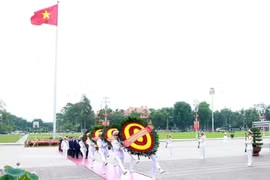
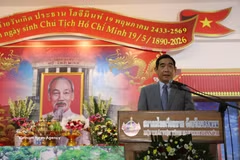
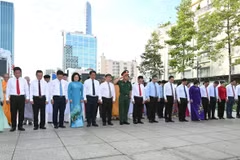
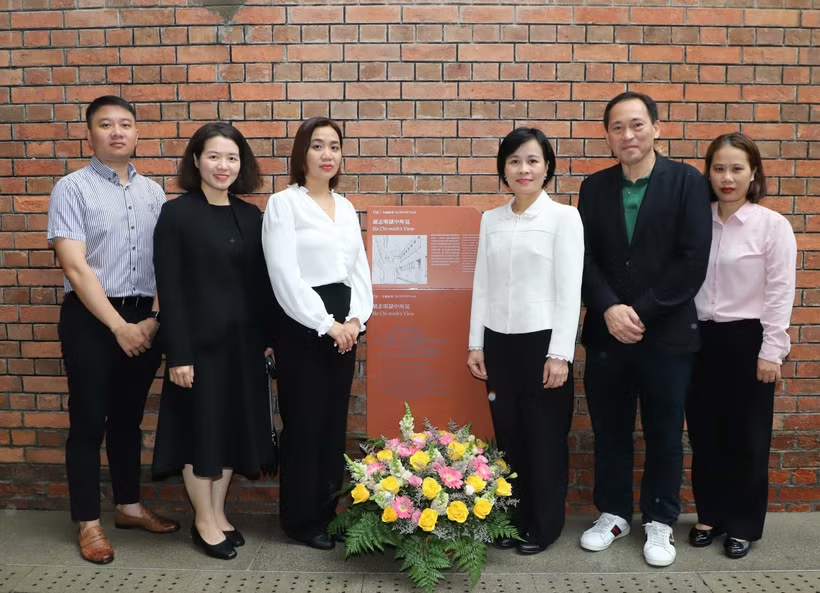
Vietnamese Consul General in Hong Kong and Macau Le Duc Hanh and representatives of Vietnamese agencies in Hong Kong offer flowers in tribute to President Ho Chi Minh at the Tai Kwun heritage site. (Photo: VNA)

Hong Kong (VNA) – The Vietnamese Consulate General in Hong Kong (China) on May 19 organised a flower-offering ceremony in tribute to President Ho Chi Minh at the Tai Kwun heritage site, a historic site closely associated with his revolutionary activities, including the founding of the Communist Party of Vietnam (CPV) and his detention in Hong Kong in the early 1930s.

The event marked the 136th birth anniversary of President Ho Chi Minh (May 19, 1890 – 2026) and the 115th anniversary of his departure in search of a path for national salvation (June 5, 1911 – 2026).

Vietnamese Consul General in Hong Kong and Macau Le Duc Hanh said that every year on May 19, the Consulate General joins members of the Vietnamese community in Hong Kong and Macau in visiting Tai Kwun, formerly Victoria Prison, where President Ho Chi Minh was arrested and imprisoned during his revolutionary activities.

She said the annual activity recalls a pivotal chapter in Vietnam’s revolutionary history while reminding younger generations of the sacrifices, hardships and moral example set by the country’s early revolutionary leaders in the struggle for national independence and reunification.

According to Hanh, President Ho Chi Minh’s time in Hong Kong coincided with a particularly important and dynamic phase of the Vietnamese revolution. It was also a period when the resilience and mettle of President Ho Chi Minh and fellow revolutionaries were severely tested, while Vietnam’s revolutionary movement began attracting growing international attention and support.

In addition to Tai Kwun, Hong Kong is home to several other historic landmarks linked to President Ho Chi Minh’s revolutionary activities in the early 20th century, including Sung Wong Toi Park, where a stone from Sung Wong Toi Hill marks the site where he convened the conference leading to the establishment of the CPV. House No. 186 Tam Kung also served as one of his secret residences before his arrest.

Tracing these historic landmarks helps preserve revolutionary traditions, deepen historical awareness and promote cultural and tourism exchanges between Hong Kong residents and international visitors, she added.

Hanh noted that the Tai Kwun heritage site has been restored and preserved by the Hong Kong authorities, with exhibitions documenting President Ho Chi Minh’s activities and locations associated with his revolutionary journey. These tangible and intangible heritage values continue to provide lasting benefits for present and future generations while creating opportunities for historical research, academic study and cultural exchange.

She also highlighted the growing number of Vietnamese students in Hong Kong, noting that many young Vietnamese visitors now seek out sites associated with President Ho Chi Minh and the revolutionary movement, helping nurture national pride and a spirit of dedication while enhancing mutual understanding with people of Hong Kong and the broader international community.

Meanwhile, Chairman of the Overseas Vietnamese Association in Macau Duong Trung Duc said the Vietnamese community in Macau always keeps President Ho Chi Minh’s teachings on solidarity close to the heart and hopes to further promote Vietnamese culture in the host society, contributing to better understanding and stronger friendship between the two peoples./.
VNA

See more

Deputy Minister of Foreign Affairs Le Thi Thu Hang speaks at the panel discussion titled “Russia – APEC: Broad Cooperation Prospects on the Horizon until 2035”. (Photo: VNA)

Vietnam shares vision, preparations for APEC 2027

Deputy Foreign Minister Le Thi Thu Hang underlined the importance of stronger coordination between APEC and other regional and global mechanisms in order to improve efficiency and optimise resources in addressing common challenges.

General Secretary of the Central Committee of the Communist Party of Vietnam and President of Vietnam To Lam delivers a keynote address at the opening of the 23rd Shangri-La Dialogue in Singapore on May 29. (Photo: VNA)

Singaporean FM highlights shared strategic outlook with Vietnam

Singapore and Vietnam remain committed to supporting a rules-based international order, strengthening ASEAN integration, and enhancing the bloc’s resilience. The two countries upgraded their ties to a Comprehensive Strategic Partnership (CSP) last year, marking Singapore’s first CSP with an ASEAN member state.

Deputy Minister of Foreign Affairs Nguyen Manh Cuong (Photo: VNA)

ASEAN Future Forum 2026 to advance ASEAN community-building process

Vietnam hopes the forum will continue to demonstrate its role as an active and responsible member of the Association of Southeast Asian Nations (ASEAN), contributing to regional affairs and advancing the Party and State’s foreign policy and international integration strategy.

General Secretary of the Communist Party of Vietnam Central Committee and State President To Lam speaks at the 23rd Shangri-La Dialogue on May 29, 2026. (Photo: VNA)

Vietnam contributes to shaping regional agenda at 23rd Shangri-La Dialogue: Indian expert

Speaking to Vietnam News Agency correspondents in New Delhi, Pradhan noted that, drawing on his extensive experience in national security and international relations, as well as his deep knowledge of international law, the top Vietnamese leader identified three closely interrelated crises facing the world today: a crisis of the international order, a crisis of the development model, and a crisis of strategic trust.

Administrative procedures cut and simplified will be publishedNational Public Service Portal (Photo: VNA)

Administrative procedures cut, simplified to be published online

The dispatch states that in implementing Conclusion No. 18-KL/TW dated April 2, 2026 of the 14th Party Central Committee on the 2026–2030 socio-economic development plan, national finance, public debt management and medium-term public investment, linked to the goal of achieving double-digit economic growth, the Government on April 29 issued 11 resolutions on cutting, decentralising and simplifying administrative procedures, business conditions, and conditional business lines. The Prime Minister subsequently directed ministries, agencies and localities to implement these resolutions.

Minister of Foreign Affairs Le Hoai Trung (R) welcomes visiting Angolan Minister of External Relations Téte António in Hanoi on June 4 (Photo: VNA)

Vietnamese, Angolan foreign ministers hold talks in Hanoi

The Vietnamese FM proposed that the two sides strengthen political trust through high-level exchanges, while maintaining existing cooperation mechanisms, particularly the Vietnam–Angola Intergovernmental Committee and Political Consultations between the two foreign ministries.