Indonesia promotes circular economy in EV battery industry

Battery recycling can bolster Indonesia's position within the EV battery production supply chain, enabling the country to become fully integrated in battery production, from raw material preparation to end-product manufacturing, according to Ahmad Faisal Suralaga, Director of Downstreaming Strategy and Governance at Indonesia’s Ministry of Investment and Downstreaming.

VinFast VF7 is showcased at the GAIKINDO Indonesia International Auto Show (GIIAS) 2025 in Indonesia. (Illustrative photo: VNA)

Jakarta (VNA) - Indonesia is stepping up the development of a circular economy model in its electric vehicle (EV) battery industry as part of efforts to address mineral supply challenges, reduce carbon emissions and promote the sustainable use of resources.

Ahmad Faisal Suralaga, Director of Downstreaming Strategy and Governance at Indonesia’s Ministry of Investment and Downstreaming, said the government is no longer focusing solely on the extraction of raw materials for battery production. Instead, it is promoting battery recycling as a key component of the EV battery value chain.

According to him, battery recycling can bolster Indonesia's position within the EV battery production supply chain, enabling the country to become fully integrated in battery production, from raw material preparation to end-product manufacturing.

In addition, Indonesia is reforming its business policies to mitigate risks and implementing an integrated system to streamline the process for investors through a single-window clearance.

Indonesia is currently one of the world's largest holders of nickel reserves and is actively developing its EV industry as a strategic sector to add value to its mineral resources, attract investment and promote green economic growth./.
VNA

See more

Visitors at a tourist site in Bangkok, Thailand. (Photo: Xinhua/VNA)

Thailand expands cross-border QR payment system

The programme allows visitors from China, Singapore, Malaysia, Indonesia, Vietnam, the Republic of Korea, Laos and Cambodia, as well as Hong Kong (China), to use their domestic mobile banking applications or e-wallets to make direct payments to Thai merchants through QR codes without the need to exchange cash.

Harvesting rice in Thailand (Photo: VNA)

Thailand, Meta provide free AI training for farmers, SMEs

The programme will provide free in-person and online training for at least 2,000 farmers and agricultural SMEs, focusing on how to build business brands on Facebook and Instagram, create engaging digital content, and use Meta's AI tools to boost sales and expand customer base. ​

Malaysia looks to become apparel hub

Malaysia looks to become apparel hub

According to the Malaysia External Trade Development Corporation (Matrade), its total trade in apparel and clothing accessories exceeded 4.5 billion USD in 2025, marking an 8.3% annual hike.

Indonesia strengthens energy security with B50 biodiesel rollout

Indonesia strengthens energy security with B50 biodiesel rollout

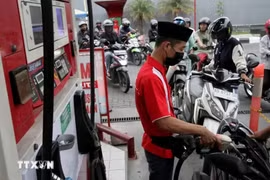
The B50 biofuel mandate would significantly reduce Indonesia's reliance on imported petroleum products. The country currently consumes around 39 million kilolitres of diesel annually, and increasing the biodiesel blend to 50% is expected to meet a substantial share of domestic demand.

People commemorate the victims of Malaysia Airlines Flight MH370 in Subang Jaya, Malaysia, on March 3, 2024. (Photo: AFP/VNA)

Malaysia extends agreement for missing-MH370-aircraft search

The extension lasts from July 1 this year until June 30, 2027. The renewed deal maintains all key terms and conditions of the existing one, including the application of the 'no find, no fee' principle. If the wreckage is successfully located, Malaysia would pay the firm 70 million USD.

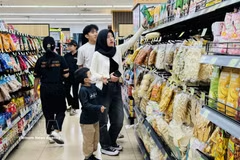
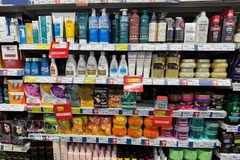
Indonesian-branded cosmetic and personal care products at a supermarket. (Photo: VNA)

Indonesia launches summer shopping campaign

According to the Indonesia Ministry of Tourism, the BINA (Shopping in Indonesia Movement) Holiday & Back to School 2026 programme involves 800 brands, approximately 80,000 outlets, and 414 shopping centres across 24 provinces. It aims to boost domestic consumption and tourist trips throughout the school break.

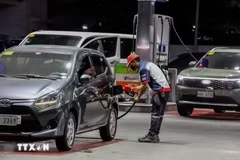
A fuel station in the Philippines. The Philippine economy expanded 2.8% in the first quarter, down from 3% in the previous quarter, weighed down by higher oil prices linked to the Middle East conflict and weaker public spending. (Photo: Xinhua/VNA)

Philippines to accelerate infrastructure spending to boost economic growth

Infrastructure spending has fallen sharply as government agencies, particularly the Department of Public Works and Highways (DPWH), adopted a more cautious approach to budget disbursement following an investigation into alleged irregularities involving multi-billion-PHP flood control projects.

Visitors to a pagoda in Bangkok, Thailand (Photo: Xinhua/VNA)

Thailand develops luxury rail services to boost tourism

Thailand’s Ministry of Transport is advancing plans to upgrade the country’s railway and tourism sectors by developing world-class luxury train services, leveraging newly enacted railway legislation to attract private investment and stimulate local economic growth.