Indonesia reviews tax incentives to protect government revenue

Indonesia currently imposes a corporate income tax rate of 22% and has offered tax exemptions and reductions for years to attract investment in special economic zones and priority sectors.

Jakarta (VNA) – The Indonesian government is reviewing tax incentives in special economic zones (SEZs) to align with the global minimum tax regime, thereby preventing revenue losses while maintaining the country's attractiveness to foreign investors.

Susiwijono Moegiaharso, Secretary of the Indonesian Coordinating Ministry for Economic Affairs, said the review comes after Indonesia implemented the global minimum tax regime in 2025. Under the new regulations, multinational corporations with annual gross revenue of more than 750 million EUR (855.01 million USD) will be subject to a minimum corporate income tax rate of 15%, regardless of where they operate.

Indonesia currently imposes a corporate income tax rate of 22% and has offered tax exemptions and reductions for years to attract investment in special economic zones and priority sectors. However, if the effective tax rate paid by a business in Indonesia falls below 15% due to tax incentives, the difference may be collected by the country where the company's parent entity is headquartered under the global minimum tax mechanism.

Susiwijono emphasised the risk that tax revenue forgone through exemptions in Indonesia could instead be collected by other countries. Therefore, tax incentives will be re-evaluated based on their actual effectiveness in attracting investment, creating jobs, and promoting economic growth, rather than simply increasing the fiscal cost of tax incentives without delivering commensurate benefits.

The move comes as Indonesia faces pressure to increase budget revenue to meet public spending needs while maintaining its competitiveness in attracting foreign investment.

Indonesia currently has 25 special economic zones with cumulative investment exceeding 335 trillion IDR (18.8 billion USD), of which 82.6 trillion IDR was attracted in 2025 alone. Economic zones such as Kendal, Gresik, Galang Batang, and Sei Mangkei have become important centres for industrial development, processing, and exports in the country./.

VNA

See more

Thailand pushes carbon data use for net-zero emissions

Thailand pushes carbon data use for net-zero emissions

Director of the Thailand Greenhouse Gas Management Organisation (TGO) Nakorn Trakwiraphat said integrating climate science, big data and artificial intelligence (AI) would enable climate and emissions data to be transformed into actionable insights for forecasting, policymaking and the building of effective greenhouse gas mitigation solutions.

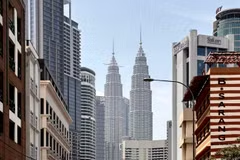
A corner of Kuala Lumpur, Malaysia. (Photo: Xinhua/VNA)

Malaysia, EU move closer to free trade agreement

Malaysian Investment, Trade and Industry Deputy Minister Sim Tze Tzin said the fourth round of negotiations, held in Kuala Lumpur from June 8-12, saw the conclusion of three chapters, namely Customs and Trade Facilitation, Trade Remedies and Good Regulatory Practices. The next round of negotiations will be held on September 21-25 in Brussels, Belgium.

Malaysia expands tourism market outreach

Malaysia expands tourism market outreach

Deputy Tourism, Arts and Culture Minister Chiew Choon Man said Tourism Malaysia is focusing on high-performing and stable markets, including China, Indonesia, Japan and India, while expanding its presence in long-haul markets such as Russia, Germany and Australia to diversify the country's visitor base.

Visitors at a tourist site in Bangkok, Thailand. (Photo: Xinhua/VNA)

Thailand expands cross-border QR payment system

The programme allows visitors from China, Singapore, Malaysia, Indonesia, Vietnam, the Republic of Korea, Laos and Cambodia, as well as Hong Kong (China), to use their domestic mobile banking applications or e-wallets to make direct payments to Thai merchants through QR codes without the need to exchange cash.

Harvesting rice in Thailand (Photo: VNA)

Thailand, Meta provide free AI training for farmers, SMEs

The programme will provide free in-person and online training for at least 2,000 farmers and agricultural SMEs, focusing on how to build business brands on Facebook and Instagram, create engaging digital content, and use Meta's AI tools to boost sales and expand customer base. ​

VinFast VF7 is showcased at the GAIKINDO Indonesia International Auto Show (GIIAS) 2025 in Indonesia. (Illustrative photo: VNA)

Indonesia promotes circular economy in EV battery industry

Battery recycling can bolster Indonesia's position within the EV battery production supply chain, enabling the country to become fully integrated in battery production, from raw material preparation to end-product manufacturing, according to Ahmad Faisal Suralaga, Director of Downstreaming Strategy and Governance at Indonesia’s Ministry of Investment and Downstreaming.

Malaysia looks to become apparel hub

Malaysia looks to become apparel hub

According to the Malaysia External Trade Development Corporation (Matrade), its total trade in apparel and clothing accessories exceeded 4.5 billion USD in 2025, marking an 8.3% annual hike.

Indonesia strengthens energy security with B50 biodiesel rollout

Indonesia strengthens energy security with B50 biodiesel rollout

The B50 biofuel mandate would significantly reduce Indonesia's reliance on imported petroleum products. The country currently consumes around 39 million kilolitres of diesel annually, and increasing the biodiesel blend to 50% is expected to meet a substantial share of domestic demand.

People commemorate the victims of Malaysia Airlines Flight MH370 in Subang Jaya, Malaysia, on March 3, 2024. (Photo: AFP/VNA)

Malaysia extends agreement for missing-MH370-aircraft search

The extension lasts from July 1 this year until June 30, 2027. The renewed deal maintains all key terms and conditions of the existing one, including the application of the 'no find, no fee' principle. If the wreckage is successfully located, Malaysia would pay the firm 70 million USD.